
Aa Reading preferences
This guide separates raw fresh momos, cooked restaurant leftovers, unopened frozen packs and thawed momos, so you can make safer decisions without treating them as the same food. It is consumer education—not a claim about a verified shelf life, recipe or storage instructions for a specific Momo Delights product.
Momo storage chart: what should you do?
| Type of momo | Storage approach | How long? |
|---|---|---|
| Fresh, raw homemade momos | Cook promptly under hygienic conditions, or freeze following a tested recipe | Do not assume a universal refrigerated shelf life; filling and handling vary |
| Fully cooked restaurant leftovers | Cool promptly, refrigerate in clean shallow covered containers | US consumer guideline: generally 3–4 days if handled and refrigerated correctly; stricter instructions prevail |
| Unopened, commercially frozen ready-to-cook momos | Keep at the labelled frozen storage condition and maintain cold chain | Follow the product-specific date and manufacturer’s validated instructions |
| Unopened, fully cooked frozen momos | Keep frozen as directed; follow instructions for heating or serving | Product-specific shelf life, not the same as raw frozen products |
| Thawed commercial momos | Use only the approved thawing, holding and cooking procedure | Follow product-specific limits; never restart the original frozen shelf-life clock |
| Cooked momos held at room temperature | Avoid extended unrefrigerated holding | US consumer guidance generally uses a 2-hour limit, reduced to 1 hour above 32°C; commercial Indian rules and validated processes may differ |
Interpretation matters: The FoodSafety.gov cold storage chart provides broad US consumer storage guidance, not a tested shelf life for all momo ingredients. The US FDA explains that frozen food may remain microbiologically safe during continuous correct storage, but its quality diminishes over time. Neither statement authorizes a restaurant to ignore the expiry or best-before conditions of a commercial dumpling product.
Fresh, raw momos: why there is no single reliable fridge-life rule
Freshly folded momos can contain vegetables, paneer, soy, poultry or other fillings. Those ingredients have different hazards and storage needs, and many raw or partially cooked dumplings look similar on the outside. It would be misleading to promise that every homemade raw momo will last a fixed number of days in the refrigerator.
For home cooking, prepare raw fillings hygienically, keep perishable ingredients appropriately cold, work in manageable batches and cook promptly using a trusted recipe. If making a freezer batch, use a tested process with suitable packaging and avoid leaving assembled dumplings at room temperature while waiting for space in the freezer. Freezing is a preservation step, not a cooking step.
Momo Delights offers different menu varieties, but a restaurant menu does not establish whether a retail or wholesale pack is raw, partly cooked or ready-to-eat. Request the actual SKU label or product specification.
How long do already-cooked momos last in the fridge?
For fully cooked leftovers that were handled safely, consumer guidance from the US Department of Health & Human Services’ FoodSafety.gov generally lists cooked meat or poultry leftovers at 3–4 days in a refrigerator at 4°C (40°F) or below. This is a useful reference point for properly handled cooked dumplings, but it is not a product-specific safety study or permission to store food that spent too long unrefrigerated.
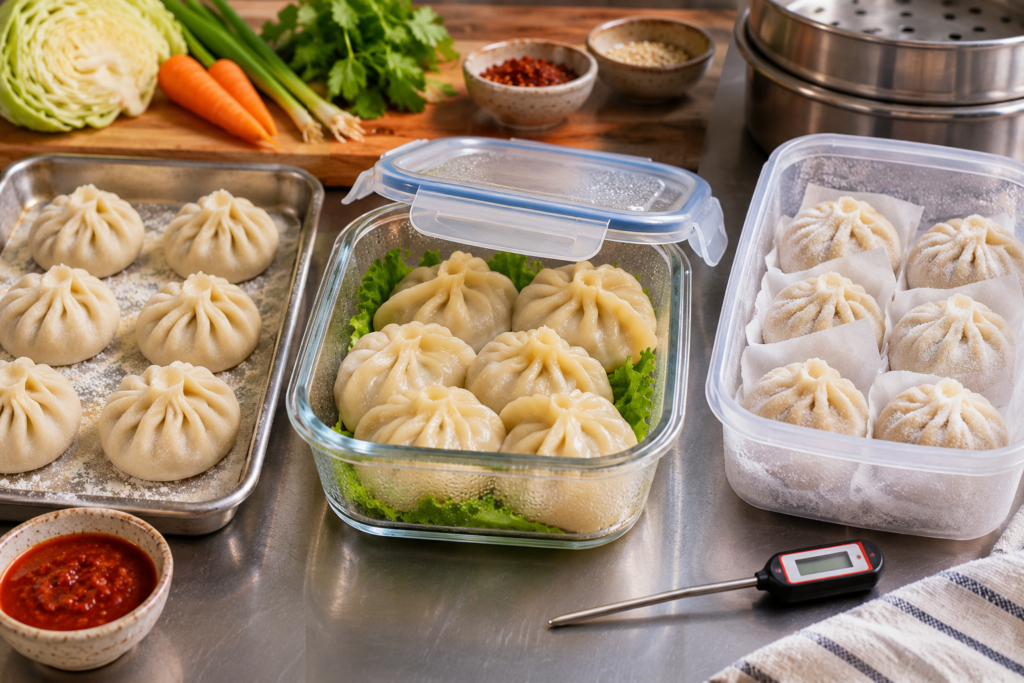
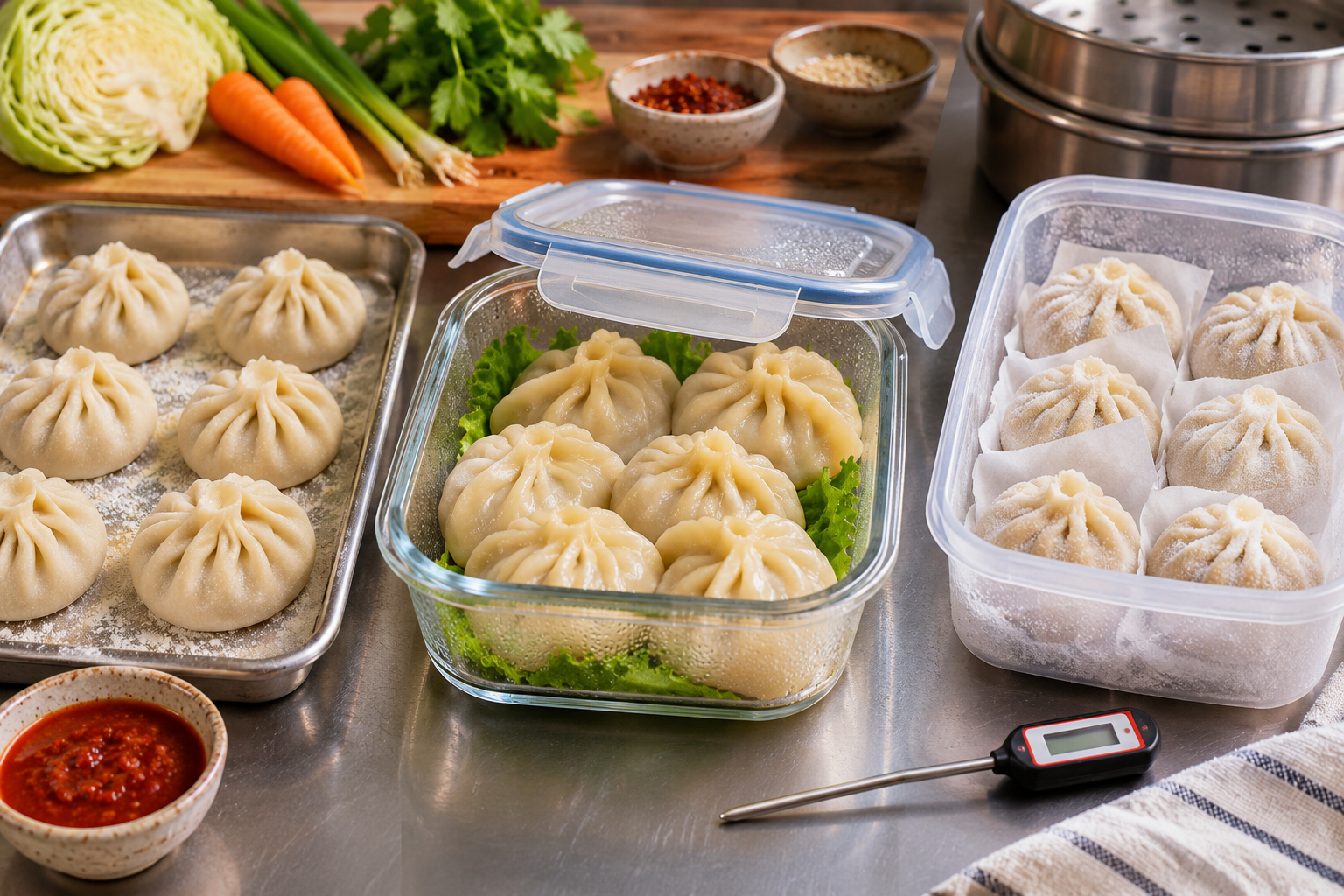
For best handling, transfer suitable leftovers into clean shallow containers, cover, label with the date and refrigerate promptly. Keep cooked food away from raw ingredients and prevent sauces or used serving utensils from contaminating it. A container that was left overnight on a warm counter should not be accepted solely because the momos still look normal.
Do paneer and vegetable momos store for exactly the same time?
Not necessarily. Complete recipe, handling, filling, sauce and processing matter. A leftover guideline should not be copied to an untested commercial recipe as a guaranteed shelf life. If the restaurant or packaging specifies a shorter time, use the stricter instruction.
Can you store momo chutney with the leftovers?
It’s usually easier to manage flavour and texture with sauces in a separate, suitable container. But that does not establish the sauce’s safety. A creamy dip, homemade tomato-chilli chutney or sesame achar may have different perishable ingredients and storage needs. Read the Momo Delights allergen information for product-related questions, and obtain actual storage instructions for the sauce used.
How long do frozen momos last?
The answer has two parts: safety and quality. The FDA food-storage guide notes that freezing at 0°F (approximately −18°C) stops bacterial growth under proper conditions, but does not kill most bacteria. Flavour, wrapper texture and moisture can decline during prolonged storage; freezer burn is generally a quality problem rather than proof of danger by itself.
Commercially packaged frozen momos still have a declared shelf life based on their formulation, manufacturing process, packaging and intended storage. Never replace a pack’s use-by or expiry date with a generic internet claim such as “frozen momos last six months.” If a brand has validated a particular shelf life, it should be documented in the specification and label.
In India, FSSAI’s hygiene framework covers food temperature controls across the supply chain. An FSSAI inspection checklist compilation includes frozen receiving and storage at −18°C or below for relevant warehouse operations. Check current, applicable rules and the product specification for the business involved.
Does freezing make raw momos ready to eat?
No. Freezing is not a cooking method. A raw or partly cooked frozen momo needs the manufacturer’s validated cooking process. An already-cooked frozen momo may instead have reheating or serving instructions. Do not assume two packs that look similar have the same status.
What is freezer burn on momos?
When moisture leaves a frozen food’s exposed surface, it may become dry or discoloured. The FDA treats freezer burn as a quality concern, not a standalone proof of contamination. However, visible freezer burn does not establish that the product was maintained at the required temperature or within its dated shelf life. If there are signs of thawing, damaged packaging or unknown handling, seek appropriate guidance rather than simply trimming the surface.
Should you thaw frozen momos before cooking?
Only if the product or tested recipe instructs you to do so. Many frozen dumpling products are intended to be cooked directly from frozen, whereas others have specific controlled thawing steps. Follow the exact label: starting state, equipment, batch size, cooking method and endpoint all matter.
The FSSAI food-safety system expects appropriate handling and storage, while the FDA cautions that freezing does not destroy most pathogens. Do not thaw perishable momos on a warm countertop or leave them exposed at room temperature because a social-media recipe suggests it. Commercial kitchens must follow their specific validated thawing SOP and applicable regulations.
Can thawed momos be refrozen?
Refreezing is not an unconditional yes-or-no question across all foods, but a commercial pack’s manufacturer instructions and local process rules take precedence. Avoid claiming that partially thawed stock is safe simply because it feels cold. Businesses should isolate questionable stock, document the temperature history and obtain a quality disposition decision. For consumers, follow the original package directions and discard food with an unsafe or unknown storage history.
When should you throw momos away?
- Perishable cooked momos were left unrefrigerated beyond applicable time limits, especially in hot weather.
- The stated use-by/expiry or validated opened-pack limit has been exceeded.
- Packaging is leaking, damaged, swollen or appears tampered with, or there is evidence of contamination.
- The cold-chain history is unknown after a freezer failure or delivery delay and a safe disposition cannot be established.
- There is obvious mould, unusual texture or off-odour; remember that harmful contamination may exist even without these signs.
- A recalled batch has been identified—follow the authority and supplier’s instructions rather than using the food.
For wider regulatory context, FSSAI’s food recall page explains the withdrawal of unsafe or non-compliant products. Taste-testing suspect momos is not a safe way to confirm suitability.
Storage mistakes that often damage momo texture
| Habit | Potential result | Better approach |
|---|---|---|
| Piling warm cooked momos into a deep container | Slow cooling and excess condensation | Follow prompt safe cooling procedures with shallow suitable containers |
| Leaving frozen packs open | Moisture loss and freezer burn | Follow pack-opening instructions and use appropriate protection |
| Mixing sauce into crisp momos before holding | Soggy crust and coating | Keep dips separate where appropriate |
| Cooking a raw pack as though it is reheated leftovers | Potentially undercooked centre | Identify raw/ready-to-cook versus fully cooked status |
| Ignoring batch and expiry information | Poor rotation and difficult traceability | Record dates and practise appropriate stock rotation |
For restaurants choosing between in-house preparation and supplied food, see momo machine versus ready-made momos. It considers production decisions separately from this home-storage guide.
Five questions to ask when buying a pack of momos
- Is the product raw, partially cooked or fully cooked? Do not infer from colour or shape.
- What is the required storage temperature? Check freezer or refrigerator directions and transport requirements.
- What is the validated shelf life? Look for the relevant printed date and any after-opening period.
- How exactly should it be prepared? Starting state, equipment, batch loading and cooking/reheating requirements matter.
- Which allergens are declared? Wheat, milk, soy and sauces may be relevant; check actual formulation and cross-contact.
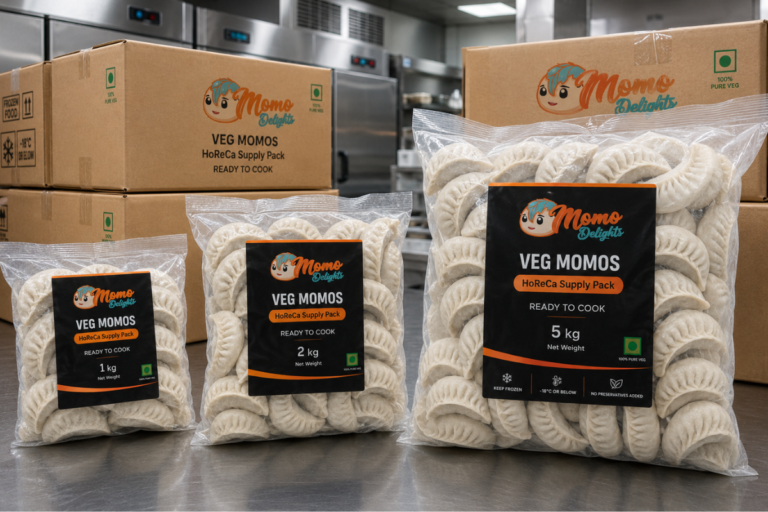
Foodservice buyers can use the Momo Delights HoReCa/B2B enquiry page to request current available SKUs, specifications, storage requirements and sourcing arrangements. No particular shelf life is asserted for the brand here.
Momo storage and shelf-life FAQs
How many days do cooked momos last in the fridge?
US consumer guidance generally uses 3–4 days for properly cooked and rapidly refrigerated leftovers at 4°C or below, but stricter product-specific instructions and local regulations take priority.
How long can raw homemade momos be refrigerated?
There is no reliable universal rule. Ingredients and preparation differ; cook promptly or follow a tested safe make-ahead process.
How long do packaged frozen momos last?
Follow the actual manufacturer’s validated shelf life and labelled storage conditions, not a generic duration.
Can I eat frozen momos without cooking them?
Not unless the actual product is explicitly ready-to-eat and its serving instructions permit it. Ready-to-cook or raw frozen momos must be properly cooked.
Is −18°C a cooking temperature?
No. It is a common frozen-storage reference; food still needs the appropriate cooking or reheating process.
Should frozen momos be defrosted first?
Only when the validated product directions specify thawing.
Can I eat momos left out overnight?
Perishable cooked momos left at ordinary room temperature overnight should be discarded.
Can freezer-burned momos be eaten?
Freezer burn itself is generally a quality issue, but it does not prove safe temperature history or that the product remains in date.
How do I know a momo is spoiled?
Mould, leakage or off-odours are warning signs, but unsafe food may appear normal. Use time, temperature, pack integrity and instructions, not smell alone.
Does Momo Delights publish one shelf life for all products?
This article makes no such claim. Request the current product-specific specification from the business.
Sources and editorial note
- US FDA — Are You Storing Food Safely? (freezing, microbial growth and freezer-burn explanation).
- FoodSafety.gov — Cold Food Storage Chart (general consumer guidance).
- FSSAI — Hygiene Requirements (Indian food-business controls).
- FSSAI — April 2025 Inspection Checklist Compilation (temperature checks in relevant operations).
- FSSAI — Food Recall (handling unsafe/non-compliant batches).
Editorial review: 2 November 2026. US consumer guidance is labelled as such and does not replace applicable Indian business requirements. Neither the freezer/storage illustrations nor general science constitute a tested shelf-life claim for Momo Delights products. The featured image is AI-generated.