Aa Reading preferences
This practical B2B guide is for restaurant owners, café operators, hotels, caterers, cloud kitchens, QSR brands and procurement teams researching bulk momo suppliers in India. It provides a checklist, purchasing vocabulary, a sample RFQ and a comparison framework. It is educational—not a promise of pricing, shelf life, certifications, delivery reach or profitability from Momo Delights.
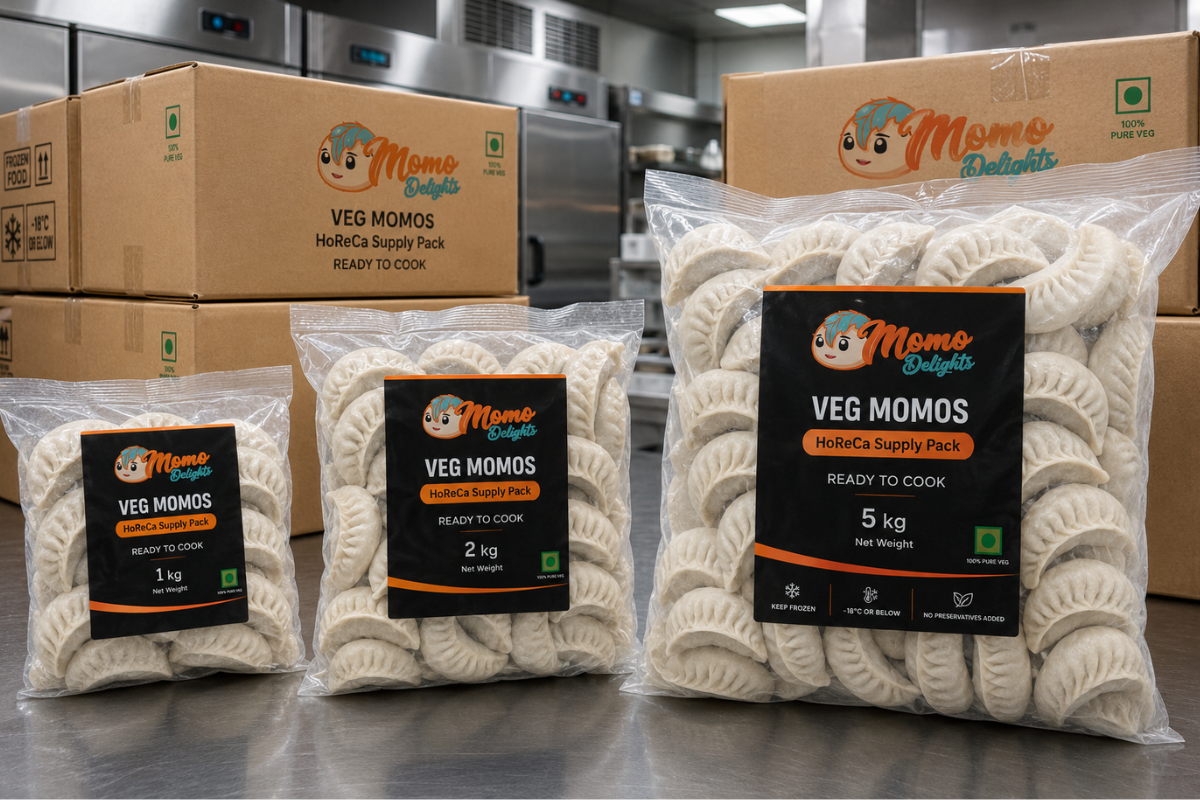
Momo Delights maintains a dedicated HoReCa / B2B foodservice supply page for businesses that want to discuss available products and specifications. Existing site resources also cover how restaurants can introduce momos to a menu and the choice between in-house momo machines and ready-made momos. This guide focuses on the next step: how to evaluate a supplier professionally.
Wholesale momo formats: what are you actually purchasing?
The same term “bulk momos” can describe several materially different goods. Confirm the form before requesting a quotation.
| Product format | What it usually means | Operational implications |
|---|---|---|
| Raw frozen ready-to-cook | Frozen formed dumplings requiring a specified cooking step | Requires freezer capacity and validated cooking procedure |
| Partially cooked / par-cooked | Product that has received some processing but still requires finishing | Do not infer food safety from appearance; follow the supplier SOP |
| Fully cooked, chilled or frozen | Product already cooked, usually requiring specified reheating/service | Different handling and reheat controls from raw product |
| Wholesale sauces / dips | Separate condiments for service or finishing | Own ingredient, allergen and shelf-life requirements |
| Custom/private-label items | Products made to a defined buyer specification, if offered | Needs written ownership, formulation, labelling and MOQ terms |
Some suppliers offer many formats, others only a subset. Never assume Momo Delights currently offers each format, private labelling or customisation; ask for the latest written product list and terms from the B2B team.
The 12-point wholesale momo supplier evaluation checklist
1. Is the food business appropriately licensed or registered?
Request the supplier’s relevant FSSAI licence/registration details and verify authenticity through the official FoSCoS portal or FSSAI Food Safety Connect. India’s food-business regulatory framework is administered through licensing and registration rules; what applies to a facility depends on its business activities and scale. Do not confuse an image of a certificate with a verified current licence covering the appropriate business.
2. What exactly is in each momo?
Ask for an item-specific ingredient statement, the declared allergens, the type of wrapper, filling composition, portion weight and whether the product is vegetarian. A visual appearance or product name is not sufficient to verify dairy, wheat, soy, sesame or nut content. The supplier should be able to discuss recipe change notification and cross-contact controls.
3. What is the product’s weight, size and count tolerance?
“100 pieces” is not enough if dumpling weights vary. Ask for nominal piece weight, allowable variation, pack count, net weight, broken-piece tolerance and fill-to-wrapper ratio. These characteristics affect portion cost, plate presentation and time to cook thoroughly.
4. What is the validated cooking or reheating SOP?
Request the exact starting state (frozen/chilled), equipment assumptions, loading limits, cooking or reheating method, endpoint criteria and any product-specific precautions. A raw meat-filled item may require a different control programme from an already-cooked vegetable product. Avoid improvised cooking times copied from unrelated brands.
5. How is temperature controlled through delivery?
For frozen or chilled products, the cold chain is part of the purchase, not an afterthought. Ask about temperature-controlled transport, handling at dispatch, route time, delivery receiving checks, packaging integrity and what happens if a consignment arrives out of specification. The FSSAI hygiene framework covers good hygiene and manufacturing practices across food manufacturing, storage and distribution.
6. Can you trace a finished batch?
Ask for batch/lot identification, manufacturing/packing date, use-by or best-before information, delivery notes and the process for tracing affected customers. The FSSAI food recall page describes withdrawal procedures if unsafe or non-compliant food has entered the market. A supplier’s recall plan and responsiveness are relevant procurement criteria, not mere paperwork.
7. What is the documented shelf life?
Shelf life depends on formulation, process, packaging and storage conditions. Request written product-specific storage instructions, unopened shelf life and any after-opening or after-thaw guidance. Do not infer “six months” or another duration from the fact that a product is frozen. A true shelf-life claim needs the appropriate supporting validation.
8. Are samples representative of commercial batches?
Sampling should use the real pack and cooking directions whenever possible. Confirm whether the delivered sample is from the normal production process, not a one-off hand-made premium batch. Include transport and storage conditions in the evaluation so the test reflects the actual kitchen experience.
9. What are the MOQ and lead-time commitments?
MOQ means minimum order quantity. Confirm it per SKU, per route and per delivery, plus standard lead times, cut-off times, frequency, payment terms and handling of emergency replenishments. A cheap unit price is less valuable if minimum orders exceed your storage and sales capacity.
10. What happens after damage, shortage or quality complaints?
Request a written receiving and claims procedure: proof required, claim window, decisions for rejected packs, credit/replacement terms, responsibility for temperature excursions and complaint response contacts. Clarify return handling for food safety reasons; not every rejected frozen consignment can safely be resold.
11. Will products be consistent as volume grows?
Multi-outlet businesses should ask how recipes, piece weights, process controls, product codes and change notifications are managed across production runs. Consistency means repeatable customer experience, not identical-looking marketing photographs. Consider sampling from multiple batches before committing to a large recurring contract.
12. What is the fully landed and usable cost?
Evaluate quoted product price together with freight, handling, storage, cooking, finishing, sauces, packaging, waste and taxes as applicable. The price of a pack is not the cost of a sellable plate. Ask whether quoted terms differ by destination, quantity, payment cycle or frequency.
How to run a wholesale momo sampling trial
A controlled sample test is more informative than an unstructured tasting. Choose products representing the target menu; cook according to the supplied instructions; compare against explicit criteria and record the results.
| Criterion | Example evaluation question | Possible weight |
|---|---|---|
| Food safety / specification | Are all required documents and controls acceptable? | Pass/fail gate |
| Flavour and filling balance | Does it fit the intended customer and menu? | 25% |
| Wrapper integrity | Does the wrapper remain intact after validated cooking? | 20% |
| Plate consistency | Are piece size, appearance and count reliable? | 15% |
| Operational usability | Can trained staff execute the SOP repeatedly? | 20% |
| Delivery and service performance | Does the product hold its intended quality through normal service? | 20% |
The weights are an illustrative scorecard only. Assign each scored criterion a score from 1 (unacceptable) to 5 (excellent), calculate its weighted contribution, and discuss disagreements. Food safety should never be traded against a higher flavour score. A compliant sample is a prerequisite for further comparison.
How to calculate the true cost per momo serving
For procurement decisions, start with a transparent formula. Suppose a pack costs ₹P, contains N usable momos, and one serving contains S pieces. The raw dumpling cost per serving is:
(₹P ÷ N) × S
Then add the variable costs of sauce, finishing ingredients, frying oil if applicable, packaging, utilities and any wastage or damaged pieces, plus labour where you need a fully loaded unit economics model. If you count only dumplings and ignore breakage or sauces, the estimate can be misleading.
Illustrative example—not a real Momo Delights quotation
Imagine a pack of 100 momos costing ₹500 and a plate of six pieces. The dumpling-only ingredient cost is ₹30 per plate (₹500 ÷ 100 × 6). If five pieces from the pack are unusable, the effective price per usable momo increases: ₹500 ÷ 95 ≈ ₹5.26, raising the six-piece cost to approximately ₹31.58 before sauces, labour, utilities, packaging or other costs. These are hypothetical inputs solely to illustrate the calculation.
The relevant question is whether the final sellable serving supports your business model at a menu price customers will accept. No supplier can guarantee your profit merely by quoting a low cost per piece. For a separate strategic comparison with in-house production, refer to momo machines versus ready-made momos.
Receiving a frozen momo delivery: what should the kitchen check?
Receiving is the first moment the restaurant can confirm that the actual shipment matches the purchase. Use a documented procedure tailored to the product and approved storage conditions.
- Verify the supplier, vehicle/delivery documents, ordered SKUs, quantities and batch information.
- Check the packaging for damage, leakage, tampering, ice conditions or other unusual signs.
- Verify product temperatures and transport conditions against the supplier’s specification and applicable cold-chain requirements.
- Check dates, storage instructions and the remaining usable shelf life.
- Record discrepancies, isolate nonconforming stock and follow the agreed rejection/escalation procedure.
- Place acceptable stock into the correct controlled storage promptly and implement appropriate stock rotation.
A product that has arrived significantly outside its validated cold chain should not be accepted just because it still feels cool. Ask the supplier’s food-safety team to document the disposition decision. The FSSAI inspection matrices offer a useful view of the compliance categories inspectors assess.
What should a wholesale momo specification sheet contain?
| Section | Example information requested |
|---|---|
| Product identity | Product name, code, ingredients, veg/non-veg status, allergen declaration |
| Physical specification | Net weight, pieces/pack, nominal piece size, packaging material |
| Process and usage | Raw/part-cooked/fully cooked, validated cooking instructions, intended applications |
| Shelf life and storage | Storage condition, expiry or best-before basis, thawing/after-opening rules |
| Regulatory | Relevant FSSAI details, required labelling and documentation |
| Logistics | MOQ, lead time, transit controls, destination coverage, acceptance criteria |
| Commercial | Pricing basis, taxes, freight, payment, claims and revision rules |
Request the latest controlled version of the specification and note its issue date. Product names used informally in a call may not match the exact SKU that arrives in the kitchen.
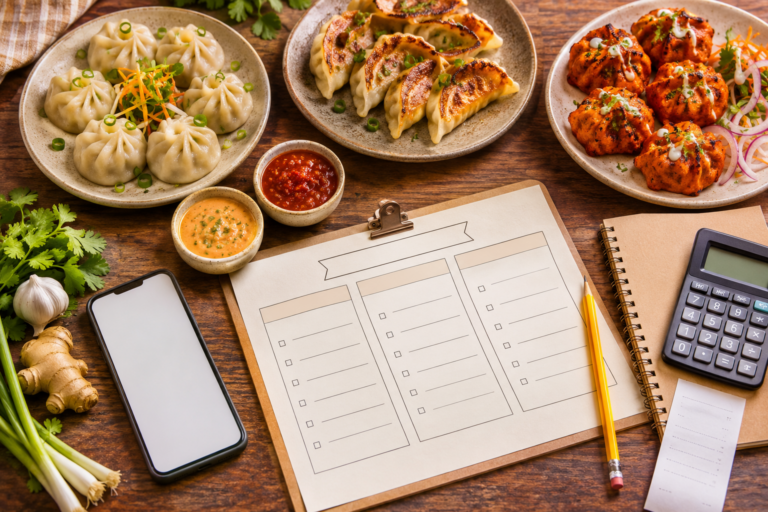
Copy-and-adapt RFQ checklist for a momo supplier
Before sending a request for quotation, collect the information below. It helps suppliers respond with comparable offers.
- Business type: restaurant, café, hotel, canteen, cloud kitchen, caterer or QSR.
- Delivery location(s): city, postcode and number of outlets.
- Desired products: veg, paneer and other permitted filling types; preferred size and piece count.
- Expected volume: pieces or cartons per week/month and likely peak demand.
- Storage capability: type and capacity of refrigeration/freezing equipment.
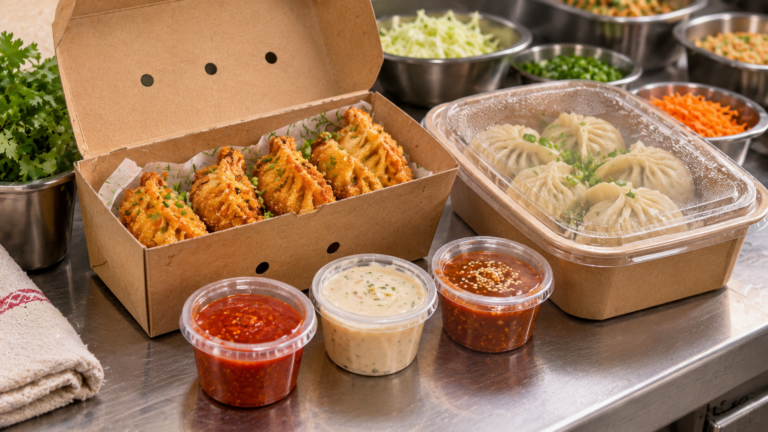
- Service format: steamed, kothey, fried, tandoori finishing, dine-in, takeaway or delivery.
- Specification request: ingredients, allergens, cooking instructions, shelf life and batch traceability.
- Commercial request: sample availability, MOQ, price basis, freight, lead time, payment and complaint policy.
The buyer should also request a trial order process and feedback contact. Sending a complete RFQ can make the first meeting more productive, but a quoted offer still needs verification and negotiation.
Eight common wholesale buying mistakes
- Comparing price per piece without normalising piece size and net weight.
- Testing a sample with a cooking method different from the supplier’s validated instructions.
- Failing to check allergens and product-status declarations.
- Underestimating freezer space, stock rotation and delivery restrictions.
- Ignoring breakage or waste when calculating portion economics.
- Accepting an unverified shelf-life claim or unexplained changes in packaging.
- Not documenting service failures, batch numbers or return criteria.
- Promoting a supplier’s claims as independently verified without checking current evidence.
Where Momo Delights fits into the process
Momo Delights describes a foodservice proposition alongside its customer-facing menu, with product and sauce information and dedicated business enquiries. The appropriate next step is not to assume a wholesale price list or manufacturing capacity from a blog article but to request current specifications, sampling arrangements, ordering eligibility and geographic supply terms from the Momo Delights B2B team. The company’s ingredient sourcing and quality assurance and traceability pages provide additional brand context to discuss in the enquiry.
If you’re considering the broader business model rather than product procurement alone, see the published Momo Franchise in India article. Buying stock from a supplier and signing a franchise agreement are materially different commercial decisions.
FAQs: wholesale momos for restaurants
What are wholesale momos?
Momos supplied in commercial quantities to businesses such as restaurants, cafés, caterers and cloud kitchens. The product may be frozen, chilled, ready-to-cook or already cooked depending on the supplier’s specification.
How do I compare two momo suppliers fairly?
Use the same intended serving size, documented safety requirements, controlled cooking process and comparable cost assumptions. Evaluate multiple batches where possible.
Should I buy frozen or fresh momos?
The answer depends on the validated shelf life, cold chain, kitchen capacity, service workflow and economics. Neither format is automatically superior for every operator.
How do I check a supplier’s FSSAI registration?
Use the official FoSCoS search or FSSAI Food Safety Connect functionality, and check that the relevant facility and business activity are covered.
What is the minimum order for bulk momos?
It varies by supplier, product, destination and commercial terms. Ask for an SKU-specific written MOQ rather than relying on a generic claim.
How long can frozen momos be stored?
Only for the shelf life validated for the specific product under its declared storage conditions. A universal duration would be misleading.
Can wholesale momos be served as tandoori momos?
Possibly, if the base product is suitable and the kitchen has a validated finishing and food-safety procedure. Get product-specific approval from the supplier.
What if the delivery temperature is out of specification?
Isolate the affected shipment and follow the documented receiving/quality procedure with the supplier. Do not accept or serve it solely on visual appearance.
Do I need a different supplier for momo chutney?
Not necessarily. Some suppliers offer both momos and sauces. Confirm actual availability, allergen information, storage requirements and whether the product suits your menu.
How can I contact Momo Delights about bulk supply?
Use the HoReCa/B2B enquiry page and include your location, projected volume, intended product type and request for a current specification and sampling process.
References and editorial transparency
- FSSAI — Business licensing: current food business licensing framework.
- FSSAI — Food Safety Connect: license-authenticity verification.
- FSSAI — Hygiene Requirements: FSMS, GMP, GHP and food-chain controls.
- FSSAI — Food Recall: role of product recall when unsafe/non-compliant food enters the supply chain.
- FSSAI — Food Safety Inspection Checklists: inspection themes.
- Momo Delights — HoReCa/B2B: business enquiries and the company’s stated supply positioning.
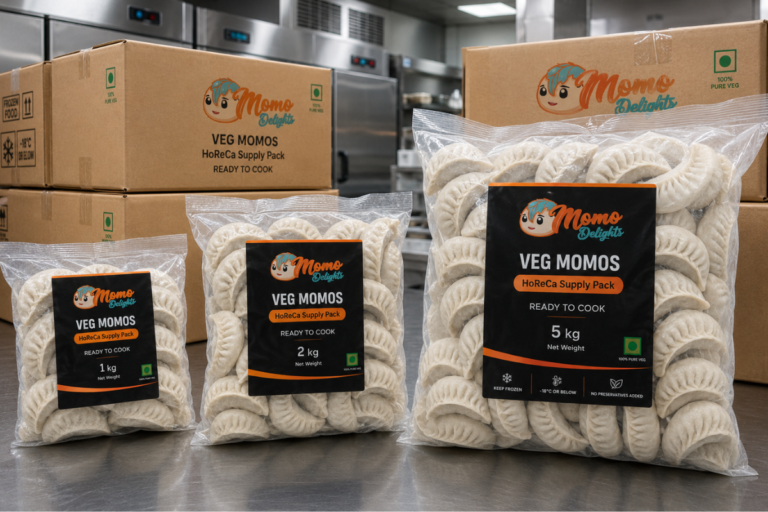
Editorial review: 1 November 2026. All example prices, criteria, scoring weights and cost calculations in this article are hypothetical educational models, not actual Momo Delights quotes, warranties or commercial promises. Product image drawn from the existing Momo Delights media library; buyers must request up-to-date approved packaging and specifications.