Aa Reading preferences
This detailed guide explains how tandoori momos differ from steamed, fried and kurkure styles; what changes during marination and roasting; why filling and coating matter; what to ask when ordering; and how to enjoy the dish without flattening Himalayan culinary history into a single restaurant recipe. It is a deeper companion to the overview of momo styles rather than a duplicate list of varieties.
The Momo Delights menu currently lists a Tandoori Momo Platter and related flavour directions such as Classic Masala Momo, Afghani Momo and Malai Momo. Actual formulation, cooking equipment and outlet availability require confirmation with the kitchen.
What exactly are tandoori momos?
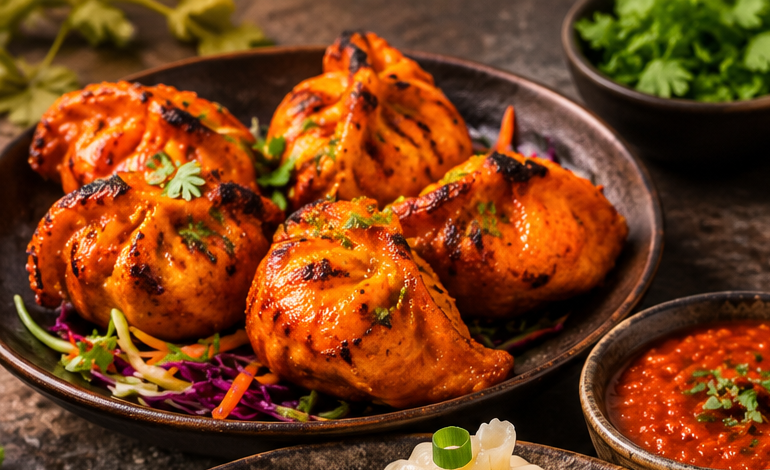
The name joins two ideas: the momo, a filled dumpling associated with food traditions across Nepal, Tibet and Himalayan regions, and a tandoori-inspired treatment associated with high-heat roasting and spiced marinades in South Asian restaurant cooking. The result is usually a more strongly seasoned exterior than that of a plain steamed momo, sometimes with charred or roasted edges.
There is no credible reason to treat every modern tandoori momo as an unchanged ancient Himalayan recipe. It is more accurate to describe tandoori momos as a contemporary fusion or restaurant adaptation. A classic steamed momo can be delicious on its own terms; a spice-coated roasted momo offers a different experience.
A published NDTV Food tandoori momo recipe illustrates a two-stage preparation: dumplings are first steamed, then coated in a yoghurt-and-spice marinade and baked until coloured. That is a documented example, not a universal kitchen standard and not evidence of how Momo Delights itself prepares its menu item.
How tandoori momos are typically prepared
Stage 1: Make the dumpling
The cook prepares a pliable wrapper dough, a seasoned vegetable, paneer or meat filling, then forms and seals the dumplings. The wrapper must hold together well through more handling than a momo that will simply be steamed and eaten. Overstuffing, a wet filling or a weak seam can become more obvious once the momo is coated and finished at high heat.
Stage 2: Cook the centre safely
Many documented tandoori momo recipes begin by steaming the momos. This can set the wrapper and cook the filling before applying a seasoning coat. It is essential that any raw filling—especially meat or poultry—be cooked using a validated procedure, rather than relying on a short final charring step to make an undercooked centre safe.
Stage 3: Coat with a suitable marinade
In the NDTV version, the marinade includes curd (yoghurt), ginger–garlic paste, red chilli, coriander, cumin, black pepper, chaat masala and besan (chickpea flour). The coating helps deliver spice across the surface. Many variations add oil, other seasonings or ingredients specific to the kitchen. The colour may come from spices and cooking, but colour alone cannot verify the exact recipe.
Stage 4: Finish with heat
The coated dumpling may be baked, grilled, roasted or finished in a tandoor according to the restaurant’s equipment. A hot finish develops roasted aromas and may slightly dry or crisp the outer coating. The trade-off is that overcooking can dry the wrapper or filling. A good finish balances flavour with a tender interior.
Stage 5: Serve promptly
A tandoori momo is often served soon after finishing, optionally with onion, herbs, lime, spices or a sauce. Those are possible accompaniments rather than guaranteed ingredients in a Momo Delights order. Sauces can be requested separately for customers who want to taste the coating’s roasted flavour.
Tandoori momo ingredients: what each element contributes
| Common ingredient | What it does | What to verify |
|---|---|---|
| Yoghurt/curd | Offers tang and a base for dispersing seasoning | Milk allergen; refrigeration; whether used at all |
| Ginger and garlic | Add aromatic depth | Freshness and individual preference |
| Red chilli | Adds colour and heat | Spice strength differs between recipes |
| Cumin and coriander | Bring warm, earthy aromatic notes | Actual spice blend varies |
| Chaat masala | May add tang and seasoning complexity | Blend composition and salt level |
| Besan | Can give body to the coating | Not used by every kitchen; check recipe |
| Oil | Can help coating and heat transfer | Amount and preparation differ |
Dietary note: A vegetable-filled tandoori momo is not automatically vegan if its coating contains curd or dairy. It is also not automatically gluten-free, since the wrapper can contain wheat. Ask for ingredients and cross-contact information; use Momo Delights’ allergen information page as a starting point.
Are tandoori momos necessarily smoky?
Not always. A smoky impression can be associated with charred surfaces or a real tandoor, but an oven-baked adaptation may taste more roasted than smoky. Cooking technique, seasoning, surface moisture and time all affect the result. Marketing words such as “smoky”, “authentic” and “clay-oven” should only be used for a specific menu item if they accurately describe how it is actually prepared.
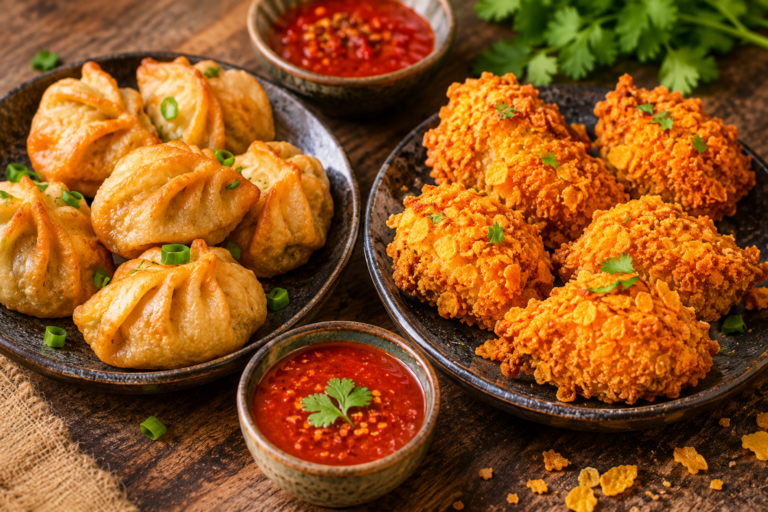
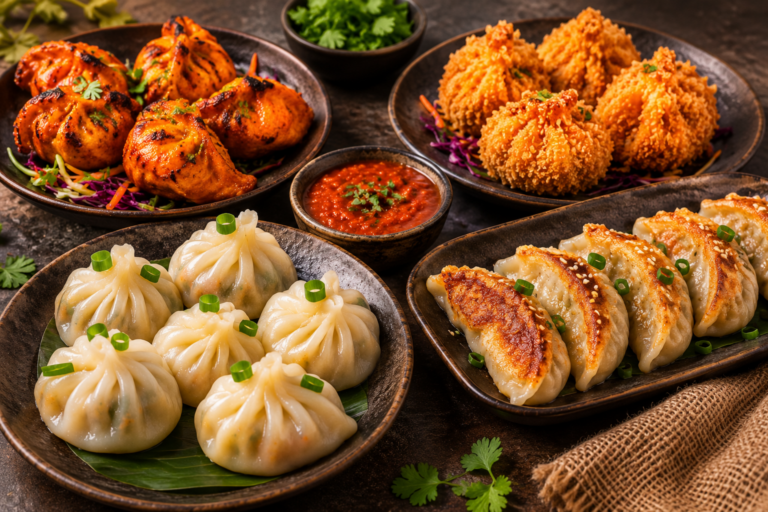
Tandoori vs steamed vs fried vs kurkure momos
| Type | Main distinguishing feature | Expected experience |
|---|---|---|
| Steamed | Steam-cooked wrapper and filling | Soft, filling-forward and well suited to tangy dips |
| Fried | Oil-based crisp finish | Crisp exterior, richer fried notes |
| Kothey | Pan-seared contact surface | Crisp-and-soft textural contrast |
| Kurkure | Crunchy coating or crisp-finish treatment | Emphasis on a crunchy bite |
| Tandoori | Seasoned coating plus high-heat roasting/grilling | Spice-led, roasted and possibly charred outer layer |
Tandoori momos may begin as steamed dumplings, so these categories are not mutually exclusive stages. A name may refer to the final flavour and cooking treatment rather than every step in the product’s preparation. The Momo Delights menu reflects this by grouping steamed, fried/kothey and tandoori styles separately.
What’s the difference between tandoori, malai and Afghani momos?
In Indian restaurant language, the terms commonly imply different seasoning directions rather than strict, universal momo recipes. Tandoori tends to suggest a bolder roast-and-spice approach; malai often signals a creamier treatment; Afghani may signal a milder, rich and creamy seasoning profile. These are menu-language conventions, not fixed standards. Malai or Afghani dishes may contain dairy and nuts depending on recipe; ask rather than guess.
The brand lists a Tandoori Momo Platter, Malai Momo and Afghani Momo on its published menu. If selecting for someone avoiding milk, nuts, wheat or spicy food, request an ingredient check from the outlet before ordering.
A practical guide to ordering tandoori momos
Choose by filling first
Vegetable and paneer fillings change the centre of the momo. Paneer brings a dairy ingredient and a different texture; vegetables can be lighter or more substantial depending on the formulation. A meat filling, where offered, needs additional attention to thorough cooking and cross-contamination controls. Check the menu for the specific item at your chosen outlet rather than assuming all fillings are sold.
Ask about heat, sauce and texture
Spice level and the seasoning of the coating differ across kitchens. If you prefer mild food, ask whether sauce can be separated or whether the product has a mild alternative. If you want the roasted flavour to stand out, take a bite without dip first, then add a small amount of sauce.
For a shared order, contrast two textures
A steamed momo alongside a tandoori preparation lets you compare wrapper tenderness against a spiced high-heat finish. Ordering two heavily coated variations may give less contrast than mixing a steamed and a roasted item. For planning a visit, open Find Us and confirm the outlet’s current service and menu.
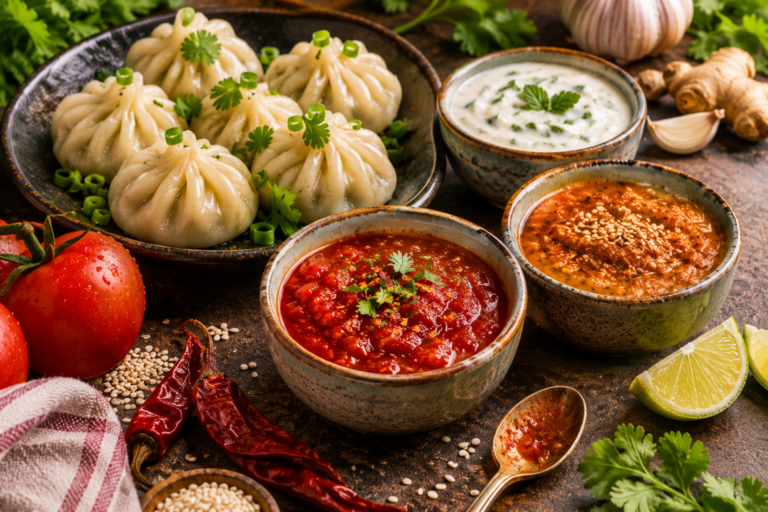
How to pair chutney with tandoori momos
The sauce changes the perceived balance. A red tomato–chilli dip can brighten the roast and spice, while a creamy herb dip may soften perceived chilli heat. Some people prefer a sour contrast; others enjoy the coating without extra sauce. There is no objectively best match. If you have a milk allergy, remember that a creamy-looking sauce can contain yoghurt or cream; never rely solely on appearance.
Preparation and food-safety considerations
Two cooking stages do not automatically guarantee safety if a kitchen uses inconsistent practices. Food businesses should maintain appropriate raw/cooked separation, hygienic marinading and storage, validated cooking processes, clean serving tools and documented procedures. India’s FSSAI hygiene requirements describe food safety management, good manufacturing practices and good hygiene practices for food operators.
- Keep raw ingredients separate from ready-to-eat food; use clean trays and utensils for the final product.
- Refrigerate perishable yoghurt-based marinades as needed; do not leave them on the counter indefinitely.
- Do not use an undercooked meat-filled momo and expect a quick surface char to cook the centre.
- Validate serving and holding procedures if operating at volume; a cooking time taken from a different recipe may not apply.
- Confirm ingredients and potential allergens, particularly dairy and wheat.
How restaurants can make tandoori momos consistent
For a restaurant, consistency is not simply “add the same spices.” It requires a defined base momo, consistent filling portion and wrapper, a weighed seasoning mix, a controlled coating ratio, a finishing method suitable for the equipment, and clear criteria for the resulting texture. Testing should include both first-service quality and takeaway holding because packaging can soften the surface.
Operators considering a momo menu can explore adding momos without hiring a specialist chef, compare momo machines with ready-made products and contact the Momo Delights foodservice team about actual product specifications. These resources do not establish any guaranteed output, cost saving or specific tandoori coating recipe.
Frequently asked questions
What are tandoori momos made from?
Typically a filled dumpling with a seasoned exterior. Documented recipes may use a yoghurt-and-spice marinade, but ingredients differ and dairy-free versions are also possible.
Are tandoori momos fried or steamed?
Some recipes steam the momo first, then bake or grill it after applying marinade. Others may use different preparation sequences. Ask the actual kitchen.
Are tandoori momos originally Tibetan?
The momo is part of Himalayan culinary traditions, while the tandoori-style treatment is better understood as a modern Indian restaurant adaptation.
Do tandoori momos always contain yoghurt?
No. Yoghurt is common in some documented recipes, but a kitchen may use a different coating. Confirm ingredients when avoiding dairy.
Is tandoori healthier than fried?
No blanket comparison is reliable. Nutrition depends on portion size, filling, marinade, oil and sauces. A roasted preparation can still contain substantial fat or salt.
Are tandoori and malai momos the same?
Not necessarily. These names usually describe different seasoning directions, though there is no universally fixed formulation.
Which sauce is best for tandoori momos?
Tomato–chilli for sharpness or a suitable creamy/herb dip for contrast are two options. Personal preference and allergen needs matter.
Does Momo Delights sell tandoori momos?
The published menu lists a Tandoori Momo Platter and related masala-style options. Confirm availability, pricing and preparation at the chosen outlet.
Sources and editorial note
- NDTV Food — Tandoori Momos Recipe: documented steaming, yoghurt-spice coating and oven-finishing example.
- FSSAI — Hygiene Requirements: hygiene and FSMS context for food businesses.
- Sikkim Tourism — Cuisine: traditional Himalayan steamed momo context.
- Momo Delights — Menu: verified brand menu names, not proprietary cooking methods.
Editorial review: 1 November 2026. Culinary claims describe general preparations and cited examples, not verified internal Momo Delights kitchen SOPs. Images are conceptual editorial visuals.