
Aa Reading preferences
These distinctions matter when you buy momos for a family meal, compare retail packs, choose a foodservice supplier or build a restaurant’s standard operating procedure. This guide focuses on labelling, storage, food safety, quality and operating choices. It does not repeat the separate detailed cooking tutorial or assume that all Momo Delights products have a particular manufacturing format.
What does “fresh momo” actually mean?
A fresh momo may be made shortly before service, sold chilled after assembly or offered hot from a kitchen. The word “fresh” is often used informally in food marketing, so it is not enough to establish that a momo is raw, cooked, safer or more nutritious. A freshly folded momo with a raw filling still requires validated cooking. An already steamed momo may have been cooked shortly before the customer receives it. The important questions are the actual product state, storage, handling and intended method of consumption.
Ready-to-cook (RTC)
Ready-to-cook momos are prepared to a point where the buyer performs a remaining cooking step. They might be formed and frozen, or chilled, and the filling may be raw or partly cooked. These products are not safe to eat merely because they look like finished dumplings. Follow the exact package directions; an unfamiliar brand’s instructions do not transfer to another brand’s product.
Ready-to-eat (RTE)
Ready-to-eat foods are intended to be consumed without an additional safety-critical cooking step, although the product can still call for reheating for serving quality or use. A ready-to-eat momo may be sold hot, chilled or frozen. Once again, the package instructions and validated process determine appropriate handling. Do not treat a hot-looking but raw, partially cooked food as ready-to-eat.
Frozen, chilled and hot are storage or service states
The words “frozen”, “chilled” and “hot” describe temperatures or storage formats, not whether the product has been sufficiently cooked. Frozen momos may be ready-to-cook or already cooked; chilled momos may be raw or cooked. These dimensions need to be recorded separately in a professional product specification.
Fresh vs ready-to-cook vs ready-to-eat: comparison chart
| Question | Fresh momos | Ready-to-cook momos | Ready-to-eat momos |
|---|---|---|---|
| What the term primarily describes | Recently prepared or presented as fresh; meaning varies | Intended use: requires cooking | Intended use: no further safety-critical cooking required |
| Can it contain raw ingredients? | Yes | Yes, potentially | Food should be processed for ready-to-eat use; verify pack instructions |
| Can it be frozen? | Not usually what buyers mean by fresh, but “fresh” is ambiguous | Yes | Yes |
| Is a heating step needed? | Depends on whether it is raw or already cooked | Yes, follow validated directions | May require reheating per label, though no extra cooking should be necessary for safety |
| What should the buyer check? | Actual handling, cook status and service time | Starting state, instructions, endpoint and storage | Storage, use-by date, opening, reheating and serving directions |
| Typical business advantage | Potential menu flexibility and fresh preparation experience | Potential prep-time and portion consistency benefits | Potential rapid service when prepared and stored correctly |
| Main limitation | Requires adequate staff and consistent handling | Needs a validated cooking step and equipment | Safety and quality still depend on handling and cold chain |
These are general industry explanations, not a substitute for product-specific legal labels. India’s FSSAI Labelling and Display Regulations set requirements for applicable prepackaged foods; requirements differ by product and market. The published regulations have been amended over time, so manufacturers should confirm the latest applicable rules rather than copying an old package.
The eight label details to check before buying momos
- Exact product name and intended use: Does the pack say raw, uncooked, partly cooked, ready-to-cook, fully cooked or ready-to-eat?
- Ingredients and allergens: Wheat in the wrapper, milk in paneer, and other filling or sauce ingredients may matter.
- Vegetarian / non-vegetarian status: Verify the actual declaration where applicable instead of inferring from colour or shape.
- Storage conditions: Are you supposed to keep the pack chilled or frozen, and at what stated temperature?
- Dates and batch: Look for manufacturing or packing details, use-by/expiry or best-before information, and batch/lot traceability.
- Cooking or reheating directions: Starting condition, method, time and any core-temperature or doneness requirement.
- After-opening and thawing guidance: How should part of the pack be handled, and is thawing required or prohibited?
- Responsible food business information: Relevant manufacturer or marketer details and applicable regulatory information.
Labels are not decorative packaging copy; they are a key part of safely using the food. In US consumer guidance, USDA FSIS explicitly warns that “ready to cook” on certain poultry products can mean raw or not ready to eat—even where the outside looks browned. That source addresses poultry products, not a universal legal definition for every momo, but its practical warning against visual assumptions is directly useful.
Why frozen does not mean fully cooked
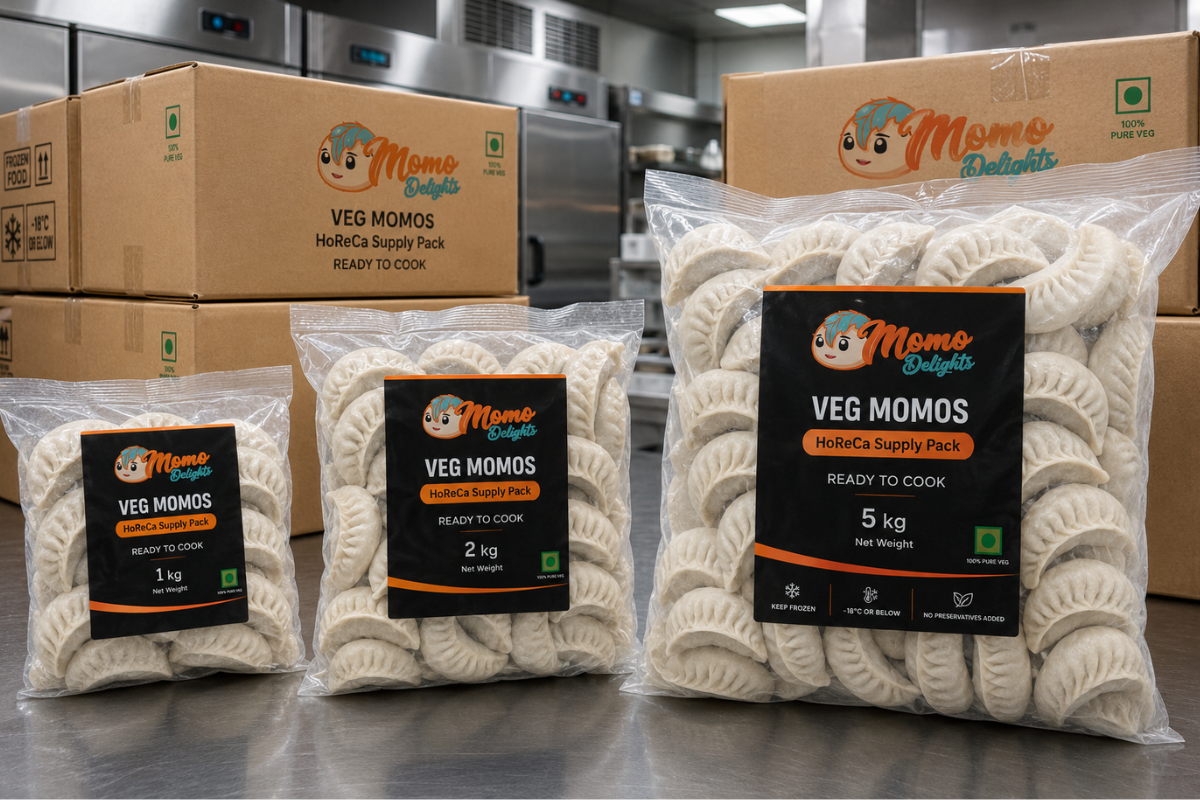
Freezing changes how a food is stored; it does not, by itself, cook the food or make it sterile. Raw filling can remain raw inside a frozen dumpling. Similarly, a product that has been briefly steamed or browned may still require further cooking. Always establish whether the supplier’s declared preparation state is raw, partially cooked or fully cooked.
There is no universally safe “five-minute” or “ten-minute” rule for all frozen momos. A fully frozen, large chicken-filled momo can have a different heating profile from a small pre-cooked vegetable momo. The manufacturer’s validated instructions should be followed, and professional kitchens should control batch size and cooking endpoint, not simply wait until the wrapper feels soft.
For poultry-focused guidance, USDA FSIS lists 74°C (165°F) as a safe internal temperature for raw poultry products; this is a US safety reference, not a universal specification for every momo. Food businesses in India should follow applicable Indian requirements and the manufacturer’s documented SOP. Our separate momo machine vs ready-made momos guide discusses the production decision, while this article focuses on product-state clarity.
Why ready-to-cook products may help a restaurant
For many restaurants, portioning and assembling dumplings by hand consumes labour, space, equipment and management attention. A suitable ready-to-cook product can reduce some of those preparation steps and help standardise piece size. However, the kitchen must still provide proper receiving, frozen or chilled storage, cooking equipment, trained staff and service controls. The commercial benefit depends on actual throughput and supplier performance—not the marketing promise that an item is “easy to cook.”
Read how restaurants can add momos without hiring a specialist chef for operational context, and use the Momo Delights HoReCa/B2B page to request current available products and specifications.
Which momo format should a home buyer choose?
| Situation | Format to consider | What to confirm |
|---|---|---|
| Eat immediately from a restaurant | Hot, fully cooked prepared momos | Ingredients, dietary needs and safe service |
| Cook a meal later with a steamer | Ready-to-cook momos | Pack cooking instructions, storage and doneness |
| Minimal kitchen preparation | Fully cooked product with specified reheating instructions | True RTE status and safe reheating/storage |
| Cook dumplings from scratch | Freshly made dough and filling | Clean preparation and complete cooking |
| Share with someone with allergies | Any suitably declared product | Full ingredients and cross-contact information first |
Purchasing for convenience should not override checking the label. If a product has no clear cooking directions, do not invent them based on a similar-looking item. Contact the producer or retailer for the relevant instructions.
Cold-chain practices: what the food business should verify
India’s FSSAI food safety framework addresses the receiving, storing and handling of perishable and frozen goods. A 2022 direction includes a food-business receiving control referencing frozen food at −18°C or below and high-risk chilled food at 5°C or below. The exact obligations for a product and operator should be checked against the current applicable directions, licence category and the supplier’s product specification.
Professional receiving checklist:
- Confirm pack identification, ordered quantity, manufacturing/expiry details and lot codes.
- Check packaging integrity and observable thawing, leakage or damage.
- Check delivery and product temperature against written receiving specifications; document exceptions.
- Move accepted products to appropriate storage promptly; do not leave cartons in warm holding areas.
- Maintain suitable stock rotation and segregate raw from ready-to-eat products to avoid cross-contamination.
- Use the manufacturer’s validated thawing and cooking procedure, not an assumed universal time.
For thawing, FSSAI’s food-safety FAQ advises controlled methods, not leaving meat on a kitchen counter. Product-specific instructions may direct cooking from frozen instead of thawing. Do not assume a thawed item is safe to refreeze just because it remains cool to the touch.
Are fresh momos always tastier than frozen momos?
There is no objective universal answer. The result depends on wrapper formulation, filling quality, freezing and thawing processes, storage, transport, cooking method, service timing and personal preferences. A carefully produced frozen momo prepared correctly can be preferable to a poorly stored fresh item, and a freshly folded momo can have distinctive texture when made and cooked well. Claims should be evaluated by controlled tasting and verified handling, not slogans.
How restaurants should compare total operating cost
An in-house fresh programme may involve labour for mixing, filling, folding, cleaning and training. An externally supplied ready-to-cook programme involves purchasing, inbound freight, storage and cooked-service labour. A fully cooked format might reduce final kitchen steps but still requires handling and validated reheating or service.
Compare cost per sellable plate, not merely cost per kilo. Account for actual piece count, breakage, wastage, sauces, oil, cooking energy, packaging and delivery. The Momo Delights B2B enquiry page is the appropriate place to request current product formats, delivery eligibility and actual specifications. No prices, capacity or contract terms are implied here.
Practical tasting and quality tests
To evaluate products fairly, use representative batches and prepare each exactly as directed. Ask judges to assess flavour, wrapper integrity, filling consistency, cooking repeatability, appearance, serving time and held texture after a realistic order-to-delivery window. Test the product for both food safety compliance and culinary quality; a high taste score cannot compensate for inadequate validated cooking or broken cold-chain controls.
When comparing fresh and frozen products, state the test conditions and serving method. Without that context, marketing statements like “fresh is better” or “frozen is the same as fresh” are too broad to be meaningful.
What Momo Delights buyers should ask
Momo Delights publishes a customer-facing menu and a separate foodservice supply proposition. The published menu contains steamed and other momo varieties, but a restaurant menu does not establish the production state, storage life or cooking instructions for any wholesale SKU. Ask the foodservice team which specific forms are currently offered, what storage they require and what product documentation is available.
For brand context, review ingredient sourcing, quality assurance and traceability and allergen information. Those pages are starting points for enquiry, not a substitute for an approved current product specification.
Frequently asked questions
Is ready-to-cook the same as ready-to-eat?
No. Ready-to-cook requires a cooking step; ready-to-eat should already have been prepared for safe consumption when stored and used as specified.
Can ready-to-cook momos be frozen?
Yes. Frozen is a storage condition, and such products still need the preparation indicated on the pack.
Are fresh momos always fully cooked?
No. “Fresh” does not establish whether the filling has been cooked.
Are frozen momos already steamed?
Not necessarily. Raw, partially cooked and fully cooked products can all be frozen.
Should frozen momos be thawed first?
Follow the product’s validated instructions; some require direct-from-frozen cooking and others specify safe thawing.
Can I safely eat a ready-to-cook momo if the wrapper looks cooked?
No. A cooked-looking wrapper does not prove the filling is safe. Follow the instructions and check the centre as required.
Do ready-to-eat momos need refrigeration?
Many cooked dumpling products do, but the specific storage requirement depends on the validated product and packaging. Read the label.
Which product format is most profitable for a restaurant?
None is inherently most profitable. Compare total costs, operational capacity, customer demand, waste and reliable supply.
How long can frozen momos be stored?
Only as long as the specific product’s documented shelf life under the required temperature and handling conditions. No universal number is appropriate.
Sources and editorial note
- FSSAI — Labelling and Display Regulations, with amendments.
- FSSAI — Food-business storage and receiving direction (2022).
- FSSAI — Safe thawing FAQ.
- USDA FSIS — Frozen uncooked products and label clarity (US poultry example).
- Momo Delights — HoReCa/B2B.
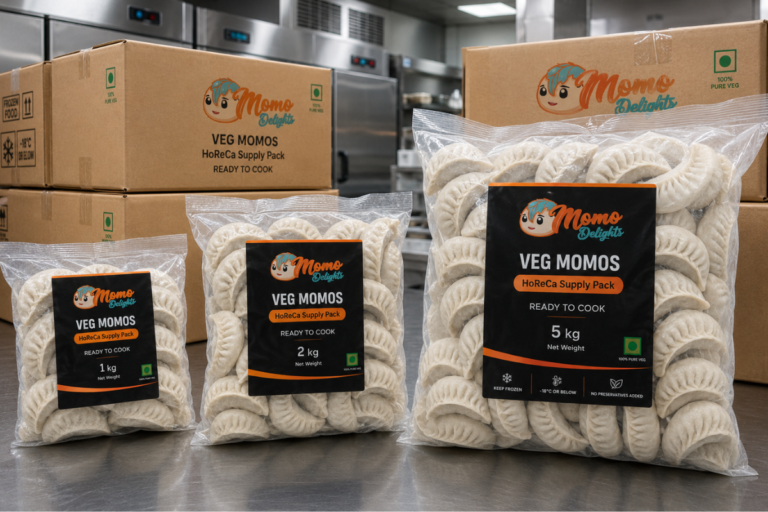
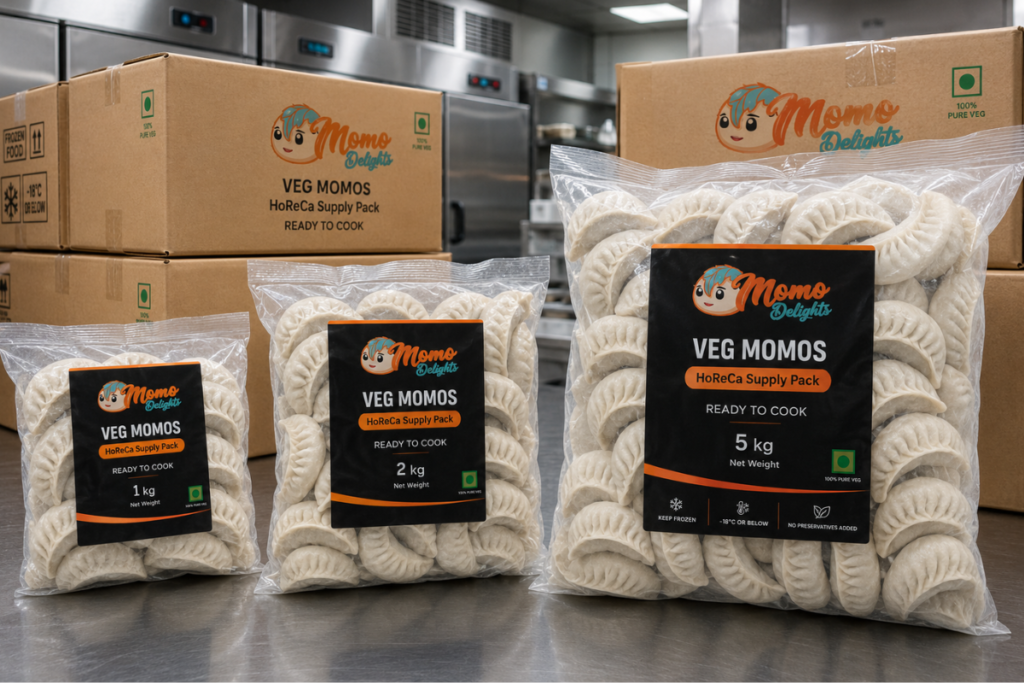
Editorial review: 1 November 2026. This is general product-education material, not an assertion that a particular Momo Delights item is raw, frozen, RTE or RTC. Buyers should obtain current pack-specific specifications and food-safety directions before use. The illustrative image comes from the brand’s media library and is not a verified retail pack label.