

Aa Reading preferences
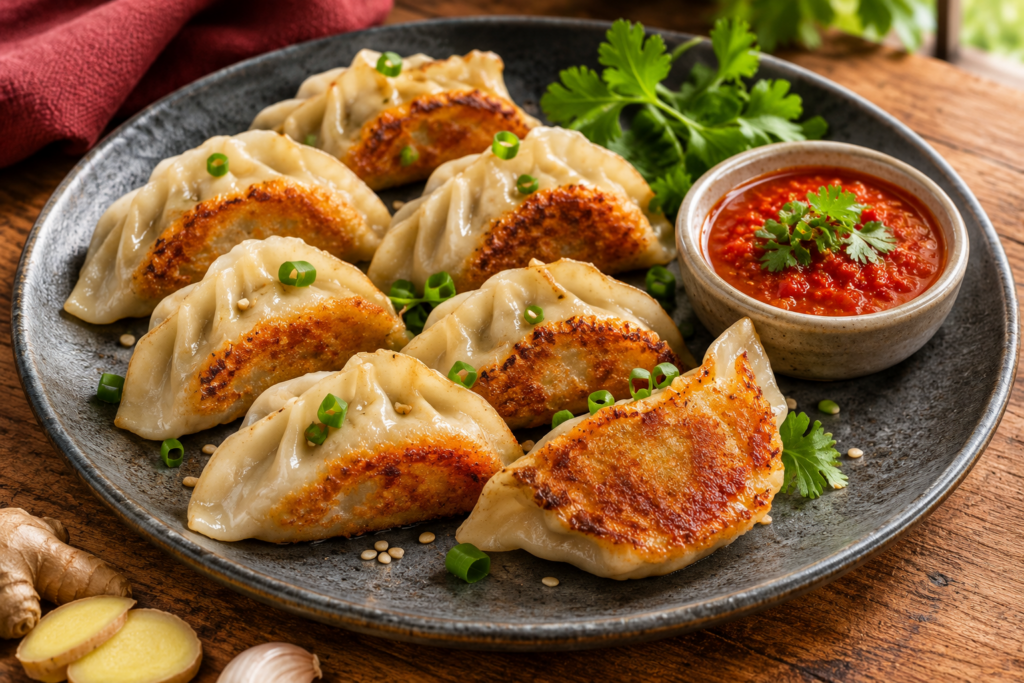
Kothey momos deliver two textures in one dumpling: a lightly browned base and a softer, tender top. It is a particularly satisfying style when you like steamed momos but wish the first bite had a little more crunch.
There are different regional and restaurant approaches to cooking kothey. This is a home-friendly crisping method using already fully cooked vegetarian momos, so the browning step is easier to control. It is not presented as the only traditional method.
Ingredients for two or three light servings
- 12 fully cooked vegetarian momos, warm or safely chilled
- 1–2 teaspoons neutral oil
- 1–2 tablespoons water, if needed to produce a little steam
- A small bowl of tomato-chilli chutney or a mild dipping sauce
- Optional spring onion greens for serving
For safety, use fully cooked dumplings, not raw or partially cooked frozen products unless their package explicitly provides suitable pan-cooking directions. If using refrigerated leftovers, heat thoroughly to 74°C/165°F as recommended by FoodSafety.gov.
Step 1: Choose the right pan
A heavy non-stick or well-seasoned pan with a lid makes this easier. Choose a size that holds the momos in one layer without squeezing them together. A lid helps warm the tops while the bases take colour, but a long covered hold can soften the very crust you are trying to create.
Do not use high heat simply to hurry the process. A scorched wrapper will be bitter before the centre has heated adequately.
Step 2: Arrange the dumplings flat-side down
Heat a small amount of oil over medium heat. Place the cooked momos gently on their flatter surface, leaving gaps. Let the bottoms develop a golden crust for a couple of minutes without moving them constantly. Then lift one edge with a clean spatula to inspect the colour.
The exact time depends on pan thickness, starting temperature and wrapper type; look for a golden base rather than trusting a fixed minute count.
Step 3: Warm through, then restore the crisp finish
If the centres still need warming, add a small splash of water away from your body and cover briefly so steam circulates. Be careful: water meeting hot oil can splutter. Once the water evaporates and the filling is properly hot, remove the lid and allow the bottom to dry and crisp again.
For refrigerated leftovers, check an appropriately thick centre with a food thermometer and aim for 74°C/165°F. You are reheating food, not using browning as evidence that the interior is safe.
Step 4: Plate quickly
Transfer the finished momos to a plate with the browned surface facing up where practical. Keep sauces separate until the first bite so the crisp base does not immediately soften. A modest spoonful of tomato-chilli or sesame-based achar is often enough to show the contrast.
Do not stack the hot dumplings in a closed container for long if you want a crisp result; trapped steam will soften their bottoms.
How to judge a good kothey momo
The base should have an even, light golden colour and a noticeable crispness without being hard or oily. The top should remain tender, the filling fully cooked and the overall bite balanced. If the bottom is pale, let it cook uncovered a little longer. If dark and bitter, reduce heat on the next batch. If the top dries before the base browns, you may be working too slowly or using excessive heat.
Common problems
| Symptom | What to change |
|---|---|
| Soggy bottom | Allow water to evaporate completely before plating |
| Wrapper tears on turning | Use a prepared pan and a thin spatula; avoid force |
| Burnt base, cool centre | Lower heat; warm gently before final crisping |
| Filling leaks | Start with intact cooked momos; avoid squeezing while moving |
| Uneven colour | Leave space and use a level pan |
A note on frozen ready-to-cook momos
A frozen package may contain raw fillings or require specific cooking steps. Do not assume that a brief covered pan treatment makes it safe. Prepare the product exactly as directed, then use a crisping finish only if compatible with that product. See the frozen momo receiving guide for the different safety questions that arise in commercial settings.
FAQs
Are kothey momos deep fried?
Typically, kothey-style momos are pan-seared rather than deep fried, though modern restaurant variants may differ.
Can I use paneer momos?
Yes, as long as they are fully cooked before you follow this home method.
Is the crispy base still good after delivery?
It may soften as steam accumulates. Eat promptly and keep sauce separate.
For more cooking inspiration, see Potstickers vs Kothey Momos: Crispy Bases and Steam-Frying and Steamed vs Crispy Momos: Kitchen Throughput and Menu Engineering. Check allergens and ingredient suitability before serving.

Leave a comment