Aa Reading preferences
Steaming can produce tender wrappers and evenly heated fillings, but ready-to-cook products are not all identical. A fresh vegetarian momo, a precooked frozen momo and a raw chicken-filled frozen momo require different handling. This guide explains the process without inventing a single ‘magic’ steam time that would be unsafe for some products.
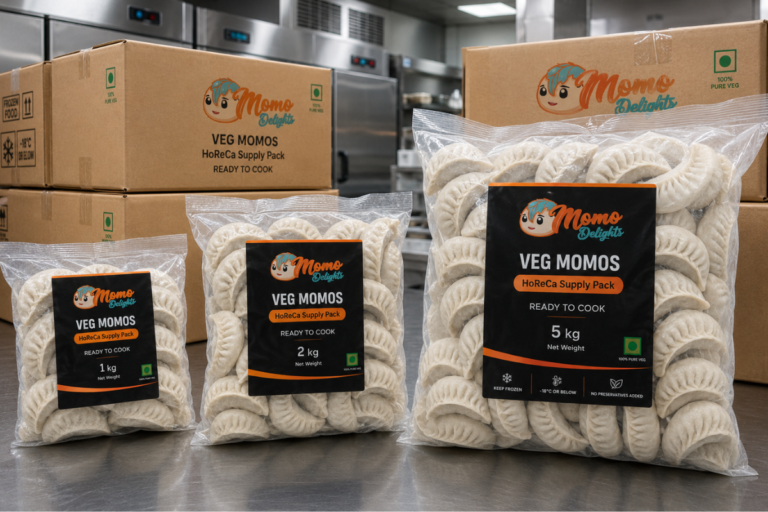
Important: This is a general educational guide, not product-specific cooking directions for a Momo Delights retail pack. If you are working with a Momo Delights foodservice product, use the supplied product specification and contact the HoReCa/B2B team for its approved cooking procedure. Instructions supplied by the food manufacturer take priority over general guidance.
Start with the label: three very different product states
The phrase ‘ready-to-cook’ means a product still needs cooking. It does not mean that the filling has already been made safe for eating. A product may be fresh, chilled or frozen, and it may contain raw or precooked ingredients. Treat the instructions as the source of truth rather than assuming all frozen dumplings are fully cooked.
| Pack description | What to check before cooking | Why it matters |
|---|---|---|
| Fresh/chilled ready-to-cook | Use-by date, storage condition, cooking method, cooking duration | Shorter chilled shelf life and potentially raw fillings |
| Frozen ready-to-cook | Keep-frozen statement, thawing instructions, cooking method, validated time | Frozen centre can cook more slowly; the pack may require a specific starting state |
| Fully cooked / ready-to-eat, sold frozen or chilled | Reheating instructions and storage/use-by information | Reheating is a different process from cooking a raw product |
The USDA Food Safety and Inspection Service explains that a product labelled ‘ready to cook’ may still be raw or not ready to eat. The example covers poultry products, but the broader lesson is relevant to reading prepared-food labels: do not assume a prepared appearance means a safely cooked centre.
What you need to steam momos
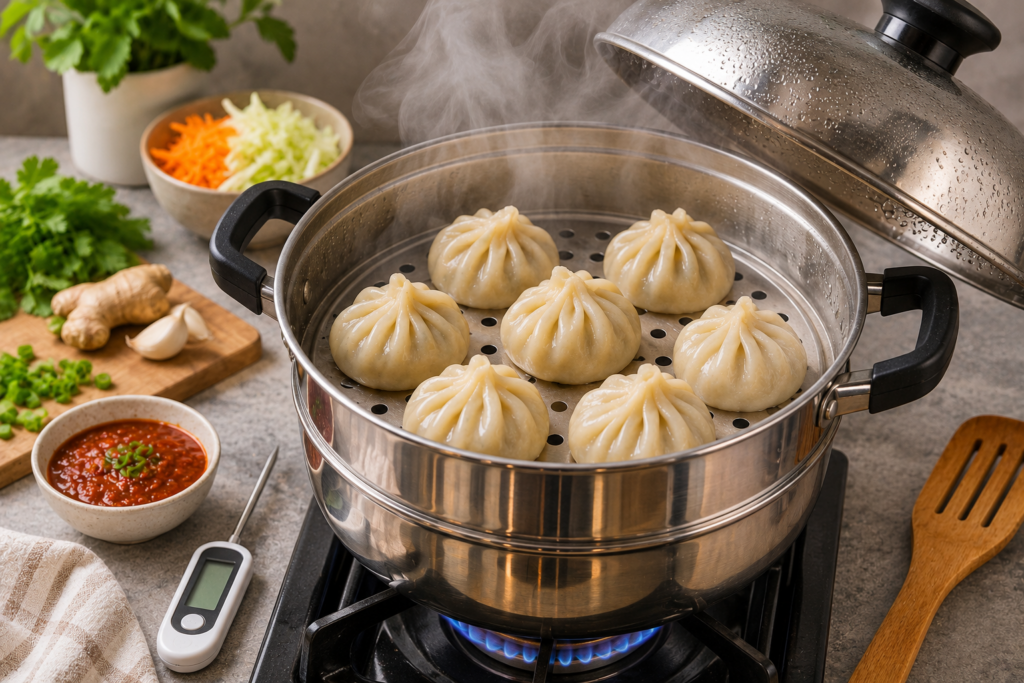
- A steamer: A stainless-steel tiered steamer, bamboo steamer placed over a suitable pot, or steam-compatible insert.
- A fitted lid: Retains steam so the temperature and cooking process remain consistent.
- Clean potable water: The water belongs below the steaming tray, not touching the dumplings.
- Clean tongs or serving utensil: For removing cooked momos without contaminating them with tools used for raw food.
- A food thermometer where appropriate: Particularly helpful for verifying the centre of meat-filled products; follow the product’s validated temperature requirements.
- Optional release aid: A little oil on the basket or perforated, food-safe liner if consistent with the product directions and equipment safety instructions.
Don’t seal off the steam holes with solid paper; steam must be able to circulate. Follow the steamer maker’s safety and water-level instructions so a metal vessel does not boil dry.
How to steam ready-to-cook momos: six practical steps
Step 1 — Check the pack and storage condition
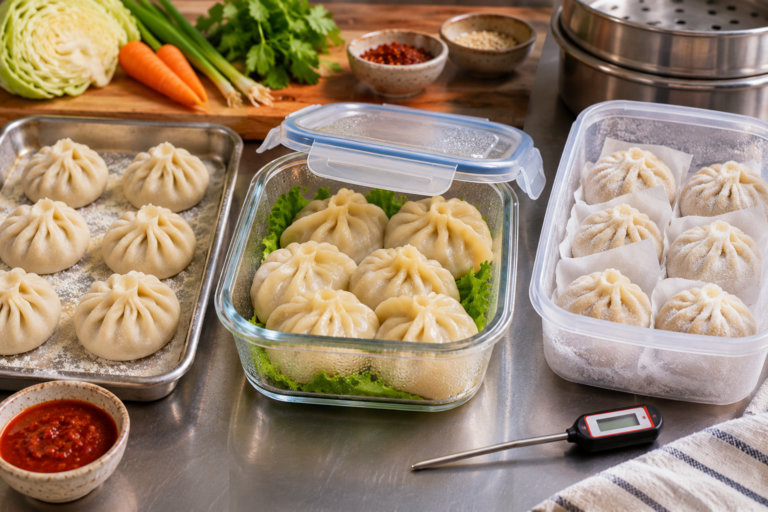
Confirm the product identity, preparation instructions, expiry/use-by date, package integrity and whether the momos must stay frozen until cooking. If a frozen pack has thawed during transport, do not assume it is safe to refreeze or cook without checking the manufacturer’s instructions and the time/temperature history.
Step 2 — Set up the steamer correctly
Use a stable, heat-safe pot and clean, potable water below the steaming surface. Heat until you have an active, steady supply of steam. A covered pot that is barely warm may not provide enough steam; vigorous boiling that splashes directly onto dumplings may damage wrappers. Manage heat to maintain a consistent steaming environment.
Step 3 — Prepare the tray to avoid sticking
Where permitted by the recipe, lightly grease the contact points or use a suitable perforated steamer liner. Place each momo on the tray so it does not touch its neighbours. Crowded layers can interfere with steam flow and make wrappers stick together. Avoid stacking uncooked dumplings on top of one another unless the equipment and instructions explicitly allow it.
Step 4 — Follow the product’s cooking method
Place the tray over the hot water, close the lid and follow the pack’s directions for whether the momos should start frozen or thawed. Do not open the lid repeatedly: each opening lets steam and heat escape and can alter the actual cooking time. If the product requires a specific cooking temperature or centre temperature, use that criterion rather than relying on a timer alone.
Step 5 — Verify thorough cooking
The wrapper should be cooked and the filling hot throughout; for raw meat-filled momos, also follow an appropriate core-temperature criterion. Where the filling includes raw poultry, the USDA FSIS recommends 74°C (165°F) as a safe minimum temperature for poultry; this is a US reference, not a substitute for the relevant local requirements or product instructions. A probe should be positioned in the thickest part of the filling, avoiding false readings from the wrapper or steamer surface.
For an unfamiliar product with incomplete cooking instructions—especially a raw meat filling—ask the manufacturer for verified instructions rather than estimating from the appearance of the dough.
Step 6 — Serve promptly and safely
Use a clean utensil to move finished momos to a plate. Keep raw-product trays and utensils away from the finished food. Serve with a sauce prepared and stored hygienically. Tomato-chilli chutney, an achar-style dip or soup are common accompaniments, but recipes differ across regions and kitchens. Browse the Momo Delights food menu for inspiration about flavour combinations.
How long should you steam momos?
There is no single safe time for every momo. The correct duration changes with size, wrapper thickness, raw versus precooked filling, frozen versus chilled starting temperature, equipment design, steam intensity and batch size.
Published traditional recipes show why general timings differ. Sikkim Tourism’s recipe specifies about 15–20 minutes for the momos described in that recipe. That figure does not automatically apply to a different frozen product, and it should never override pack instructions.
| Situation | Safer approach |
|---|---|
| Commercial frozen momo pack gives steaming instructions | Follow the stated starting temperature, method, time and doneness guidance |
| Fresh momo recipe specifies a method and duration | Follow that tested recipe, accounting for changes in size or filling |
| Raw chicken-filled momo with no approved directions | Seek manufacturer guidance; verify appropriate core-temperature safety using a thermometer |
| Already-cooked momo being reheated | Follow the reheating directions; heat thoroughly rather than treating it as a raw product |
What if the clock ends and the centre is still cool? Continue cooking until the food meets its validated doneness criteria. A timer tells you how long the product has been heated—not whether it has reached a safe condition.
Should frozen momos be thawed first?
Follow the specific pack. Some validated recipes direct the cook to steam a frozen product without thawing; others require safe defrosting before cooking. The correct option depends on how the product was designed and tested. Never guess because another brand uses a different procedure.
If the instructions call for thawing, avoid a countertop at room temperature. The FSSAI guidance on safe thawing identifies controlled refrigeration and other specific methods, depending on the food and intended cooking process. The guidance also stresses avoiding contamination from drips and keeping time and temperature under control. Only thaw what you need, and do not casually refreeze thawed, uncooked products.
For businesses, FSSAI food-safety management procedures apply across storage, preparation, raw/cooked separation, temperature monitoring and cleaning—not only the final steaming step. See FSSAI hygiene requirements.
Momo steaming troubleshooting: texture problems vs safety problems
Why do momos stick to the steamer?
Wrapper dough can adhere to dry metal or adjacent dumplings. Leave spacing, ensure the basket is clean and use an appropriate liner or tiny amount of oil if permitted. Let the outer surface settle briefly before lifting with a suitable utensil. Do not aggressively pry a split dumpling with a sharp tool.
Why are wrappers tearing?
Possible causes include overfilling, fragile wrapper dough, sticking during removal, too much handling, or excessive water splashing the wrapper. If tearing occurs in a packaged product, check that it was stored and cooked exactly as instructed. A torn wrapper does not necessarily mean the centre is unsafe, but it does mean you should assess the batch rather than ignore the handling problem.
Why are my momos dry?
Possible contributors include filling composition, wrapper-to-filling balance, cooking beyond what the recipe requires or holding the cooked momos uncovered. More time is not always an improvement once thorough cooking is verified.
Why are the wrappers gummy or underdone?
Insufficient steam, cold starting conditions, overloaded trays or an unvalidated time may be involved. Return the dumplings for further cooking according to the product’s directions; do not serve undercooked food. Texture by itself cannot confirm a safe centre temperature.
Can I use a microwave?
Only if the pack provides suitable microwave directions or a validated recipe specifies a safe method. Microwaves can heat unevenly, leaving cold centres despite hot outer surfaces. Consult the manufacturer’s reheating/cooking instructions. The UK Food Standards Agency’s guidance discusses uneven microwave heating and the importance of heating food fully.
Five food-safety mistakes to avoid
- Assuming a frozen dumpling is already cooked: Read the wording carefully, especially with meat fillings.
- Thawing on a kitchen counter: Use an approved method only when the product instructions call for thawing.
- Using one steaming time for every pack: Starting temperature, filling and batch size matter.
- Relying only on wrapper colour: The centre of the filling needs to be safely cooked.
- Cross-contaminating a cooked plate: Keep utensils for raw food separate from clean serving tools.
Ingredient choice matters too. Whole-wheat wrappers contain gluten; paneer contains milk; fillings, coatings and dips may have other allergens. If buying for someone with dietary restrictions, read the actual pack and allergen information rather than inferring ingredients from the name of a momo.
How a restaurant can use a standardised momo cooking procedure
For a café, hotel or QSR outlet, a documented cooking SOP should define batch size, starting product temperature, steamer model or cooking environment, validated time/temperature parameters, record keeping, safe hot-holding where appropriate, hygiene controls and corrective steps for an out-of-spec result. Different products and equipment require validation rather than one generic SOP copied from another kitchen.
Foodservice operators can learn more through Momo Delights’ HoReCa/B2B supply information. For context on kitchen staffing and menu operations, read how restaurants can add momos without hiring a specialist chef and momo machines vs ready-made momos. These resources inform purchasing decisions; they do not replace product-specific safety instructions.
FAQs: steaming ready-to-cook momos
Can I steam ready-to-cook momos directly from frozen?
Only when the product’s instructions allow cooking from frozen. Some packs require a particular thawing method or state first. Follow the manufacturer, not an unrelated recipe.
How many minutes do frozen momos need?
There is no universally reliable time. Use the specific pack’s validated procedure and check the centre for proper cooking.
How do I stop the momos from sticking?
Arrange them with space, keep the tray clean and use an appropriate perforated liner or a light release coating if compatible with the instructions.
Should the steam water touch the momos?
In a conventional steamer, no. Keep the water below the insert so steam, not boiling water, does the cooking.
Can I steam momos in a pressure cooker?
A pressure cooker’s steaming accessory may be usable if the manufacturer supports that method and product directions allow it. Do not assume pressure-cooking time or pressure settings are interchangeable with ordinary steaming.
What temperature is safe for chicken-filled momos?
For raw poultry, USDA FSIS recommends a safe minimum internal temperature of 74°C (165°F). Use a thermometer correctly and follow applicable local rules and product instructions.
Can I refreeze uncooked momos after thawing?
Do not automatically refreeze them. Follow the product instructions and FSSAI guidance on safe thawing and food handling.
Can I use the same tray for raw and cooked momos?
Only after effective cleaning and sanitisation suitable for food-contact equipment. Avoid transferring raw-food contamination to finished food.
Sources and verification
- Sikkim Tourism — Traditional momo cooking example (recipe-specific time, not frozen-product guidance).
- FSSAI — Thawing food safely (controlled methods and avoiding contamination).
- FSSAI — Food hygiene requirements (professional food handling).
- USDA FSIS — Cooking frozen stuffed raw poultry products (74°C/165°F reference for poultry).
- UK Food Standards Agency — Cooking and reheating food (heating thoroughly and microwave issues).
Editorial and safety note (1 November 2026): These are general educational principles, not validated cooking directions for a specific Momo Delights retail or foodservice SKU. A knowledgeable food-safety reviewer should confirm product-specific instructions before publication. Images are conceptual AI-generated illustrations, not verified operating demonstrations.