

Aa Reading preferences
A new outlet employee can memorise a menu in an afternoon and still be unprepared for a busy counter. Real competence means knowing when to stop an unsafe preparation, where to find the correct recipe, how to protect an allergen-sensitive order and how to hand over a food-quality problem.
This seven-day training plan is a suggested induction framework, not a claim about Momo Delights’ proprietary training programme. Each food business should adapt it to its validated SOPs, legal duties, equipment and staff responsibilities.
Day 1: hygiene, reporting and safe habits
Show the employee how and when to wash hands, when not to work around food because of illness, what protective clothing is required and where to report an unsafe condition. Walk through separate clean and dirty zones, chemical storage, waste handling and emergency contacts. Have the trainer demonstrate correct actions and ask the employee to repeat them.
Day 2: product identity and allergens
Review approved SKUs, fillings, wrappers, sauces, portion sizes and current product specifications. Make staff identify wheat, milk, soy, sesame and peanut possibilities without guessing. Practise an enquiry where a diner asks whether a paneer momo is vegan or whether a sesame sauce can be served to someone with a nut allergy.
The correct answer may be “I need to verify this” rather than a confident but false reassurance.
Day 3: receiving, cold storage and stock control
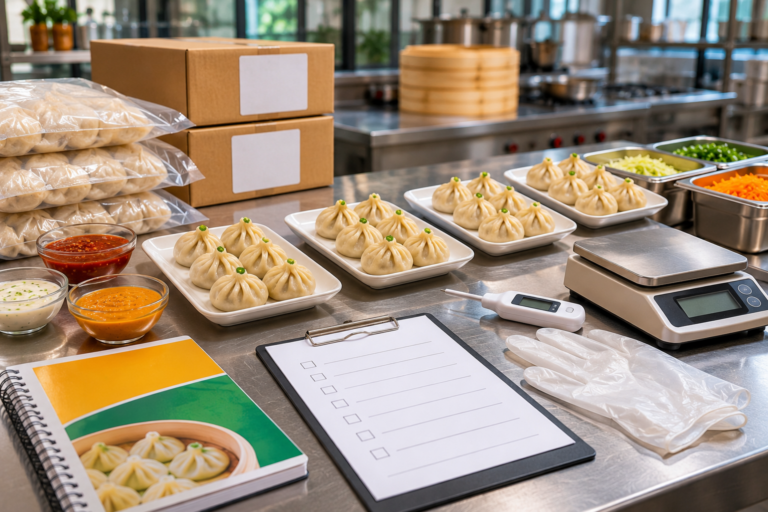
Practise reading a delivery label, recognising a batch code, checking packaging integrity and recording temperatures under the site SOP. Explain why frozen storage, FIFO/FEFO rotation and quarantine of rejected stock are connected but different controls. Ask the employee to locate a named batch in the freezer without opening or handling unrelated cartons unnecessarily.
Day 4: preparation and cooking verification
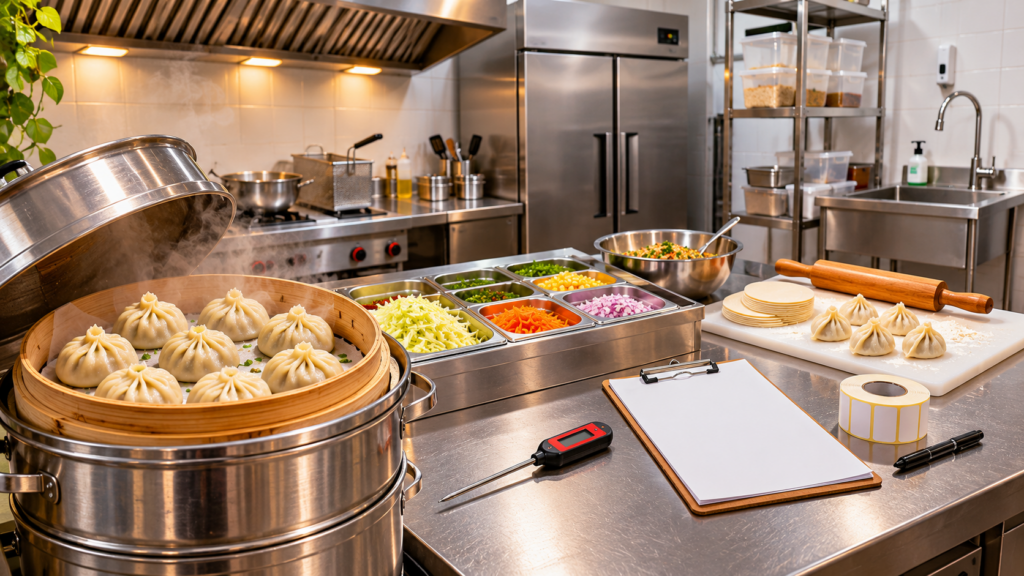
Demonstrate the approved cooking method for each category, including raw versus pre-cooked frozen products, equipment load, timing and any required core-temperature checks. A worker should never substitute an improvised air-fryer or fryer method for a manufacturer’s directions. Use a food thermometer correctly and log exceptions.
Day 5: counter service and packaging
Train the handoff sequence: repeat an order, mark dietary requirements accurately, package sauces with matching lids, verify portions and check the final box before giving it to the guest. Run a role-play for a missed item, a broken box and an order that may have contacted an allergen. Train a calm explanation and an escalation route rather than improvising a discount.
Day 6: supervised rush-hour service
Assign a mentor to supervise one realistic busy shift. Measure preparation consistency, communication and safety decisions, not simply order speed. A fast employee who bypasses sanitation or cooking checks is not ready for independent service. Give immediate, specific feedback and allow another attempt at weak tasks.
Day 7: demonstrate competence
| Assessment | Evidence required |
|---|---|
| Hygiene | Correct handwashing and work-zone practice |
| Allergens | Knows how to check specs and escalate |
| Receiving | Accurate lot, date and storage check |
| Cooking | Follows validated SOP and verifies doneness |
| Service | Correct product, portion and sauce handoff |
| Incident response | Knows when to stop, isolate and notify |
Record strengths, retraining needs and sign-off by an authorised supervisor. This is an internal skill assessment, not a legal certification.
FoSTaC: the formal food-safety training context
FSSAI states that food businesses with state or central licences should have at least one trained and certified food-safety supervisor for every 25 food handlers or part thereof at each premise. FoSTaC provides official training pathways. An internal seven-day induction does not replace the required trained-supervisor arrangement or any other applicable training obligation.
Use FSSAI’s official FoSTaC page for current requirements and courses.
Keep the training alive
Review common service errors and food-safety incidents regularly, and update the SOP whenever a product, supplier, equipment configuration or regulation changes. A practical refresher might ask a staff member to explain one real allergen-sensitive order from receipt to handoff. Document corrective training and monitor whether behaviour actually improves.
For brand-specific business information, visit the Momo Delights franchise page; this guide does not assert that the franchisor promises this exact programme.
FAQ
Can an employee work independently after one week?
Only after demonstrating competence under the business’s requirements; the schedule is a framework, not an automatic pass.
Does internal onboarding replace FoSTaC?
No. Formal food-safety supervisor training and internal SOP instruction serve different purposes.
Should training cover allergens even at a vegetarian outlet?
Yes. Wheat, milk, soy, sesame and nuts can occur in vegetarian food.
For practical franchise and outlet planning, explore Restaurant Rent Sensitivity for a Momo Outlet: Planning Guide and Seasonal Demand Planning for a Momo Franchise Outlet. Check current terms and local operating conditions independently.



Leave a comment