
Aa Reading preferences
This operations guide is written for foodservice managers, café and QSR operators, cloud kitchens, multi-outlet restaurants and franchise partners. It offers a practical 12-part consistency framework, a sample standard operating procedure (SOP) structure, an illustrative scorecard and a corrective-action template. It is not a claim that Momo Delights currently uses each suggested control; the business publishes its own general quality assurance and traceability principles and HoReCa supply proposition, which buyers should discuss directly with the team.
Why do the same momos taste different at different outlets?
Even when two kitchens start with exactly the same dumpling, small differences can change the final plate. One outlet may overload the steamer, another may leave cooked momos waiting before serving, and a third may use a larger sauce portion. A fried or tandoori finish introduces further variation in oil, temperature, coating and waiting time. Transport and cold-chain differences can affect the condition of a supplied product before cooking even begins.
Customer experience is therefore the result of a connected chain:
Product specification → production batch → packing → transport → receiving → storage → cooking → sauce/finishing → holding → packaging → service → feedback.
The food-safety side of this chain is not optional. FSSAI’s hygiene requirements explain that food businesses must implement an appropriate Food Safety Management System (FSMS) and follow applicable Schedule 4 good manufacturing and hygiene practices. A consistency programme should be designed around those requirements rather than replacing them with a subjective taste checklist.
A 12-part momo quality and consistency framework
| Control | What should be standardized | Typical record or evidence |
|---|---|---|
| 1. Approved SKU | Product code, filling, wrapper, declared ingredients | Current controlled specification |
| 2. Supplier and batches | Approved sources, lot identity and substitutions | Purchase order and lot traceability |
| 3. Receiving | Condition, quantity, temperature, packaging | Receiving log and exception record |
| 4. Storage | Approved refrigeration/freezing and stock rotation | Temperature and stock-control records |
| 5. Portion specification | Pieces per plate, sauce amount, garnishes | Recipe card and portion audit |
| 6. Equipment and batch | Approved steamer, pan, fryer and loading size | Equipment SOP and calibration records |
| 7. Cooking endpoint | Validated food-safety criteria for each product | Documented monitoring and corrective action |
| 8. Finishing | Seasoning/coating, sauce and texture standards | Reference card and controlled recipe |
| 9. Holding and packaging | Time/temperature controls and presentation | Service instructions and checks |
| 10. Staff competence | Training and observed practical ability | Training and retraining record |
| 11. Complaints and traceability | Issue capture, lot search and escalation | Complaint register and trace exercise |
| 12. Audit and improvement | Sampling, review, trends and action closure | Outlet checklist and follow-up log |
This is a proposed implementation framework, not a certification or a published Momo Delights operating system. Each outlet should make it specific to the actual products, legal category and service format.
1. Start with one controlled momo specification per menu item
Names like “Veg Momo,” “Paneer Momo” or “Tandoori Momo” are too broad to standardize a kitchen. A usable specification identifies the exact SKU, current version number, intended filling and wrapper, nominal piece size, permitted variations, allergen declaration, packaging, storage condition, cooking state and approved service use.
For example, the published Momo Delights menu includes Classic Veg Momo, Paneer Momo, Veg Kothey Momo and other styles. But a consumer-facing list does not provide the current wholesale specification. Operators should request a dated, version-controlled product sheet and compare delivered batches against that specification.
Where the restaurant makes wrappers and fillings from scratch, use measured batch recipes rather than “some flour,” “one bowl of cabbage” or “a little chilli.” Weigh ingredients, document preparation yields and record any authorised substitutions. Ingredient changes can affect allergens and must not be made casually.
2. Make receiving and cold-chain checks consistent
When frozen or chilled momos arrive, the outlet should verify product name, quantity, lot/batch, labelled dates, package condition and temperature against written acceptance criteria. Receive perishable stock promptly into the correct storage. A carton that looks acceptable can still require investigation if the supplier cannot account for a cold-chain deviation.
Key receiving questions include:
- Does the delivered item match the ordered SKU and the current approved recipe?
- Are packing condition, seal and lot details present and readable?
- Does the product temperature meet its documented specification and applicable requirements?
- Has the product been transported and unloaded under suitable conditions?
- What is the procedure for rejecting a damaged or out-of-spec carton?
- Who records the incident and contacts the supplier?
FSSAI’s inspection checklists provide a structured view of compliance topics across manufacturing and catering operations, while its hygiene requirements cover the underlying FSMS framework. Any concrete acceptance temperature and time limits must be tied to the current applicable rules and product specification rather than invented in a marketing article.
3. Write a product-specific momo cooking SOP
A good SOP must be usable by a newly trained employee during peak service, not merely attractive in a corporate manual. Each menu item should have an approved cooking process covering starting temperature, product status (raw, partly cooked or fully cooked), the permitted equipment, maximum load, cooking sequence, validated centre/doneness requirements, the method of checking and corrective actions.
Illustrative SOP template
| Field | Information to document |
|---|---|
| Document ID/version | SKU, revision number, approval and review date |
| Product starting state | Frozen, chilled or already fully cooked, per verified specification |
| Equipment | Approved steamer, pan, oven/fryer model and setup |
| Batch size | Maximum pieces and tray loading |
| Cooking | Validated sequence, time/temperature controls and endpoint |
| Food-safety check | Method, frequency, responsibility and record |
| Finishing | Approved sauce, garnish, oil or coating quantities |
| Service | Required plate presentation and permitted holding conditions |
| Exception | What to do if the result is out of specification |
This table is a documentation example, not a complete validated cooking SOP. A universal steam time is unsafe because filling, product state, size and equipment vary. A frozen raw-filled momo cannot be treated as though it were an already-cooked chilled dumpling. Training should include the difference between cooking raw product and reheating an already-cooked product.
4. Control portions, sauces and menu presentation
Two plates with identical momos can still disappoint customers if one contains substantially less chutney or a different number of pieces. Standardise the declared serving count, approved cup size, topping quantity and packaging. If the menu item calls for a crisp kothey finish, test whether the plate arrives with a pan-contact surface that is browned but not overcooked.
For foodservice costing, this also matters financially: over-portioning sauce, extra dumplings or unused packaging reduces contribution margin. Momo Delights’ existing article on adding momos without a specialist chef provides operating background. Real kitchen standards should align with customer expectations and verified food-safety requirements, not simply the cheapest possible serving.
5. Keep tandoori, kothey and kurkure finishes consistent
The same base momo can be finished in multiple ways, but each adds separate sources of variation:
| Finish | Potential variation | Control to test |
|---|---|---|
| Steamed | Wrapper softness and filling heat | Validated steam conditions and portion size |
| Kothey | Browned surface and soft upper wrapper | Consistent pan-contact area, moisture and serving time |
| Fried | Exterior crispness and oil-related factors | Approved oil practice, load, heat and finishing SOP |
| Kurkure | Coating thickness and breakage | Measured coating quantities and adhesion |
| Tandoori | Marinade coverage, roast colour and spice | Weighed ingredients, approved finish and quality checks |
These are generic culinary control suggestions, not assertions about Momo Delights’ actual kitchen methods. A restaurant shouldn’t assume it can turn an arbitrary frozen SKU into any of these styles without obtaining supplier approval and validating food-safety endpoints.
6. Standardise takeaway and delivery experiences
Immediate dining and a 20-minute takeaway journey can produce different textures. Crisp coatings may soften when steam is trapped, and sauces may leak or soak into wrappers. Trial packaging as part of product development and assess the finished item at realistic pickup/delivery conditions. Record any changes in texture, temperature and presentation that need improvement.
Packaging tests need to respect food safety, including safe materials, temperature requirements and time limits. A dish that looks visually better after an extended delay is not necessarily microbiologically safe. Follow appropriate product specifications and outlet SOPs rather than adopting an unvalidated holding time from a competitor.
7. Use training that verifies actual competence
A written recipe alone doesn’t establish that every cook can perform it. Combine short training material with observed practice. Verify that team members can identify each SKU, check storage temperatures, load equipment correctly, perform approved doneness checks, portion sauce and know when to stop service or escalate an issue.
Retraining should be triggered by meaningful recipe updates, equipment changes, repeated mistakes, safety incidents or poor audit results—not solely by a fixed annual calendar. FSSAI’s published Schedule 4-related guidance addresses training records, documented SOPs and periodic review in covered operations. Confirm which current provisions apply to your business.
8. A practical 100-point outlet consistency scorecard
The following is an illustrative internal improvement tool, not an official FSSAI rating and not the Momo Delights brand’s actual audit standard. Legal and food-safety requirements remain independent pass/fail criteria.
| Review area | Suggested weight | Evidence |
|---|---|---|
| SKU, recipe and current specification | 15 points | Document version and actual ingredients match |
| Receiving and storage discipline | 20 points | Current temperature/lot records and observations |
| Cooking SOP execution | 20 points | Observed process and validated cooking records |
| Portion and sauce consistency | 15 points | Measured sample plates |
| Texture, presentation and takeaway trial | 10 points | Controlled sensory review |
| Staff training and supervision | 10 points | Practical competency checks |
| Complaint response and traceability | 10 points | Documented response drills and records |
| Total | 100 points | Trend results across outlets and review dates |
For each category, use documented evidence and a consistent scoring rubric. Track scores over time and keep corrective actions. Do not average away a critical food-safety failure with strong presentation or customer-service scores. A failed legal or safety requirement should trigger the appropriate hold, investigation and corrective action.
9. What happens when an outlet fails a quality check?
Effective quality systems do more than collect poor scores. They identify the immediate issue, protect customers and products, investigate the cause, change the process when needed, train staff and verify that the fix works. A simple corrective-action record might include:
| Field | Example entry (fictional) |
|---|---|
| Issue | One outlet reports an unusually high wrapper-breakage rate |
| Immediate control | Segregate affected product and follow approved quality decision process |
| Potential causes to investigate | Changed batch, transport damage, thawing deviation or handling |
| Evidence | Batch/lot codes, temperatures, sample records, staff observations |
| Owner and due date | Named operations/quality representative and agreed review date |
| Verification | Repeat batch test under normal service conditions |
| Closure | Document evidence that the problem was resolved |
Do not assume wrapper defects always have the same cause. The issue may originate in manufacturing, logistics, storage or final preparation. The chain of records helps distinguish them. For problems involving possibly unsafe food, invoke the appropriate FSMS controls and regulatory reporting or withdrawal procedures when required.
10. Product traceability and recall readiness
Multi-outlet operators need a way to determine which locations received a particular batch and what stock remains. A workable traceability system connects the product SKU and lot to the supplier, receipt date, storage location and any relevant delivery or usage records. A complaint about one carton should not require guessing which other outlets may have received the same batch.
FSSAI’s food recall information explains the responsibility of food-business operators to withdraw non-compliant or unsafe food and notify authorities where required. A documented traceability/recall plan is a food-safety capability, not a marketing badge. Do not claim a tested recall system for a particular company without evidence.
11. Use consistent customer-feedback categories
A complaint that “the momos weren’t good” is hard to act on. Capture the specific item, outlet, purchase time, service channel, lot/batch where available, and the actual problem: dry wrapper, leaking filling, sauce change, underheated centre, missing item or packaging failure. Separate subjective flavour feedback from possible safety concerns.
Look for repeated trends. If the same batch generates similar texture problems across outlets, examine the supply chain; if only one outlet has the issue, investigate the final cooking or handling process. The goal is to learn from evidence rather than blame individual team members without checking facts.
12. Review changes before launching them network-wide
Small ingredient, cooking-equipment or sauce changes can have large consequences across several branches. Use a change-control process that documents the reason, checks allergen and food-safety implications, trials the change, obtains approval, updates specifications and trains staff before rollout.
For example, swapping a wheat wrapper for a grain blend alters more than appearance: it can change dough handling, texture and allergen claims. Switching to a new steamer changes how the batch heats. A new takeaway box may change condensation. Review these items as systems rather than isolated menu decisions.
Questions to ask a momo foodservice supplier
When evaluating a central manufacturer or wholesale partner, ask for the current written specification, declared storage condition, cooking procedure, allergen details, lot traceability, complaint/escalation process and delivery-service terms. Ask whether the supplier can provide representative samples across more than one batch, and how product changes are notified.
Momo Delights describes a foodservice and quality proposition through its HoReCa/B2B page, quality and traceability page, and ingredient-sourcing page. These are appropriate starting points for an enquiry, but a prospective buyer still needs product-specific documents and evidence before relying on any commercial or quality claim.
For related restaurant planning, see Momo machine versus ready-made momos and how restaurants can add momos without a specialist chef. Those explain the sourcing decision; this article focuses on controlling the chosen system across outlets.
Multi-outlet momo quality FAQs
How can restaurants make momos taste consistent across outlets?
Use approved product specifications, controlled ingredients, validated cooking methods, measured portions, staff training and repeated checks across branches.
Does central manufacturing guarantee identical taste?
No. Central production may reduce one source of variation, but storage, cooking, finishing and service still affect the customer experience.
What is a momo SOP?
A documented step-by-step operating procedure for a particular product and task, including equipment, process controls, quality expectations and corrective actions.
Should restaurants use one cooking time for all momo varieties?
No. Product size, raw versus cooked state, filling, starting temperature and equipment change the validated procedure.
How do you test portion consistency?
Measure piece count, approved serving weight where relevant, sauce portion and garnishes against a controlled menu specification.
What is the role of batch traceability?
It helps identify which stock, outlets and shipments may be affected by a product complaint or possible recall.
How should a franchise audit food quality?
Use a consistent scorecard with evidence, while handling food-safety compliance as separate mandatory pass/fail requirements.
Do frozen supplied momos need a cooking SOP?
Yes. Their initial raw or cooked status, validated cooking directions and storage conditions must be documented for each SKU.
Can customer ratings alone measure quality?
No. Reviews are useful feedback but do not replace food-safety records, product specifications, controlled tasting or operational checks.
Where can restaurants enquire about Momo Delights supply?
Use the official foodservice enquiry page and request current approved product and process information.
Sources and editorial note
- FSSAI — Hygiene Requirements: mandatory FSMS, GMP and GHP framework.
- FSSAI — Food Safety Inspection Checklists: compliance-assessment themes.
- FSSAI — Food Recall: regulatory traceability and withdrawal context.
- FSSAI — Published Schedule 4-related provisions: SOPs, training, audit and records in covered operations; confirm latest applicability.
- Momo Delights — Quality Assurance & Traceability: brand’s published quality positioning.
- Momo Delights — HoReCa/B2B Supply: official enquiry channel for current supplier documentation.
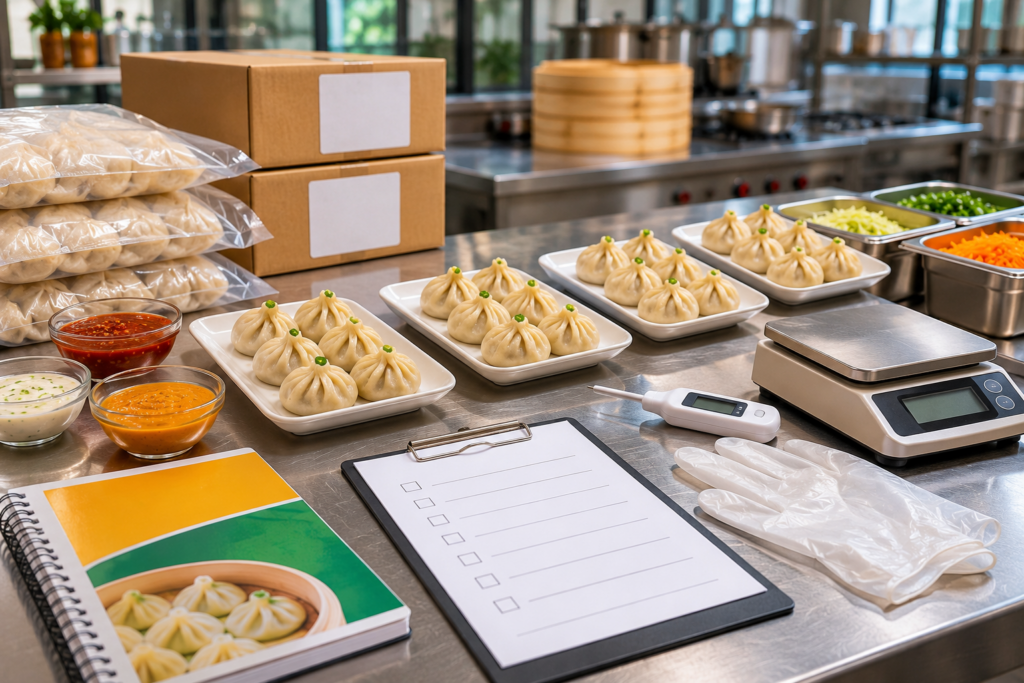
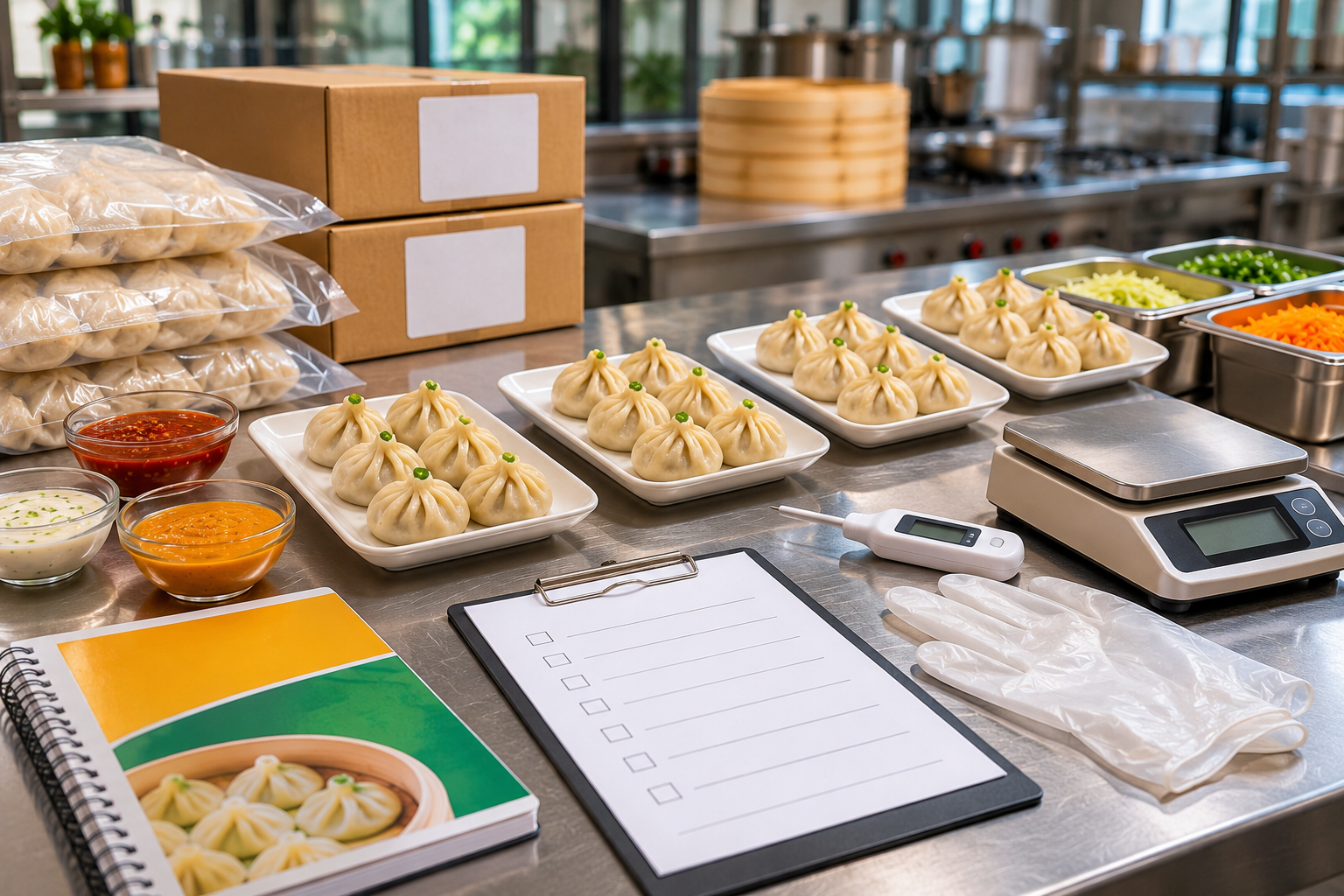
Editorial disclosure, 1 November 2026: This is an independent educational operating framework. All scorecard weights, example records and proposed procedures are illustrative; they are not presented as existing Momo Delights practices, inspections, certifications or audit scores. The featured artwork is AI-generated and does not depict a verified Momo Delights facility. Legal compliance and product-specific safety controls require appropriate qualified review before operational use.