

Aa Reading preferences
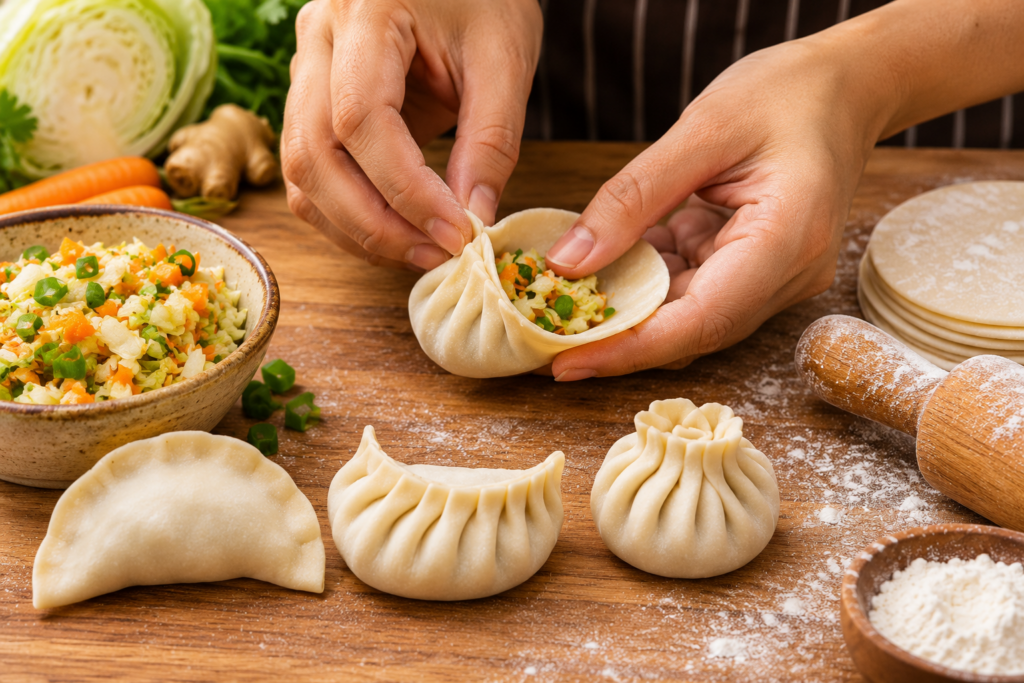
Beautiful pleats make a momo look special, but they are not a requirement for a satisfying dumpling. When you are learning, a dependable half-moon seal is often more useful than trying to make twelve neat folds with dough that is drying in your hand.
This method focuses on what actually matters: a thin, workable wrapper, a filling that does not wet the rim and an unbroken join from one end of the crescent to the other.
Prepare the wrapper before touching the filling
Roll a small dough ball into a round that is thinner at the perimeter and a little sturdier in the centre. A rough circle is fine; extremely thin spots and cracked edges are the real problems. Keep remaining dough covered so the surface stays supple.
If the wrapper springs back immediately, it may need a little more rest. If the edges break when folded, it may be too dry or have been over-floured. See the wrapper troubleshooting guide for dough-specific fixes.
The half-moon seal, step by step
- Place the filling. Put a small spoonful in the centre, leaving a clean border all around.
- Lift one edge. Bring one side of the wrapper over the filling to meet the opposite side.
- Join the centre. Pinch the middle gently, pushing out any obvious air pocket without squeezing filling into the seam.
- Seal outward. Work from the middle to each tip, pressing the two clean edges together.
- Check the join. Look for gaps, wet patches or filling caught between layers.
- Set it down carefully. Place the finished crescent on a lightly dusted or suitable food-safe surface and keep it covered until cooking.
Done well, the result is a simple crescent with a neat sealed rim—no decorative pleats required.
Should you wet the edge?
It depends on the dough. Fresh, slightly tacky momo dough may seal with firm pinching alone. A wrapper that has dried a little can sometimes benefit from a tiny dab of water. Too much water creates a slippery rim and weakens the join, so start with the smallest amount and test one dumpling before wetting a whole batch.
How much filling is too much?
There is no universal spoon measurement because wrapper diameter and thickness vary. The useful test is whether the edges meet naturally without stretching over a dome of filling. If they do not, reduce the portion. You can always use the extra filling in the next wrapper; you cannot fix a torn one by squeezing harder.
Wet cabbage or mushrooms can be another issue. Squeeze or cook off excess moisture as appropriate for your recipe, and let any sautéed filling cool before assembling.
Cooking and removing the finished crescents
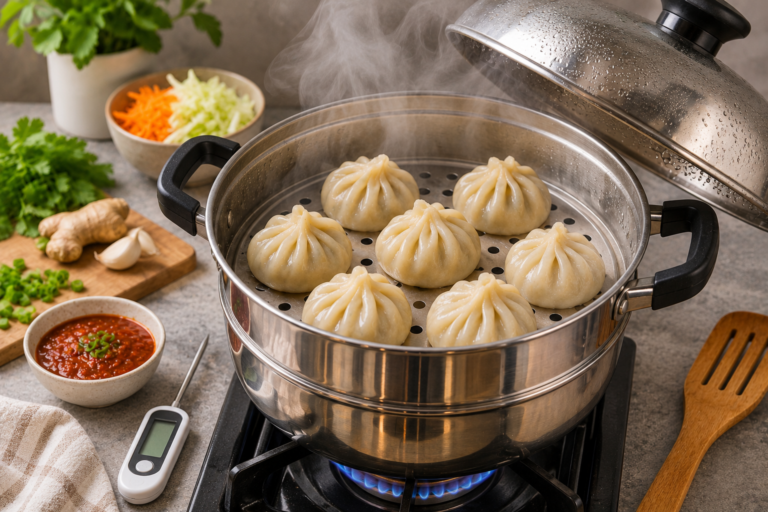
Place the dumplings with a little space between them on an oiled or lined steamer surface. Do not pile raw crescents together. Steam according to the recipe and filling until fully cooked; commercially frozen products require their own label instructions. Lift finished momos gently with an appropriate utensil so the sealed rim is not pulled apart while still hot.
For raw meat or poultry fillings, use a food thermometer and the applicable safe cooking temperature; a translucent-looking wrapper alone does not prove the centre is safe.
When to start learning pleats
Once your basic crescents survive steaming and have a pleasant wrapper-to-filling balance, try one or two small folds near the ends. A good seal is a practical craft. Decorative shape can come later without changing the quality of the filling.
Common questions
Can half-moon momos be pan-fried?
Yes, provided the fold holds and the cooking method fully cooks the filling.
Do I need a dumpling press?
No. Clean hands and manageable dough are enough.
Why does the seam reopen during steaming?
Common causes include filling on the rim, dry dough, overstuffing and insufficient pressure along the seal.
Further reading: Momo Delights — preventing wrapper tears; FoodSafety.gov — safe cooking temperatures.
For more hands-on momo ideas, explore Meaning of Momo Pleats: Shape, Craft and Practical Purpose and Momo Delights menu. Always check dietary needs and ingredient labels.



Leave a comment