
Aa Reading preferences
Momo Delights’ published franchise overview describes an indicative 120–250 sq. ft. outlet format. That figure provides a starting point for site discussions, not approval of every space within that range. Actual kitchen layout, utilities, storage, signage, lease rights and compliance must be evaluated for the proposed concept. This article provides a practical momo franchise location-selection checklist, a weighted scoring framework and a way to test rent sensitivity without fictional promises of revenue.
For the brand’s overall fee and FOFO (Franchise Owned, Franchise Operated) proposition, consult its published franchise article and official franchise enquiry page. This guide concentrates on choosing the actual site, rather than repeating a general explanation of franchise fees or support.
First, define the actual momo outlet format
Restaurant sites cannot be evaluated sensibly until you know what the outlet needs to do. A compact takeaway-heavy momo counter, an express QSR with a few seats and a dine-in restaurant have different frontage, storage, power, ventilation, staffing, waste-handling and delivery requirements. Ask the brand for a current approved format specification and equipment list before looking for a property.
For Momo Delights, the published model references a compact outlet footprint, central product systems and partner-managed daily operations. This may influence the layout, but a franchise partner should not conclude that central supply eliminates all on-site storage, cooking or hygiene requirements. Obtain documented conditions for the exact equipment, cold storage and menu services intended.
| Format question | Why it matters |
|---|---|
| How many orders at peak hour? | Counter capacity, steamer/fryer loading, staff movement |
| How much dine-in seating? | Space allocation, cleaning and customer circulation |
| How many delivery orders? | Rider pickup area, packing space and order staging |
| What foods require hot finishing? | Power/gas, exhaust and fire-safety planning |
| What chilled or frozen products are stored? | Refrigeration/freezer footprint and receiving controls |
| What branding is permitted? | Visibility and permissions under the actual lease/local rules |
Footfall vs relevant customers: measure both
A street can be busy while still attracting very few people who will buy the proposed menu at the proposed time. A location near students may perform at different hours from one near offices or housing. For a momo concept, explore demand for quick snacks, shareable meals, takeaway and delivery, along with actual affordability and food preferences.
Count footfall directly. Visit each candidate property on at least one weekday and one weekend, including times relevant to lunch, after-school/evening snacks and dinner. Count passers-by in short, comparable intervals and note who can actually access the entrance. If the property is on a road where traffic cannot stop safely or pedestrians cannot cross easily, heavy vehicle movement may offer little value.
A current Indian restaurant location-scouting checklist similarly emphasises catchment, footfall, competition, technical feasibility and lease conditions. Such operator guides are useful frameworks, not statistically proven conversion rules for Momo Delights or any city.
What to record during a site visit
- Observed pedestrian count by time, with clear observation duration.
- Relevant visitors: students, office workers, shoppers, nearby residents and families.
- Busy periods versus quiet periods, including weekday/weekend differences.
- Nearby complementary businesses such as colleges, supermarkets, cinemas or offices.
- Ease of crossing the road, stopping briefly, finding the entrance and collecting an order.
- Signs of temporary activity or a one-off event that could inflate the observed count.
Do not multiply a passing-traffic count by an invented “standard conversion rate” and call it a revenue forecast. Use conservative observed and researched assumptions, then validate them through local trials and the franchisor’s site-review process.
Frontage, visibility, accessibility and delivery pickup
For a fast-service outlet, customers should be able to identify the brand, find its entrance and understand what it sells without difficulty. Assess the sightline in both directions, the permission to install signage, window visibility and competing signboards. A visually prominent upper-floor property may not be comparable to a ground-floor unit for takeaway.
Equally important is physical access. Consider steps, pavement condition, people with mobility needs, lawful parking or stopping, wet-weather access and road crossings. A location that relies on delivery must give riders a sensible collection process so pickup traffic does not block walk-in guests or food preparation.
Map the likely delivery catchment using the actual platforms and service constraints relevant to the property. A theoretical radius drawn on a map does not guarantee that an aggregator currently serves all addresses within it, or that delivery times remain stable during traffic peaks.
How to evaluate nearby competition
Competition can indicate local appetite for quick-service food, but too many undifferentiated offerings can also make customer acquisition expensive. Look at other momo sellers and broader snack alternatives—chaat, rolls, burgers, fried snacks and Chinese/Asian quick bites. Record advertised pricing, menu variety, opening hours, service model and visible customer activity without relying on fabricated ratings or unsupported “number-one” claims.
Ask whether the candidate site would create a distinctive convenience advantage: nearer to a busy office cluster, easier to collect from, more visible at evening snack time or better situated for a neighbourhood delivery market. The answer should come from actual observation and customer research.
Kitchen and technical feasibility: check before signing
Food safety is a hard constraint, not a point that can be offset by excellent footfall. The FSSAI hygiene requirements describe the need for suitable hygiene, food-safety management and appropriate site design. The regulator’s inspection checklist framework covers design/facilities, operations, maintenance and sanitation, personal hygiene and training, among other topics.
At a site visit, verify at least the following, with qualified professionals where required:
- Permitted use: Commercial foodservice activity is lawful under the property and local rules.
- Electricity: Confirm available sanctioned load for the intended equipment and any required upgrade.
- Ventilation/exhaust: Assess compliant exhaust route, odour management and landlord permissions.
- Water: Ensure a suitable, dependable supply and required treatment where relevant.
- Drainage: Evaluate wastewater handling, grease and cleaning requirements.
- Cold storage: Locate refrigeration/freezing equipment and safe product receiving without blocking service.
- Cleaning and hand hygiene: Confirm usable wash facilities, food-safe surfaces and pest-control feasibility.
- Fire and life safety: Confirm applicable requirements for cooking equipment, access, equipment servicing and emergency procedures.
- Waste handling: Check segregation, storage and authorised disposal arrangements.
- Accessibility and exits: Ensure lawful safe movement for customers and employees.
Do not infer that every space smaller than 250 sq. ft. has the same legal obligations. Requirements depend on actual use, premises, local authority and equipment. Relevant business registrations and food licences should be checked through FSSAI FoSCoS and the appropriate local agencies, with current rules verified rather than an old checklist copied blindly.
What rent can a momo outlet afford?
Affordable rent is relative to realistic sales and contribution, not simply rupees per square foot. Property A may have higher rent but better visibility; property B may be cheaper but require more advertising or produce fewer orders. Compare base rent, common-area charges, property-related taxes where applicable, deposit, lock-in, annual escalation, maintenance, signage costs and installation expenses.
For a simple starting measure, occupancy cost ratio = monthly occupancy-related costs ÷ monthly net sales × 100, with a consistent definition of both. This ratio is a diagnostic rather than a guarantee of success. It may change widely by concept, city, delivery mix and margins.
Illustrative rent sensitivity—not a revenue forecast
| Hypothetical monthly net sales | Hypothetical monthly rent | Rent / sales ratio |
|---|---|---|
| ₹3,00,000 | ₹45,000 | 15% |
| ₹4,00,000 | ₹45,000 | 11.25% |
| ₹5,00,000 | ₹45,000 | 9% |
These numbers are deliberately hypothetical and do not describe actual Momo Delights revenue, rent or margins. They show how a fixed occupancy cost becomes more or less burdensome depending on sales. Include common-area charges and other property expenses in your real model, and do not treat the table as a recommended sales target.
Before signing, have a competent adviser examine the lease term, rent escalation, deposit return, permitted use, sublease/franchise permissions, fit-out consent, signage, repairs, exit rights, renewal and responsibility for restoring the premises.
A 100-point momo franchise site scorecard
Compare at least two or three genuine candidate sites using the same scoring rules. The weights below are a proposed decision aid for this guide, not an official Momo Delights scoring system or an empirically validated model.
| Factor | Weight | What good evidence looks like |
|---|---|---|
| Target catchment fit | 20% | Observed and researched demand from likely customers |
| Relevant footfall across actual trading hours | 20% | Documented repeated counts, not broker assurances |
| Rent and lease affordability | 15% | Full cost schedule and conservative sales sensitivity |
| Frontage, visibility and access | 15% | Clear legal signage, accessible entrance and collection flow |
| Technical and operating feasibility | 15% | Verified utilities, layout, food safety and approvals |
| Competition and complementary businesses | 10% | Actual visits and observed customer patterns |
| Inbound supply and delivery logistics | 5% | Practical stock receiving and rider pickup |
| Total | 100% | Use same data standards across sites |
Give each factor a score from 1 (poor) to 5 (excellent). Multiply the rating by its percentage weight and divide by 5 to generate a contribution in percentage points. Add all contributions for a maximum score of 100. Keep the underlying notes, date and evidence links, not just the score.
Hard-gate warning: A site that cannot legally be used for the proposed food operation, lacks safe utilities or is rejected by the brand’s formal site approval process should not be rescued by a high numerical score. Address critical legal and safety issues before using the scorecard for comparison.
One-week practical location-research plan
A short structured field-study can prevent a rushed lease decision. The timings below are examples to adapt to the local market, not a claim that every momo outlet shares the same peak periods.
- Day 1 — Define the outlet: Obtain the required layout, equipment and site criteria from the franchisor; list non-negotiable conditions.
- Day 2 — Shortlist: Identify several legal commercial premises and compare the full rent, deposit and fit-out obligations.
- Day 3 — Weekday observations: Count relevant footfall at more than one time and record access and competitor activity.
- Day 4 — Technical checks: Ask the landlord for documents and arrange qualified review of electrical, ventilation, water and fire-related feasibility.
- Day 5 — Delivery logistics: Check real platform service areas, potential rider flow, packing layout and stock receiving.
- Day 6 — Weekend observations: Repeat footfall counts and compare with weekday patterns. Note local events that may distort the count.
- Day 7 — Score and challenge: Rank viable sites, run conservative sales/rent scenarios, review risks with the franchisor and seek legal/financial advice before commitment.
Retain a simple evidence file containing dated photos, counting notes, proposed layout, landlord documents, utility details and commercial terms. This is considerably stronger than selecting a site from pictures and a broker’s verbal promise.
What should be in a franchise site approval request?
An effective submission to a franchisor includes the exact address, street-level photographs, dimensions, entrance and frontage, floor plan, power and water details, exhaust feasibility, current property use, proposed trading hours and commercial terms. Add location observations, estimated customer mix and any relevant local permissions.
For Momo Delights, the process should begin by confirming current site criteria on the official franchise page or directly with its authorised team. A blog reader should not interpret the published 120–250 sq. ft. figure as automatic permission to occupy any particular unit.
Seven red flags to investigate before paying a deposit
- The landlord cannot document the right to lease the space for the intended business.
- Food preparation or required exhaust installation appears prohibited or physically infeasible.
- The quoted rent omits substantial common-area, maintenance or fit-out charges.
- Traffic looks excellent in one short visit but is poor at intended service times.
- Access is dangerous, difficult or dependent on unlawful stopping or signage.
- Freezer, handwash, cooking and packing areas cannot fit while meeting applicable safety rules.
- The prospective franchise agreement and property lease impose inconsistent obligations or timelines.
These are reasons to verify facts and obtain professional advice, not claims that any specific listed Momo Delights outlet has such issues. Site suitability should be assessed on a property-by-property basis.
Why compact format does not automatically mean low operating risk
A small outlet can reduce certain occupancy and fit-out needs, but the same limited footprint can create storage and capacity bottlenecks. If a queue blocks the fryer or orders accumulate without a designated rider pickup area, the space can limit sales even with strong local demand. Small kitchens also need proper hand hygiene, cleaning, receiving and food safety.
A FOFO franchise partner generally manages day-to-day operations. Review the existing Momo Delights model overview for the brand’s published responsibilities, supply framework and commercial structure; then request current contract terms. No outlet format, location score or franchise brand can guarantee a particular return on investment.
Frequently asked questions about momo franchise locations
What is the best location for a momo franchise?
The best site is one where relevant demand, technical feasibility, rent, accessibility and operating capacity align. A busy street alone is not enough.
How much space does a Momo Delights outlet need?
The brand’s published franchise overview references approximately 120–250 sq. ft. The exact proposed site needs formal approval and functional review.
Should a momo franchise be near a college?
It could be attractive if the location fits student demand and pricing, but academic schedules, competition, rent and evening demand must be researched.
Is a food-court location better than a high street?
Neither is universally better. Compare contractual charges, customer mix, opening restrictions, operating constraints and realistic sales.
How do I estimate footfall?
Perform repeated, timed counts at the exact frontage during relevant weekdays and weekends; record accessible pedestrians rather than using a vague traffic impression.
How do I decide if rent is too high?
Model full occupancy costs against conservative net sales and expected contribution, including other operating obligations.
What must I verify before signing a lease?
Permitted use, ownership/lease rights, fit-out approval, exhaust, power, water, signage, applicable safety requirements, deposit, escalation and exit provisions.
Can a site pass the scorecard but still be unsuitable?
Yes. Legal, food-safety and technical conditions are pass/fail requirements and should not be offset by a numerical score.
Does a good location guarantee franchise profits?
No. Sales execution, food cost, payroll, rent, competition and operating quality all affect results.
How do I request Momo Delights site approval?
Use the official franchise enquiry page and ask the brand’s authorised team about its current site-review and approval process.
Research sources and disclosures
- Restaurant Daily — Restaurant Location Scouting Checklist for India (2026): catchment, observation, feasibility and lease framework.
- FSSAI — Inspection Checklists: design, operational and hygiene-related checks.
- FSSAI — Hygiene Requirements: food safety management and premises practices.
- FSSAI — Food Business Registration: official regulatory entry point; current eligibility must be checked.
- Momo Delights — Published Franchise Model Overview: the brand’s indicative compact format and general operating proposition.
- Momo Delights — Franchise Enquiry: official contact for current criteria and approval process.
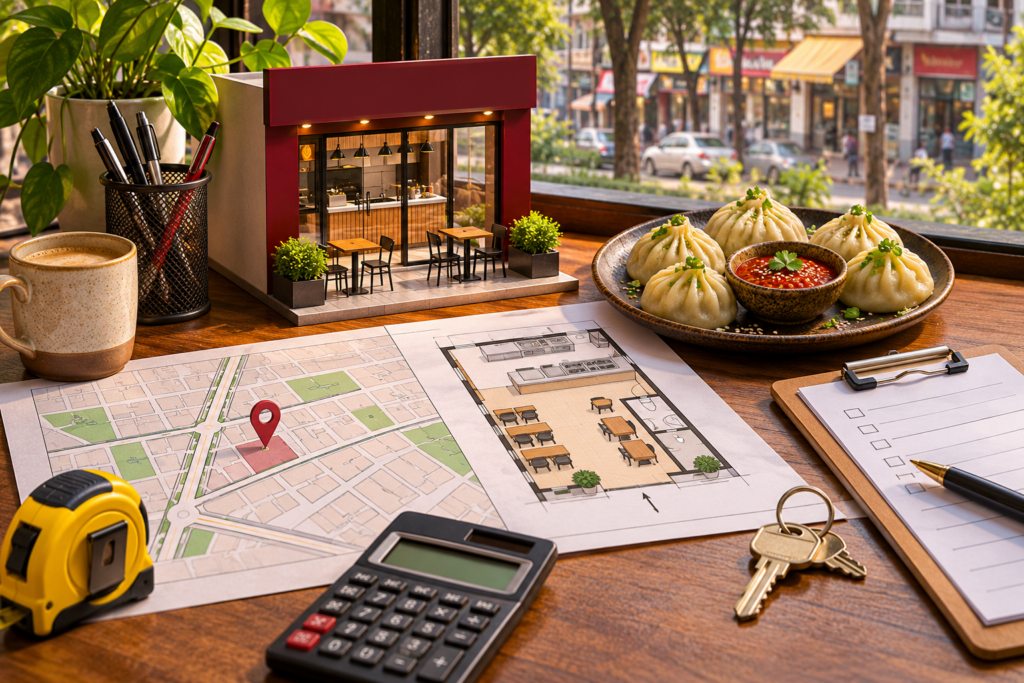
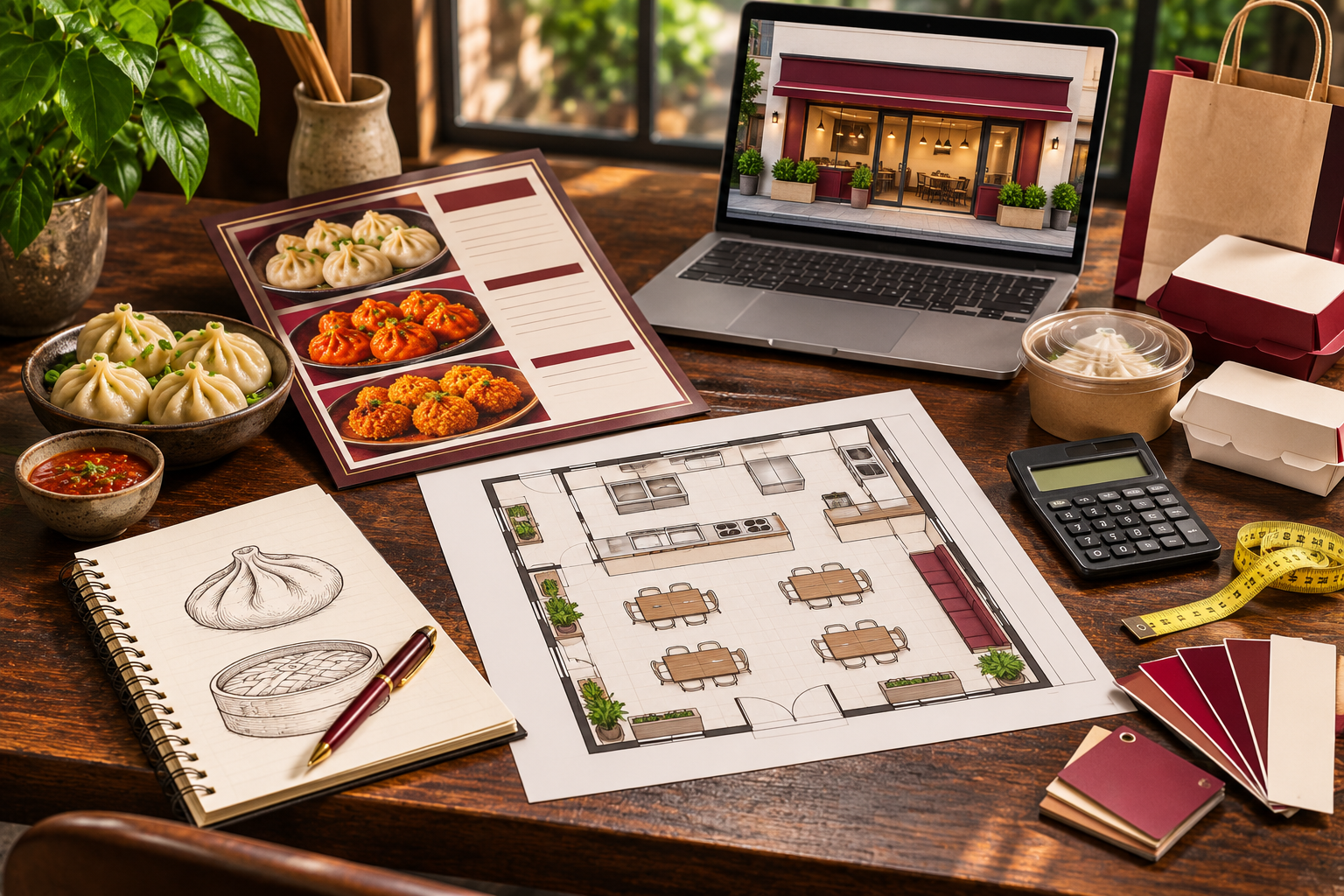
Editorial and financial note, 1 November 2026: Weighted scorecard, fieldwork timetable, rent/sales amounts and assumptions are examples developed for education, not Momo Delights site approval criteria, forecasts or guarantees. A qualified legal, technical and financial review is necessary before committing to a property. The featured image is a conceptual AI-generated scene and does not portray an existing property or an actual approved store design.