Aa Reading preferences
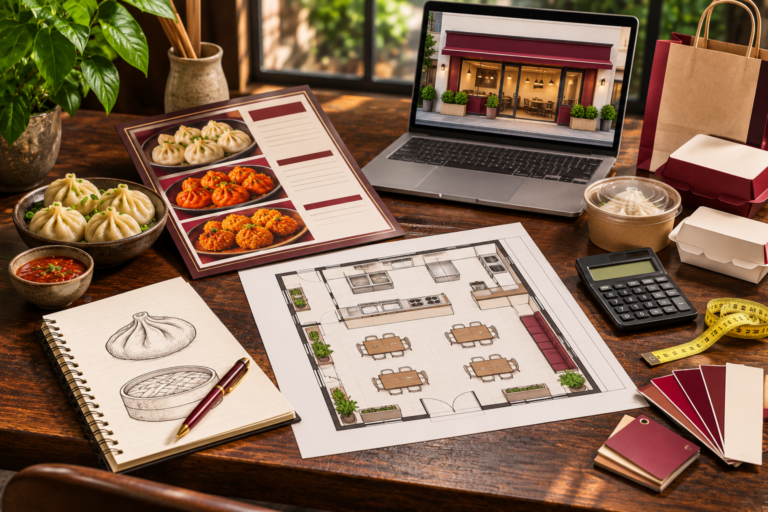
Momo franchise cost in India is more than a franchise fee. The real investment includes the outlet setup, space, equipment, opening stock and the cash needed to run the business before sales become consistent. A successful investment decision starts with a clear cost structure—not a headline number.
At Momo Delights, our published FOFO franchise core model is ₹10 lakh: ₹3 lakh for the brand licence, onboarding, training and operating framework, and ₹7 lakh for the turnkey outlet setup. The model also describes 0% sales royalty, with separately identified brand-related contributions. Property deposits, rent, working capital, applicable taxes and any site-specific requirements need to be budgeted separately. Your final requirements follow the approved outlet format and written commercial proposal.
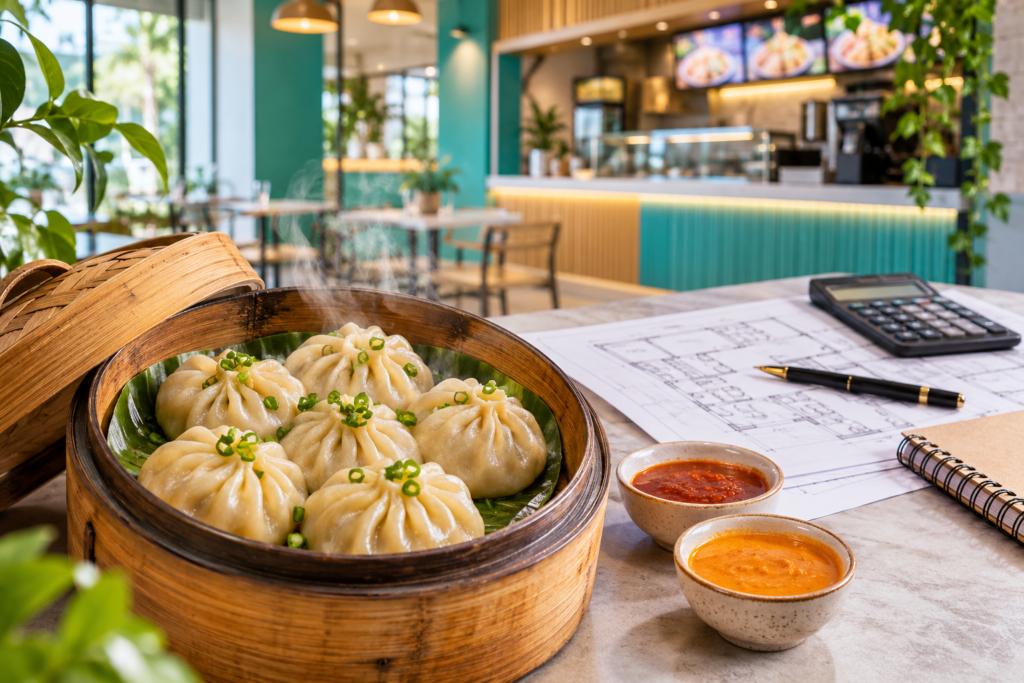
Our approach to building a momo business is Healthy. Tasty. Organised. We combine chef-driven Himalayan-inspired food with centralised product systems, operational standards and franchise support. This guide explains how investment is structured, how to evaluate a location and what daily sales and cost control mean for an outlet’s long-term sustainability.
In this guide: investment components, our FOFO format, outlet-model decisions, a practical opening-capital worksheet, operating margins, break-even calculations, compliance and a franchise-readiness checklist. Research and article review: 22 November 2026.
How much does a momo franchise cost in India?
There is no single amount for every kind of food outlet. A street-facing takeaway counter, a compact QSR, a cloud kitchen and a full dine-in restaurant need different premises and operating systems. Franchise investment must therefore be assessed by approved format, what is included and the cash needed beyond opening day.
Momo Delights franchise investment: our published FOFO core model
Our structured Franchise Owned, Franchise Operated (FOFO) approach is designed for partners who want to own and manage a Momo Delights outlet with an established food, supply and operating framework. The published core package is:
| Core franchise component | Published amount | What it covers |
|---|---|---|
| Brand licence and onboarding | ₹3,00,000 | Brand licence, onboarding, training and operating framework |
| Turnkey outlet setup | ₹7,00,000 | Defined fit-out, fixtures, equipment, branding and launch setup under the agreed scope |
| Core FOFO model | ₹10,00,000 | Combined core package; other premises and operating needs are assessed separately |
Outlet format: our published core format describes approximately 120–250 sq. ft., subject to site suitability and approval. The FOFO structure describes 0% sales royalty, a ₹10,000/month Brand Growth Fund, and a ₹10,000/month optional Local Sales Booster. A zero-percent royalty is distinct from recurring contributions and operating expenses.
For partners, the important distinction is between the core franchise package and the complete capital requirement. The latter also depends on rent, deposit, local site works, taxes, inventory, staffing and working capital. Use the Momo Delights FOFO model guide for the detailed responsibilities and inclusions, and the official franchise programme for the appropriate site-specific discussion.
What falls inside the package—and what needs a separate budget?
| Core model components | Site-specific or operating requirements |
|---|---|
| Brand onboarding and defined operating framework | Property security deposit and rent |
| Agreed turnkey setup, equipment and signage scope | Additional property works or permissions outside the agreed scope |
| Defined training and launch components | Working capital, payroll and utility bills |
| Specified brand systems and supply arrangements | Stock purchases, freight and other recurring expenses |
Use this as a planning distinction, not as a substitute for the current itemised package document. Costs should never be counted twice, and an omitted expense should not be hidden behind the words “turnkey setup.”
How outlet format changes the investment decision
| Operating format | What to evaluate | Main commercial trade-off |
|---|---|---|
| Compact takeaway / kiosk | Frontage, queues, prep space, safe cold storage and rent | Smaller space can reduce some costs but can constrain capacity |
| Compact branded QSR | Walk-in demand, delivery mix, equipment layout and staffing | Broader service capacity requires disciplined execution |
| Delivery-first kitchen | Packaging, platform fees, delivery times and repeat demand | Reduced dining area, but higher dependence on digital orders |
| Dine-in café or restaurant | Seating, service staffing, fit-out and sustained occupancy | More customer occasions, alongside greater fixed costs |
Not every format is part of every franchise programme. The correct investment comparison is between formats actually offered and approved, using their complete scope and recurring obligations—not assumed industry averages.
India’s momo franchise opportunity: market data and business reality
India’s organised foodservice sector has become a significant opportunity for entrepreneurs, including specialist snack and quick-service concepts. Redseer’s July 2026 research estimates India’s foodservice market at approximately US$90 billion and projects growth to around US$150 billion by 2030. The consultancy estimates organised foodservice growth of roughly 17–18% annually, compared with slower growth for the unorganised market. These are research estimates and forecasts for the overall foodservice industry—not measured growth for momo franchises specifically.
The opportunity is meaningful, but a growing sector does not remove basic restaurant risks. Customer demand must be won street by street. Location rent can absorb gross margin, delivery-platform economics can differ sharply from walk-in sales, and poorly managed refrigeration or inconsistent food quality can undermine both profitability and trust.
What makes a momo concept commercially attractive?
- A recognisable product: Momos already have established consumer familiarity across many Indian cities, reducing the need to explain the core dish.
- Multiple service occasions: Takeaway snacks, lunch, family sharing and delivery can create different demand windows.
- Focused preparation: A well-designed menu may share equipment and ingredients across steamed, pan-seared and other variations.
- Opportunities for standardisation: Portion control, filling specifications, sauce quality and food-safety procedures can be taught and monitored.
- Compact formats: Some franchises offer smaller footprints, although usable prep space, storage and safe workflows remain essential.
None of these advantages is automatic. A concept still needs good product-market fit, stable supplier costs, a viable site and a disciplined operator. Evaluate local demand before selecting a franchise just because its wider category is growing.
Franchise fee vs total investment: what are you actually paying for?
The franchise fee typically purchases defined rights and brand-related onboarding. The total investment can include the fees plus installation, premises, staff readiness, stock, opening costs and operating reserves. A royalty, if any, is another separate element. A proposal should identify each amount, the payment date and whether it is refundable.
| Budget line | Check before signing |
|---|---|
| Licence / franchise charges | Rights, tenure, renewal, training, territory and taxes |
| Civil works and interiors | Existing condition, approved drawings, signage and site exclusions |
| Commercial kitchen | Steamer capacity, freezers, worktables, sinks, exhaust and electrical load |
| Technology and brand systems | POS, menu software, integrations, installation and monthly charges |
| Lease costs | Refundable deposit, brokerage, advance rent, lock-in and annual escalation |
| Opening inventory | Food, sauces, packaging, minimum orders, freight and storage |
| Hiring and opening | Recruitment, training travel, launch marketing and trial-operation waste |
| Compliance and professional review | Food registration/licensing, premises approvals, accountant and contract review |
| Cash reserve | Operating shortfalls, repairs, supply disruption and sales ramp-up |
Request a line-item bill of materials. If equipment and fit-out are already part of a turnkey price, adding them a second time exaggerates cost. If deposits, inventory or electrical work are excluded, omitting them understates the amount of capital actually needed.
A simple all-in investment worksheet
Build the worksheet before paying a booking amount:
Total opening cash requirement = franchise/licence + approved build-out and equipment + site costs + pre-opening spending + first stock + working-capital reserve + contingency − items already included in the package.
Start with our published ₹10 lakh FOFO core structure. Then enter actual numbers from your approved site and operating plan. An accurate worksheet is more useful than a universal “total franchise cost” figure:
| Capital requirement | Enter your amount | Evidence required |
|---|---|---|
| Core FOFO model | ₹10,00,000 | Written scope of current franchise package |
| Refundable property deposit | ₹_____ | Lease term sheet |
| Site requirements outside included setup | ₹_____ | Approved work estimate |
| Opening inventory not included in package | ₹_____ | Supply and packing quotation |
| Legal, licensing and opening costs | ₹_____ | Relevant local requirements and invoices |
| Cash reserve for operating months | ₹_____ | Cash-flow forecast for a cautious sales case |
| Emergency / replacement reserve | ₹_____ | Risk assessment and equipment plan |
| Total cash required | ₹_____ | Add the actual figures, excluding items already included |
Practical rule: Prepare three cases—cautious, expected and optimistic—and fund the project around a tolerable cautious case, rather than relying on immediate peak sales. Ask who pays for delivery platform commissions, inventory losses, repairs, brand contributions and staff replacements.
Do not confuse investment with expense. A refundable deposit and cash reserve tie up capital but are not immediately equivalent to a non-refundable franchise fee. A useful financial review includes an opening cash-flow forecast and a separate income statement.
FOFO vs FOCO: who owns and operates the outlet?
Before selecting premises, understand the operating relationship. An ownership acronym cannot replace a clear written agreement about responsibilities, payments, food-safety controls and decision-making.
| Operating model | General structure | What the investor should confirm |
|---|---|---|
| FOFO: Franchise Owned, Franchise Operated | A franchise partner owns and manages day-to-day operations under brand systems. | Lease, team, inventory, local marketing, daily accounting and partner operating duties. |
| FOCO: Franchise Owned, Company Operated | The brand manages defined day-to-day operations while an investor holds the agreed ownership interest. | Who controls the bank account, manages employees, bears losses and makes operating decisions. |
| Independent business | Entrepreneur develops the brand, product, supply relationships and operating system. | Full responsibility for recipe quality, procurement, hiring, marketing and service standards. |
Momo Delights’ published core model is FOFO. Our franchise partner is responsible for premises, staff, local operations and the guest experience, while our framework centres on products, training, standard operating procedures, opening support and centralised supply. Other model labels are included here only to explain the terminology; they should not be interpreted as an offer of a specific alternative Momo Delights format.
Ownership and format are separate decisions. A partner-run compact QSR may combine walk-in and delivery sales, but still needs a properly assessed kitchen workflow. Review our QSR and cloud-kitchen menu planning guide alongside the location scorecard before discussing site approval.
Momo franchise profit: calculate contribution before you calculate ROI
Franchise advertisements frequently emphasise sales, gross margin or potential payback. Investors need a more useful measure: contribution per completed order after variable costs. That contribution must be large enough to pay rent, staff, utilities and other fixed costs before there can be operating profit.
There is no reliable universal “momo franchise profit margin” that applies to every business. Product cost, packaging, staffing, direct-versus-delivery mix, local menu prices, rent and discounts change the answer.
Worked example: direct orders and delivery orders behave differently
The following worked example is a financial planning demonstration, not sales or margin data from a Momo Delights outlet. Replace these assumptions with the approved menu, actual product costs and your site’s sales mix. Here, “realised revenue” means revenue per completed order after customer discounts and refunds, using consistent accountant-approved indirect-tax treatment.
| Illustrative order economics | Direct / takeaway | Platform delivery |
|---|---|---|
| Realised revenue per order | ₹180 | ₹200 |
| Variable product, sauce, packaging, payment, promotion and platform-related costs | ₹72 | ₹130 |
| Contribution per order | ₹108 | ₹70 |
| Contribution margin | 60% | 35% |
Assume 60% of sales transactions are direct/takeaway and 40% are delivery. Weighted average realised revenue becomes ₹188 per order (0.6 × ₹180 + 0.4 × ₹200), while weighted contribution becomes ₹92.80 per order (0.6 × ₹108 + 0.4 × ₹70). These numbers are not market benchmarks; the point is that a channel with higher menu revenue can still contribute less cash after its additional costs.
How many orders must a momo outlet sell to break even?
Suppose total monthly fixed operating costs are ₹1,80,000, including rent, payroll, utilities, software, maintenance and an assumed marketing allowance. The business needs ₹1,80,000 ÷ ₹92.80 ≈ 1,940 orders per month, or approximately 65 orders daily across 30 trading days, just to reach operating break-even on these assumptions.
| Hypothetical demand | Monthly orders (30 days) | Realised sales | Contribution | Operating result before excluded items |
|---|---|---|---|---|
| 45 orders/day | 1,350 | ₹2,53,800 | ₹1,25,280 | −₹54,720 |
| 65 orders/day | 1,950 | ₹3,66,600 | ₹1,80,960 | +₹960 |
| 90 orders/day | 2,700 | ₹5,07,600 | ₹2,50,560 | +₹70,560 |
Calculation: monthly orders × ₹188 realised revenue or ₹92.80 contribution; deduct assumed ₹1,80,000 monthly fixed expense from contribution. Excludes financing, depreciation, income tax, owner drawings, unusual repairs and capital recovery. These are scenarios, not audited results, projected franchise earnings or guaranteed profits.
To stress-test a proposal, run the same calculation with 20% fewer orders, a lower average ticket, higher delivery share, higher supplier prices and rent escalation. The momo franchise operating-cost and break-even guide provides a deeper model for individual cost lines.
ROI and payback are not the same thing
Operating margin compares operating profit with sales. Return on investment compares returns with the capital invested, according to a defined period and accounting method. Cash payback asks how long cumulative net cash inflows would take to recover an initial investment. Do not use one profitable month to imply a guaranteed investment-recovery period.
When a brochure states “ROI in 12 months,” request the underlying monthly data and whether it includes lease deposits, taxes, working capital, franchise renewals, loan interest, replacement equipment and operator salary. Ensure the example refers to a similar city and outlet format.
How to choose the right location for a momo franchise
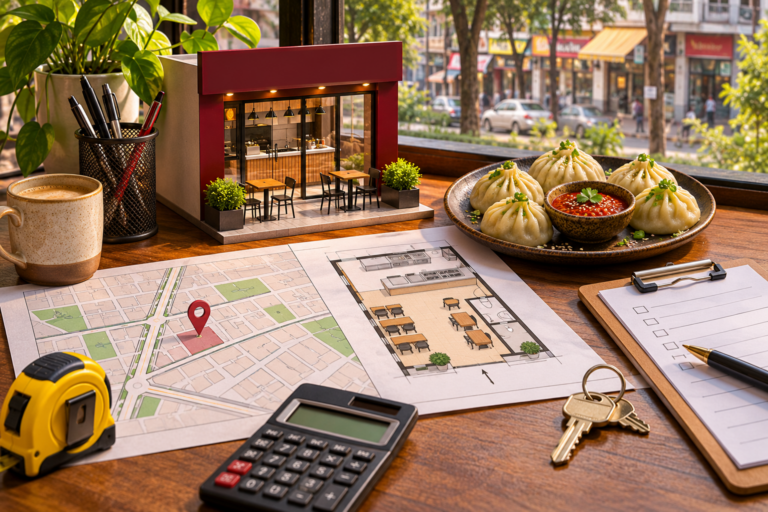
Great food alone cannot fix a site with weak demand. Look for a location whose customers, peak hours and economics fit the outlet format. Study not only apparent footfall but also the proportion of passersby likely to buy, achievable menu pricing, direct competitors, delivery coverage and the physical capacity to serve orders.
A practical local demand test
- Observe at least three trading windows: weekday lunch, weekday evening and weekend evening. Record relevant footfall and competitor queues separately.
- Map a delivery catchment: note delivery time, office/residential density, competing concepts and the price of a comparable order after delivery costs.
- Calculate occupancy pressure: evaluate rent against cautious monthly sales, not only a best-case forecast.
- Inspect the site: water, drainage, cold storage, refrigeration backup, power, ventilation, waste handling and permitted commercial use.
- Test operational peaks: can the steamer, work surface, packing station and staff maintain hygiene and reasonable throughput at busy times?
For example, 1,200 potentially relevant pedestrians a day with a 3% conversion assumption would represent 36 walk-in orders—only if both the footfall estimate and conversion actually occur. Add separately justified delivery demand instead of silently treating all pedestrian traffic as customers. This is a planning illustration, not a measured conversion rate.
Centralised product supply vs in-store preparation: compare the full cost
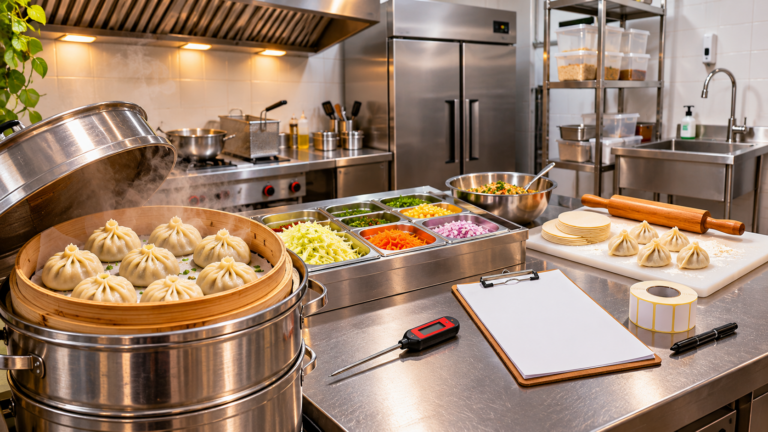
A traditional scratch kitchen and a centrally supplied momo outlet can have different labour needs, raw-material handling and quality-control demands. Neither is universally cheaper. A central-supply model may simplify portioning and reduce dependence on specialist food preparation at every outlet, but purchasing terms, freight, cold-chain reliability, storage and waste still matter.
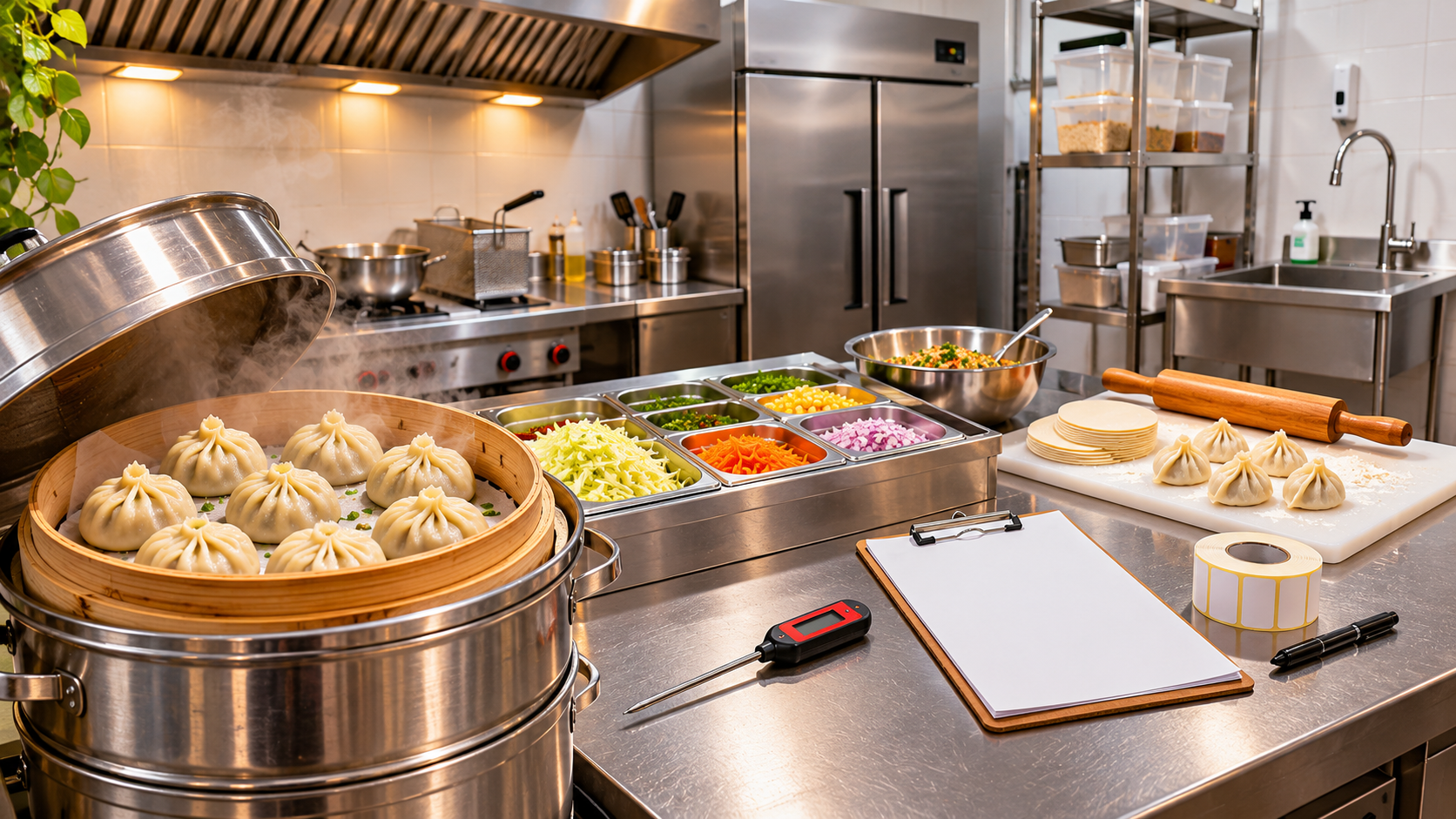
Compare options using usable cost per serving rather than only the purchase price per kilogram. Include product yield, rejected pieces, sauces, freight, freezer electricity, wastage, labour, cooking time and service delays. A supplier that is cheaper on invoice but unreliable during peak hours can become costly through stockouts and inconsistent food.
Useful supporting guides include our momo kitchen equipment checklist, cost-per-serving calculator framework and restaurant momo supplier checklist.
How to evaluate a momo franchise partnership
A franchise partnership should combine great food with workable economics, reliable operations and clear mutual responsibilities. Use this evidence checklist during your franchise discussion; it is designed to uncover both strengths and weaknesses before you commit capital.
| Evaluation area | Evidence to request | Possible warning sign |
|---|---|---|
| Food and repeat demand | Food tasting, verified outlet reviews, menu quality checks | Only staged testimonials and no comparable operating outlet |
| Investment transparency | Itemised quote, tax treatment, vendor specifications and payment milestones | Pressure to pay before written inclusions |
| Outlet economics | Comparable real operating examples with assumptions, permissions and context | Guaranteed income or fixed payback without evidence |
| Product and supply chain | Product standards, costs, dispatch coverage, cold-chain protocols and remedies | Undefined freight, mandatory purchases or stockout processes |
| Training and execution | Training syllabus, SOPs, refresher arrangements and support contacts | Vague promises of “complete support” |
| Territory and contract | Term, exclusivity if any, renewals, exit, transfer and dispute clauses | Verbal assurances absent from the signed agreement |
| Location feasibility | Catchment assessment, site approval and technical layout | Site accepted without checking utilities or rent sensitivity |
An operator who plans to supervise the store daily may value training, supply reliability and systems differently from a hands-off investor. Be clear about the work you want to do, the capital you can afford to lose and the rights you need in the agreement. For a contract checklist, read our food franchise due-diligence guide and franchise agreement documents guide.
Why Momo Delights builds around taste, quality and systems
At Momo Delights, our philosophy is Healthy. Tasty. Organised. Our Himalayan-inspired food draws on momo traditions associated with Nepal, Tibet, Sikkim and Darjeeling. Chef-driven product development brings character to the menu; well-defined preparation, manufacturing and service processes help make that food experience more consistent from one order to the next.
Our goal is not simply to place another sign above a counter. It is to build food businesses that respect flavour, keep hygiene and product control central, and give partners an organised way to operate. Learn more about our story and quality assurance and traceability.
Our franchise system brings together standardised products, centralised manufacturing and fulfilment, training, operational procedures, launch support and technology-informed management. With essential product systems organised upstream, the outlet team can focus on safe preparation, attentive service, order accuracy, stock control and repeat customer satisfaction.
Training and execution remain critical. A well-designed system is only as strong as the daily routine followed by the people running it. Our related resources explain first-week staff onboarding, consistent multi-outlet food quality and responsible methods to grow restaurant sales.
How our FOFO partnership operates
Our published FOFO framework brings the brand and outlet partner together around a clear division of work. The brand supports defined product systems, operating methods, onboarding and standards; the franchise partner manages the physical store, team, customer experience and local execution. Specific deliverables and cost responsibilities are documented in the applicable agreement.
| Brand framework | Outlet partner execution |
|---|---|
| Chef-led product and recipe standards | Consistent preparation, safe handling and customer service |
| Central product supply and agreed fulfilment | Stock ordering, receiving, storage and waste control |
| Onboarding, operating SOPs and training approach | Staff hiring, rostering, payroll and daily supervision |
| Defined launch, brand and operational resources | Approved location, local compliance and disciplined operating costs |
Our FOFO franchise guide explains the published core investment and operational duties. If you have a proposed outlet location, visit the Momo Delights franchise programme to explore the approved model and next steps.
Food licences and operating compliance in India: 2026 essentials
Franchise branding does not remove food safety obligations. A momo outlet needs the relevant FSSAI registration or licence, along with applicable premises, local-body, labour, tax and safety compliance. The correct route depends on the business activity, entity, turnover and location.
In 2026, FSSAI announced new turnover thresholds effective 1 April 2026. For the restaurant category, the official FoSCoS category eligibility schedule lists:
- Registration: annual turnover up to ₹1.5 crore.
- State licence: turnover above ₹1.5 crore and up to ₹50 crore.
- Central licence: turnover above ₹50 crore.
Other food-business categories and special conditions may have different requirements. Verify your precise kind of business and the applicable fee through the official FoSCoS portal. Seek local professional advice on GST and lease-related permissions rather than assuming that one brand-level licence covers every independent outlet.
Frequently asked questions about momo franchise cost
What is the Momo Delights franchise cost in India?
Our published FOFO core structure is ₹10 lakh, comprising a ₹3 lakh franchise/onboarding framework component and ₹7 lakh turnkey setup. Your full opening cash requirement also depends on property costs, taxes, stock, working capital and approved site-specific needs. Review the franchise programme for the current process.
Does the Momo Delights franchise charge royalty?
The published FOFO structure describes 0% sales royalty. It also identifies a ₹10,000 monthly Brand Growth Fund and an optional ₹10,000 Local Sales Booster. Budget these separately from supply and normal operating expenses; your agreement governs the applicable terms.
Can I start a momo business under ₹5 lakh?
A basic independent stall and a structured branded FOFO franchise are different investments. Our published ₹10 lakh FOFO core model is not an under-₹5 lakh package. Choose a format based on its complete requirements rather than trying to fit an unsuitable outlet into an arbitrary headline budget.
How much working capital does a momo outlet need?
There is no universal amount. Model at least a cautious sales-ramp period using actual rent, wages, utilities, brand contributions, stock replenishment, payment timing and equipment risks. The rent sensitivity guide and monthly operating-cost model provide helpful planning frameworks.
What determines momo franchise profitability?
Daily order count, average realised bill, channel mix, per-order contribution, local rent, employee costs, inventory waste, repairs and execution quality. A zero-percent sales royalty by itself does not guarantee profit. Use a 30-day unit-economics model with both direct and platform delivery costs.
Does Momo Delights provide training and product systems?
Our published franchise framework describes onboarding, training, recipes and SOPs, central product fulfilment, launch assistance and technology-supported operations. The detailed delivery schedule and responsibilities belong in the specific approved agreement.
What size shop is needed for the Momo Delights FOFO model?
The published core format describes approximately 120–250 sq. ft. as an indicative range, subject to site assessment. Access, utilities, hygiene flow, storage and business permissions matter as much as raw floor area.
Which documents should I prepare before applying for a franchise?
Be ready to discuss your preferred city, likely premises or catchment, available capital, food-business experience and involvement in daily operations. For detailed contract reviews, see our franchise agreement document checklist.
Before you invest: a one-page decision checklist
- Choose a feasible outlet format based on site constraints and your ability to operate it.
- Obtain a dated, itemised investment quote, including inclusions and exclusions.
- Confirm every recurring charge, mandatory purchase and payment milestone.
- Validate the location with observed demand and realistic occupancy costs.
- Calculate contribution per order separately for walk-in and delivery sales.
- Model a cautious case, not just the sales number shown in a proposal.
- Budget working capital, deposits, replacements and an emergency cash reserve.
- Verify food safety, local permissions and operational responsibilities.
- Review the agreement with qualified legal and financial advisers.
- Visit comparable operating outlets and speak with partners who consent.
The best momo franchise is not automatically the one with the lowest advertised fee. It is the format whose product, economics, systems and obligations fit a location and operator over the long term. For entrepreneurs who value Himalayan-inspired food, a structured product system and a hands-on partnership, explore the Momo Delights franchise programme.
Sources and editorial notes
Reviewed: 22 November 2026. This guide brings together our published franchise framework, practical restaurant cost analysis and official food-safety resources. Market estimates are credited to the original research organisation; figures in the order-economics calculation are explicit hypothetical assumptions rather than Momo Delights operating results.
- Momo Delights — official franchise programme and FOFO business model guide
- Redseer — India foodservice market analysis (2026)
- FSSAI — official 2026 reforms announcement and FoSCoS — activity-specific eligibility criteria
Actual commercial terms, taxes, outlet permissions and operating costs depend on the location, format and applicable agreement. The scenarios explain financial methods and are not income or investment-return guarantees.