
Aa Reading preferences
This guide is for restaurant operators, cafés, cloud kitchens, QSRs and foodservice purchasing teams selecting momo chutney cups, takeaway packaging and sauce-handling procedures. It covers container compatibility, leakage testing, temperature, allergens, cost and a practical trial scorecard. It complements the broader sauce-flavour discussion without presenting an untested recipe or claiming to reveal Momo Delights’ sauce formulas.
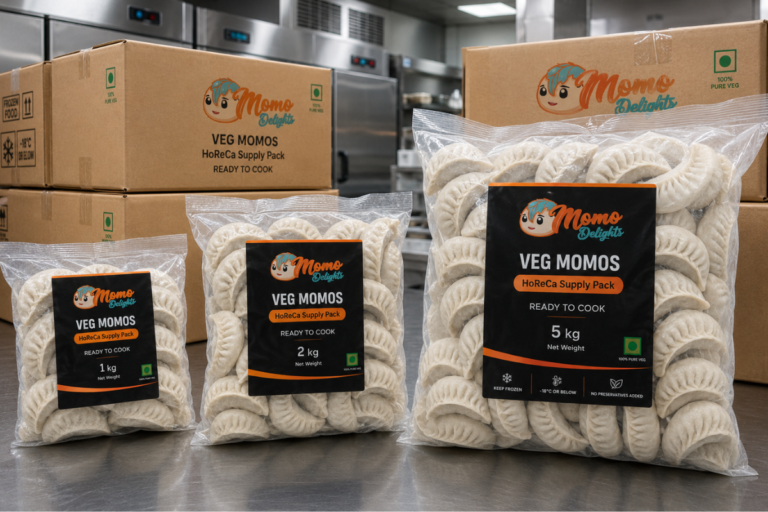
Momo Delights describes momos, sauces and dips among its foodservice categories on the official HoReCa/B2B page. Specific sauce formats, packaging, approved shelf lives, minimum quantities and geographic supply terms must be requested directly from the business.
Why momo chutney needs its own takeaway packaging plan
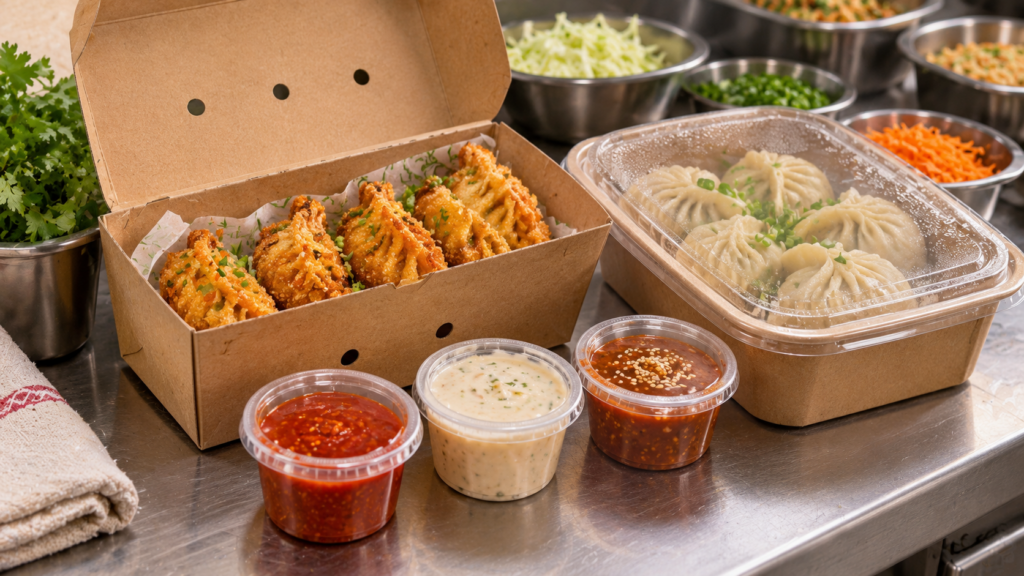
A delicious sauce served on a restaurant plate may arrive differently after a motorcycle delivery. Vibration and movement can loosen lids; temperature changes can affect texture; an overflowing cup may leak into a bag; and chilli sauce placed directly over fried or kurkure momos can soften a crunchy surface. These are separate issues from microbiological safety and should be assessed separately.
Good packaging has several jobs: protect food from contamination, remain suitable for food contact, resist predictable handling stresses, identify products where required, preserve acceptable eating texture and help staff assemble an accurate order. A cheap cup that fails in transport can generate waste, customer complaints and re-delivery costs.
The FSSAI Digest guidance on safe and suitable food packaging explains the need for packaging appropriate to foodservice use, and the FSSAI regulatory index links to the Packaging Regulations, 2018 and their amendments. The official amendment page lists changes, including one dated 7 August 2026. Procurement teams must check the current applicable provisions before adopting a new material.
Five common momo sauce formats and their packaging implications
| Sauce category | Typical service texture | Packaging consideration |
|---|---|---|
| Tomato–chilli chutney | Smooth or slightly textured, pourable | Secure lid, appropriate seal and portion control |
| Sesame–tomato achar | Can be thicker and textured | Check allergens, filling method and clean rim |
| Garlic–chilli dip | May be oily or chilli-forward | Compatibility with oil, staining and heat |
| Creamy or yoghurt-based dip | Smooth or semi-thick | Potential milk allergen and validated cold-chain requirements |
| Jhol-style sauce | Broth-like and relatively fluid | Higher spill risk; use container rated for the intended liquid and conditions |
These are culinary examples, not a statement that Momo Delights currently sells every sauce or supplies each in a retail tub. Recipe, acidity, fat content, temperature and shelf life vary, so packaging must be matched to the actual sauce specification.
What does “food-grade” mean for a chutney cup?
“Food-grade” is not merely a marketing sticker. The packaging material has to be suitable for the intended food contact and conditions. In India’s Food Safety and Standards (Packaging) Regulations, food-contact materials are subject to requirements for suitability and safety. Operators should obtain relevant documentation from suppliers, considering whether the cup is designed for hot filling, chilled storage, oily or acidic sauce, sealing and transport.
A container suitable for a cool, thick dip is not automatically suitable for a hot, oily or acidic sauce. Similarly, a compostable-looking or paper-style cup is not automatically the best answer if its lining or lid does not hold the particular liquid. Never infer safe microwaving, hot filling or reuse from appearance alone.
| Packaging characteristic | Question for supplier |
|---|---|
| Food-contact compliance | Which applicable standards and documents support the intended use? |
| Temperature suitability | What food and filling temperatures are approved? |
| Food compatibility | Is the material suitable for the actual acidity, fat and ingredients? |
| Closure security | How is leakage prevented during normal delivery movement? |
| Label or tamper provision | Can the business identify the sauce and any needed warnings? |
| End-of-use handling | Are the disposal/recycling claims accurate for local facilities? |
The official FSSAI Basic Catering training material advises using food-grade packaging that is protected from physical, chemical and biological contamination. This is professional food-safety guidance, not a guarantee for any specific packaging brand.
How to test momo sauce cups before placing a large order
A sauce cup that holds water on a counter may still leak during a delivery. Test with the actual approved sauce formulation at its intended filling temperature and fill level, using a representative closure and outer bag. Do not use real customer orders for experimental packaging trials.
- Fill-level test: Set a documented target volume with adequate headspace and check repeatability.
- Closure test: Have staff apply the lid under normal service conditions and record failed seals.
- Transport simulation: Carry a sealed pack on a realistic route or use a controlled movement test, checking for leaks and lid separation.
- Compatibility check: Inspect for deformation, staining or other unacceptable changes after the intended holding period.
- Food-safety review: Verify that all temperatures, times and materials match the approved process; a no-leak result is not a microbiological validation.
- Customer-use test: Check whether the lid opens safely and whether the cup can be dipped into without unreasonable spill risk.
- Cost review: Record purchase cost, discarded cups, leaking orders and operational handling time.
Use the same process for two or three candidate packs before comparing them. The table below is an illustrative evaluation tool, not a certified packaging test.
| Review area | Example scoring | Hard requirement? |
|---|---|---|
| Food-contact suitability and documented compliance | Pass/fail | Yes |
| Approved temperature/process compatibility | Pass/fail | Yes |
| Leak resistance | 0–5 points | Define acceptance criteria |
| Ease of packing and opening | 0–5 points | No, unless safety-related |
| Presentation and stacking | 0–5 points | No |
| Landed cost per successful order | Compare ₹ values | Commercial decision |
Do not trade away mandatory food-contact or temperature requirements for a higher appearance score or a lower unit price.
Packaging cannot replace safe preparation and temperature control
Fresh tomato chutney, dairy-based dip and other wet sauces may be perishable. The required shelf life and holding process depend on formulation, processing and validation—not just the acidity, colour or amount of chilli. Chilli does not make a sauce shelf-stable. A freshly made sauce should not be advertised as safe for days or weeks without a documented basis.
The FSSAI hygiene requirements cover food-safety systems across handling, storage and distribution. For general consumer context, FoodSafety.gov’s delivery-safety guidance notes that hot food should arrive hot, cold food cold, and perishable restaurant deliveries should be eaten promptly or refrigerated. The US consumer guidance uses a two-hour maximum at room temperature, reduced to one hour above 32°C; Indian food businesses must apply their relevant local rules and validated processes.
Common operating mistakes: filling sauce cups too early and leaving them at ambient temperature, using a container incompatible with hot sauce, contaminating lids with used utensils, and returning unused opened cups to stock. Correct procedures should be set in a kitchen’s food-safety management system.
Labelling and allergen disclosure for momo dips
Red tomato chilli chutney may seem simple, but colour is not an ingredient list. Some momo achaars use sesame; creamy sauces can contain milk; other recipes may use peanuts, tree nuts, soy or wheat-containing additives. A restaurant should hold a current approved formulation and provide accurate allergen information, including cross-contact considerations where relevant.
For Momo Delights customers, the official allergen information page is a starting point, while item-specific questions should be confirmed directly. The site’s menu lists food categories, but it is not a substitute for a wholesale sauce specification or a product label.
When several dip cups look similar, use an appropriate, accurate identifier to reduce service mistakes. Labels or packaging claims must align with applicable regulation and the actual product; do not place an unsubstantiated “vegan,” “allergen-free” or “preservative-free” claim on an order.
Should a restaurant pack sauce separately from steamed, fried and kurkure momos?
Often it helps preserve texture, especially for fried and kurkure styles, because moisture can soften a crisp exterior. Steamed momos may tolerate a different moisture environment, but sauce leakage can still damage the order. Separate packing is a texture and logistics decision; food safety may require additional temperature-control or segregation measures depending on the sauce.
A practical order assembly check covers the momo type, filling, portion count, number and identity of dips, lid security, allergy instructions and dispatch timing. If chilled dairy sauce and hot momos share an outer bag, assess the thermal conditions carefully and use a validated arrangement; convenient presentation alone is not enough.
Calculate sauce packaging cost per successful order
Compare the total cost of the fulfilled order, not just the lowest listed cup price. Include the cup, lid, any label, outer packaging, filling loss, damaged stock, assembly labour and the cost of complaints or replacements. The right format balances compliance, reliable delivery and customer experience.
Illustrative example—not an actual supplier quote: Suppose a cup and lid cost ₹3.20, a label costs ₹0.30, and a restaurant uses two cups per order. Direct material cost becomes 2 × (₹3.20 + ₹0.30) = ₹7 before sauce, packing labour, freight and waste. A competing cup costing ₹2.70 may not be cheaper if its closure failure causes frequent replacements. Use measured defect data before drawing conclusions.
For a wider view of unit economics, a restaurant should evaluate momo, sauce, finishing and channel expenses together. Ask the Momo Delights B2B team for current sauce options and pack specifications rather than assuming the hypothetical numbers here are its prices.
Copyable restaurant RFQ checklist for momo sauce packaging
- Product: Sauce type, ingredients, allergens, viscosity, acidity data if relevant and intended storage condition.
- Pack: Required nominal fill volume, cup/lid type, materials, seal and temperature suitability.
- Compliance: Applicable food-contact documentation and any necessary evidence of conformity.
- Operations: Filling method, holding time, closure process, order volume and transport conditions.
- Commercial: Unit price, freight, minimum order, expected lead time, defects and claims terms.
- Testing: Representative samples, success criteria and documented approval process.
For foodservice operators evaluating Momo Delights products, the brand’s quality and traceability page offers context, but written product-specific specifications are essential.
Frequently asked questions about momo sauce packaging
Should momo chutney be packed separately?
Separate packing can help preserve the texture of crispy momos and reduce sauce spills, provided suitable food-safety conditions are maintained.
Which cup size is best for momo chutney?
There is no universal size; base it on actual dip use, plate count and the supplier’s verified container volume and compatibility.
Are paper sauce cups always safer than plastic cups?
No. Materials must be suitable for the actual sauce and intended food-contact conditions; visual appearance is insufficient.
Can hot chutney be poured into any food-grade cup?
No. Verify the cup and lid are approved for the intended filling temperature and sauce composition.
Does spicy chutney need refrigeration?
It can. Chilli heat does not establish shelf stability; follow the validated storage instructions for the actual recipe.
How can delivery restaurants reduce sauce leaks?
Test cup/lid compatibility, fill level, secure closure, carrying conditions and staff assembly practice using the real sauce.
Is sesame usually present in red momo sauce?
Some recipes use it and some do not. Confirm the actual ingredient statement rather than inferring from colour.
Can restaurants use one dip cup for all sauces?
Only after verifying suitability for each sauce’s chemistry, temperature, viscosity and service conditions.
Does Momo Delights supply packaged sauces wholesale?
Its foodservice page lists sauces and dips as a category. Actual pack formats, pricing and availability should be confirmed with the team.
Sources and editorial note
- FSSAI Digest — Safe and Suitable Food Packaging Materials (official guidance context).
- FSSAI — Regulations (Packaging Regulations, 2018 and current standards).
- FSSAI — Packaging Amendments (current amendment list).
- FSSAI — Basic Catering Training (hygienic food-grade packaging).
- FoodSafety.gov — Delivery Safety (general consumer temperature guidance).
- Momo Delights — HoReCa/B2B Supply (official enquiry point).
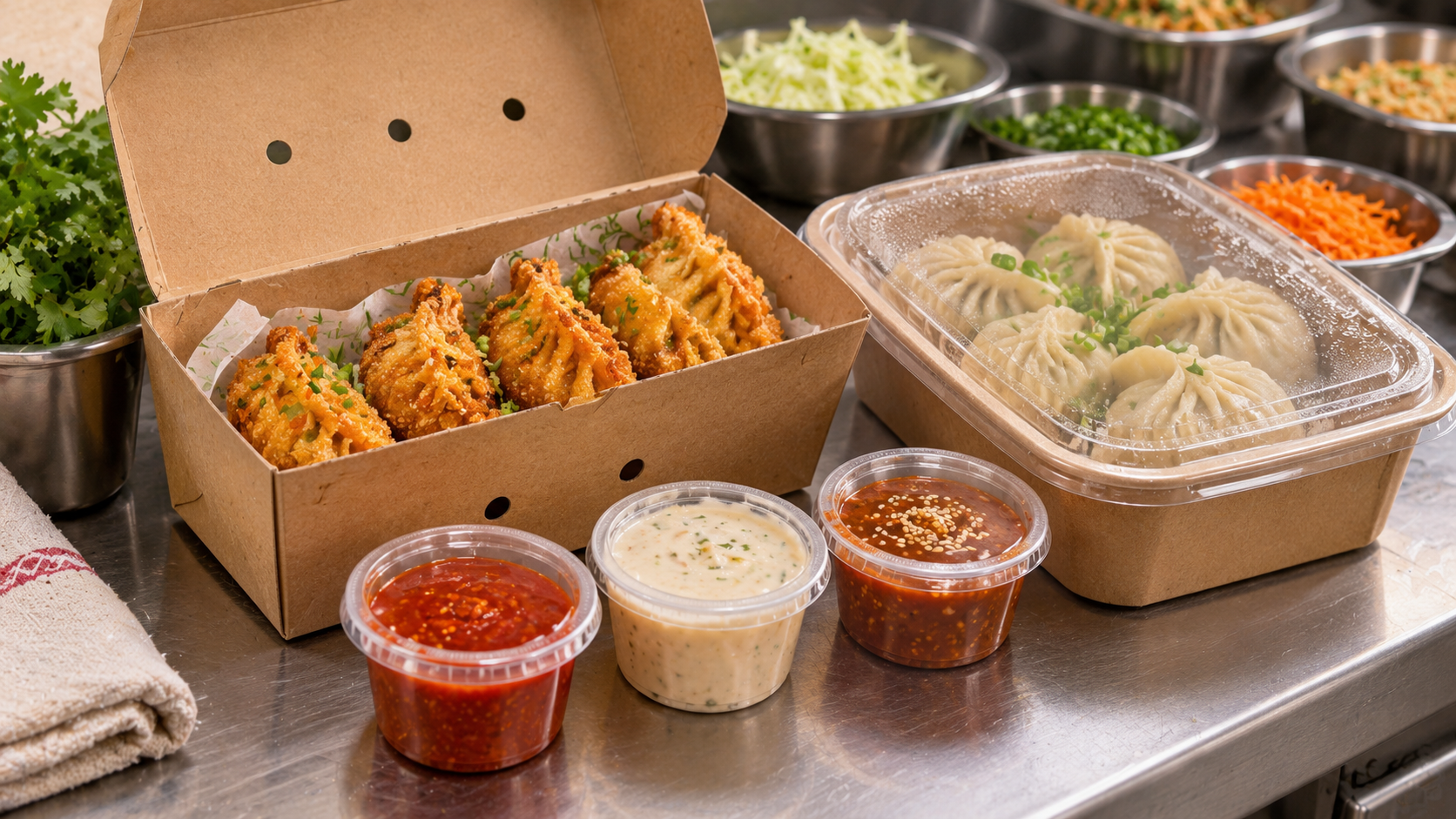
Reviewed 1 November 2026: Packaging tests and cost examples are educational, not a validation certificate, current Momo Delights packaging procedure or published product quote. The featured image is an AI-generated concept, not a photograph of actual branded packaging.