
Aa Reading preferences
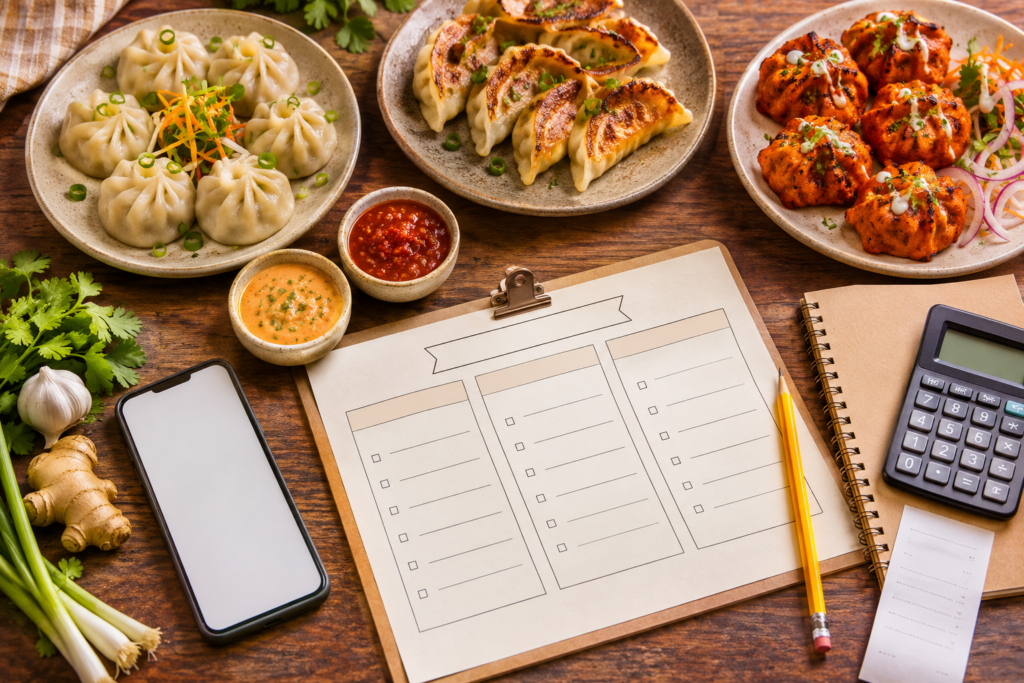
This practical guide shows how to plan a 10–12-item launch menu, estimate preparation complexity, organise steamed, kothey, fried and tandoori-style products, and audit results after opening. The example menu is hypothetical; it is not a promise that Momo Delights sells these exact items wholesale, offers fixed franchise packages, or recommends a universal menu size. For its verified current consumer offerings, use the official Momo Delights menu.
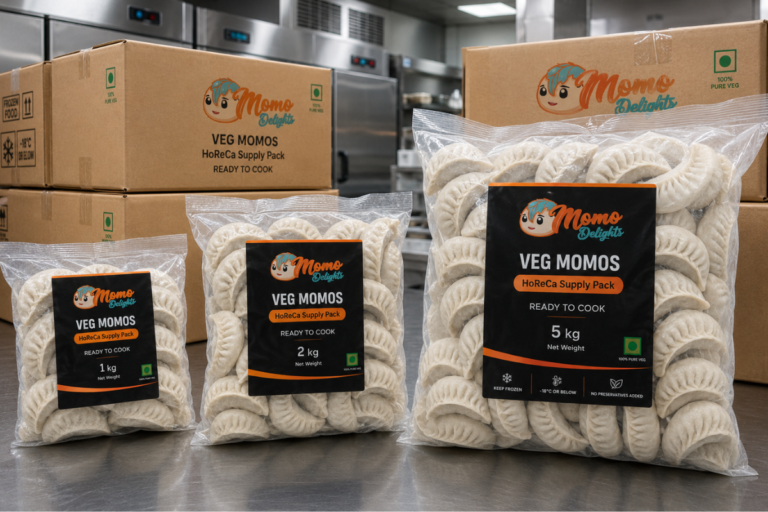
For operators wanting to discuss foodservice supply, Momo Delights has a separate HoReCa/B2B enquiry channel. The right product list, delivery area, specifications and commercial terms must be confirmed in a current quotation.
Why a focused momo menu can work better than an enormous one
Every additional menu SKU creates possible purchasing, training, preparation, storage, photography, allergen and quality-control tasks. Too many weakly differentiated items can make the customer’s decision more difficult and complicate the kitchen during peak service. A concise menu does not mean boring food: a few well-chosen fillings and finishing methods can create useful variety without uncontrolled complexity.
Start by defining the audience: office lunches, student snacks, family takeaway, evening footfall, or delivery-heavy customers. Then decide which formats fit the demand and the existing equipment. A tiny cloud kitchen with one steamer and one pan should not promise unlimited fried, roasted and multi-sauce items without testing actual capacity.
In restaurant operations, menu engineering looks at how frequently a dish sells and how much contribution it produces. India’s National Council for Hotel Management and Catering Technology teaching material covers the popularity-versus-profitability menu matrix, while recent industry guidance explains the importance of item-level contribution and actual sales mix. Neither source establishes a fixed ideal number of momo dishes or guaranteed returns.
A sample 12-item momo launch menu
The table is a planning exercise, not an official Momo Delights menu, price list or wholesale catalogue. The aim is to demonstrate how menu categories can provide choices without requiring a separate production system for every item. Items should only be offered if the restaurant has ingredients, supplier approval, safe cooking SOPs and appropriate equipment.
| Illustrative menu section | Potential item | Why it might be included |
|---|---|---|
| Steamed basics | 1. Classic vegetable steamed momo | Soft-wrapper reference product |
| Steamed basics | 2. Paneer steamed momo | Different filling for dairy-consuming customers |
| Steamed basics | 3. Spinach-corn momo | Alternative vegetarian flavour, if validated |
| Pan-seared | 4. Veg kothey momo | Crisp contact side with soft top |
| Pan-seared | 5. Paneer kothey momo | Filling choice using a similar finish |
| Crisp | 6. Fried vegetable momo | Traditional fried-snack texture |
| Crisp | 7. Kurkure-style vegetable momo | Coating-led crunch, if equipment allows |
| Spiced finish | 8. Tandoori-style vegetable momo | Bolder seasoned exterior |
| Spiced finish | 9. Creamy-style momo | Contrasting flavour; verify dairy and nuts |
| Sampling | 10. Mixed-texture sampler | Encourages discovery if throughput is manageable |
| Accompaniment | 11. House-style tomato-chilli dip | Complements multiple core items |
| Accompaniment | 12. Another appropriate dip or beverage | Optional contrast without another complex hot station |
Several example names overlap with styles listed on Momo Delights’ public menu, but this is not an assertion that all these items are sold to businesses or in the suggested combinations. Menu architecture should be based on actual feasibility and customer needs, not copying another shop’s list word for word.
Build menu variety from components, not uncontrolled recipes
One reason a small dumpling menu can offer variety is that filling, wrapper, cooking finish and sauce are different dimensions. But combining them all without checks creates a large number of possible SKUs and increases operational complexity.
For example, two fillings and three finishes create six potential combinations mathematically. This does not prove all six are appropriate for production: a supplier may restrict certain finishes, some fillings may not tolerate frying, and the equipment may not cook each combination safely. Test and approve each offered SKU explicitly.
| Menu dimension | Typical choices | Operational question |
|---|---|---|
| Filling | Vegetable, paneer, spinach-corn | How many distinct ingredients and allergens? |
| Wrapper | Standard, whole-wheat, grain blend | Is the formula and handling validated? |
| Finish | Steamed, kothey, fried, tandoori-style | Which equipment and skills are required? |
| Sauce | Tomato-chilli, mild creamy, sesame-style | Storage, allergens and portion cost? |
| Serving size | Small snack, standard plate, sampler | Does actual pack count support consistency? |
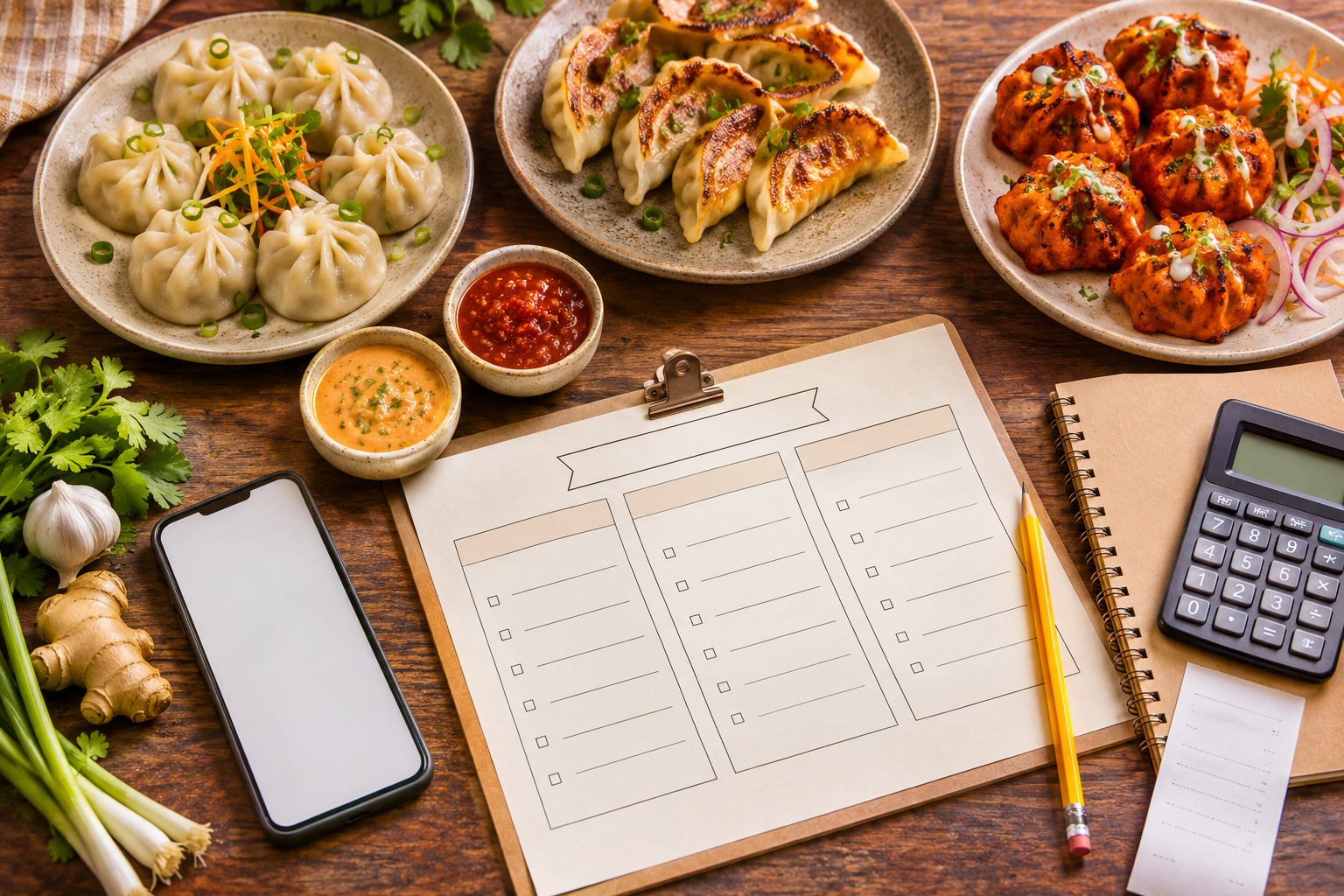
Match the launch menu to real kitchen capacity
A workable QSR menu is constrained by more than ingredient availability. Evaluate the service station for each approved cooking and finishing process. Steaming needs appropriate equipment and loading control. Pan-searing needs cooking space and a safe release technique. Fried styles need suitable oil management, ventilation and equipment. Creamy or chilled sauces may require different storage conditions.
Before approving an item, ask: Does it use a new machine? Does it need an additional employee at peak? Can the team maintain safe cooking endpoints? Does it slow down the other menu items? Will the holding and packaging method preserve acceptable texture?
Under FSSAI hygiene requirements, a food business should implement an appropriate Food Safety Management System and relevant good hygiene practices. New SKUs should be designed into that system—not launched using untested general cook times.
Example capacity test, not an actual Momo Delights standard
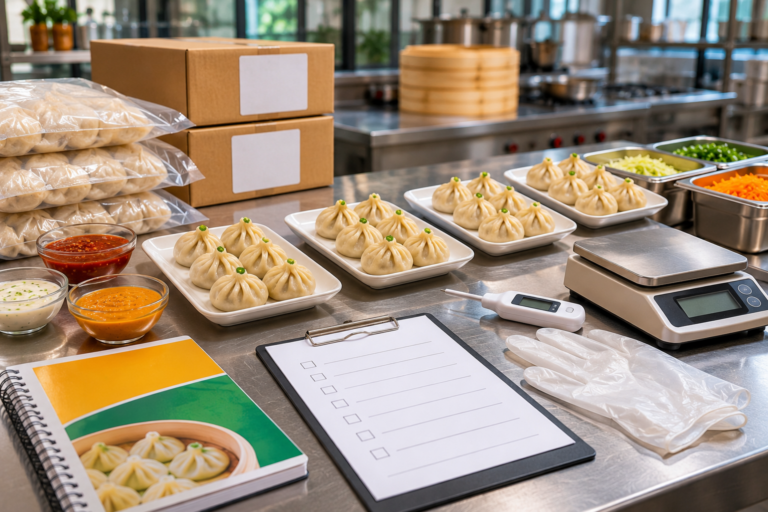
Run a supervised trial with a realistic combination of orders at the same time. Record order time, cook start, completion, safe food-temperature checks, packaging errors and discarded products. A menu that works perfectly for one sample order may not be feasible during an evening rush.
A helpful scorecard might include serving-time consistency, out-of-stock rate, wrapper breakage, sauce errors, product quality and complaints. Every safety-critical failure should be addressed separately from customer-experience scores.
Price a momo menu using real costs, not competitor guesses
Menu pricing must cover the actual sellable serving: momos or batch ingredients, sauce, garnish, oil and preparation losses. For takeaway or delivery, also assess packaging, discounts and relevant channel charges. The cost to purchase one momo is not the complete cost of a finished plate.
Illustrative arithmetic only: Suppose a hypothetical plate sells for ₹160 excluding relevant tax and costs ₹52 in food ingredients. Its food-only contribution is ₹108 and its food cost percentage is 32.5% (₹52 ÷ ₹160 × 100). Now suppose packaging costs ₹12 and an applicable per-order channel charge is ₹24. The remaining contribution before other costs is ₹72. These are made-up teaching numbers, not Momo Delights prices, supplier quotations or profit forecasts.
That ₹72 still has to support labour, rent, utilities, software, marketing, financing and other obligations. A high food-only margin is not proof that a dish earns net profit. Compare contribution across actual channels and serving sizes, and do not assume one universal “target food cost” suits every operation.
The National Council for Hotel Management’s menu engineering material and Indian restaurant menu-engineering guidance describe how contribution and popularity can guide pricing and item selection.
Design takeaway and delivery menu items for the actual journey
A dish served directly from a hot steamer and the same dish eaten after transport may behave differently. Steamed wrappers can dry or become sticky depending on handling; fried and kurkure coatings can soften when steam condenses; wet sauces can leak or alter texture. Before listing a new item on a delivery platform, test it in representative approved packaging and a realistic travel scenario.
Food contact, temperature control and cooking safety must be validated independently of taste. The FSSAI Packaging Regulations and food packaging guidance are relevant when assessing sauce cups, liners and delivery containers.
A simple takeaway-focused menu may feature a few robust items rather than every dine-in variation. Separate sauce cups where that improves texture, but only use packs and holding methods suitable for the actual product.
Make ingredient, spice and allergen information easy to understand
Customers should be able to tell whether a momo is vegetable or paneer, which finish it uses and what sauces accompany it. Paneer contains milk; many momo wrappers contain wheat; sesame, soy or nuts may be present in some fillings or condiments. A millet or beetroot menu name does not automatically mean gluten-free.
For dietary clarity, build a product sheet for every SKU with its true ingredients, declared allergens, possible cross-contact risks, portion size and approved cooking instructions. Use accurate menu descriptions instead of broad claims such as “healthy,” “diabetes-friendly,” “100% gluten-free” or “no preservatives” without appropriate evidence and approvals.
Momo Delights provides an allergen information page, but individual item formulations and outlet practices should still be verified before making restrictions-related promises.
How to use menu engineering after launch
Once orders are coming in, evaluate the dishes on sales volume and contribution per item, not just the highest selling price. A classic menu-engineering framework uses four groups:
| Category | Popularity | Contribution | Possible action |
|---|---|---|---|
| Star | High | High | Keep reliable and easy to find |
| Plowhorse | High | Lower | Review portion, pricing and operational cost |
| Puzzle | Lower | High | Test description, visibility or product positioning |
| Dog | Lower | Lower | Investigate reformulation or removal after context checks |
The framework is described in Indian hospitality education material. Its category cut-offs are analytical conventions; there is no reason to apply them blindly during a very short or unusual sales period. Consider stockouts, festivals, promotions, discounts, ingredient changes and channel mix.
Simple item comparison: Record item units sold, net realised selling price, ingredient cost, other direct variable costs, total contribution and common customer complaints. Compare within relevant sections. A ₹20 contribution item sold 1,000 times produces a different total contribution from a ₹60 contribution item sold 50 times. Profitability still depends on full operating expenses.
How to improve discoverability in search and AI answers
Write descriptions that answer genuine customer questions. Rather than “Our Best Premium Momo,” use an accurate phrase such as “Steamed vegetable momos with a soft wheat wrapper, served with a spicy tomato dip” only if those details match the actual recipe. Identify ingredients, cooking style, serving count, dietary caveats and outlet availability in structured menu fields.
Keep dish names consistent across the website, ordering platforms and in-store menu wherever the item is identical. Link product-category explanations to the main menu, relevant outlet pages and location directory. Search and AI discovery benefit from clear facts, but no wording, schema markup or keyword use guarantees a top ranking or inclusion in AI answers.
A practical 30-day launch and review checklist
| Period | Priority | Evidence to collect |
|---|---|---|
| Pre-launch | Approve every SKU, safety process, price and supplier arrangement | Controlled product sheets and test records |
| Week 1 | Check missing items, packaging failures and cooking execution | Daily error and feedback log |
| Week 2 | Measure real prep times, stock usage and peak capacity | Order time and inventory data |
| Week 3 | Evaluate food and channel costs by item | Cost sheet and realised net sales |
| Week 4 | Review popularity, contribution, complaints and weak SKUs | Menu matrix and actions with owners |
The timetable is an illustrative management routine, not a guaranteed timeline for profitable launch. Continue monitoring and revisiting the conclusions as more stable demand data becomes available.
How Momo Delights can fit into a restaurant menu planning process
Momo Delights’ foodservice page describes momos, dim sum, spring rolls, sauces and dips as broad supply categories. A buyer should request the currently available product catalogue, exact SKUs, storage and cooking specifications, allergens, pricing, minimum order and delivery arrangements. The site’s quality and traceability page provides brand context, not a substitute for actual controlled product specifications.
For a broader sourcing discussion, read Momo Machine vs Ready-Made Momos and How Restaurants Can Add Momos Without a Specialist Chef. This article’s contribution is a menu architecture and launch-evaluation framework, rather than a supplier selection or cooking tutorial.
Momo menu planning FAQs
How many items should a momo cloud kitchen launch with?
There is no universal ideal number. A small, well-tested menu is often easier to execute than many unvalidated variations. The 12-item example here is illustrative only.
Should every filling be sold in steamed, fried and tandoori forms?
No. Only offer combinations that have appropriate product approval, equipment, validated cooking processes and customer demand.
How do you make a momo menu more profitable?
Know real serving and channel costs, measure sales mix and contribution, reduce waste and review prices and products responsibly.
Is food cost percentage the same as profit?
No. Labour, rent, utilities and other operating expenses remain after food costs.
Should a momo menu include a sampler?
It can be useful if it is operationally manageable, accurately portioned and easy to assemble without slowing service.
What should be shown in a delivery-menu description?
Accurate filling, wrapper or finish, serving count, sauce and relevant dietary information; do not invent attributes.
Are creamy or paneer momos vegan?
Not when they contain milk-derived ingredients. Check each full recipe.
Can a restaurant offer millet or beetroot momos as gluten-free?
Only with actual verification that the finished recipe and preparation meet the applicable requirements.
Does Momo Delights supply every item in this sample menu?
No such claim is made. Contact the foodservice team for a current catalogue and specifications.
How often should menu performance be reviewed?
Review operational problems frequently and menu economics over an appropriate period of representative sales; avoid decisions based on one unusual day.
References and editorial disclosure
- National Council for Hotel Management and Catering Technology — Advance Food & Beverage Management II (menu engineering matrix).
- Eateri — Restaurant Menu Engineering Guide (2026) (contribution and sales mix analysis).
- FSSAI — Hygiene Requirements (food business FSMS framework).
- FSSAI — Regulations (food packaging context).
- Momo Delights — Menu (actual consumer item listings).
- Momo Delights — HoReCa/B2B Supply (business enquiry and catalogue confirmation).
Editorial review: 1 November 2026. This is educational menu-design guidance. The 12-item plan, ₹ examples, timelines and matrices are hypothetical; they are not the approved Momo Delights outlet menu, a wholesale quote, an audited store performance statement or a promised return on investment. The featured illustration is AI-generated.