


Aa Reading preferences
Not every chilli is long and narrow. Dalle Khursani is recognised for its small, round appearance, bright red ripeness and powerful heat. In Sikkim, it belongs to a food landscape where robust chutneys and pickles are enjoyed with a wide range of meals, including Himalayan-style snacks.
The story is more than a heat challenge: Dalle Khursani has a registered geographical indication connected with the eastern Himalayan region, making its identity a matter of documented food heritage as well as flavour.
The official GI record
India’s official Geographical Indications Registry lists Dalle Khursani under application 636, certificate 414, with a registration date of 14 September 2021. The stated geographical area covers Sikkim and West Bengal, and the registered proprietor is the North Eastern Regional Agricultural Marketing Corporation Limited (NERAMAC). APEDA’s Sikkim GI listing reproduces these details.
That means the GI description should not be simplified to “only grown in Sikkim” when the registry lists the wider approved area. A GI registration is not a certificate that any unverified retail jar contains an authentic GI-eligible chilli.
What does the chilli look and taste like?
The National Portal of India describes Dalle Khursani as a hot pepper associated with Sikkim, used fresh, dried and in pickles, chutneys and sauces. Sikkim government reporting describes its rounded form and intense pungency. Its flavour can add a distinctive bright, fruity or aromatic quality beneath the heat, though taste varies with growing and processing conditions.
A heat scale is difficult to compare accurately without a specific tested sample. Avoid assuming every chilli has the same Scoville Heat Unit value or treating publicity ranges as a lab result for your particular jar.
How it can appear beside momos
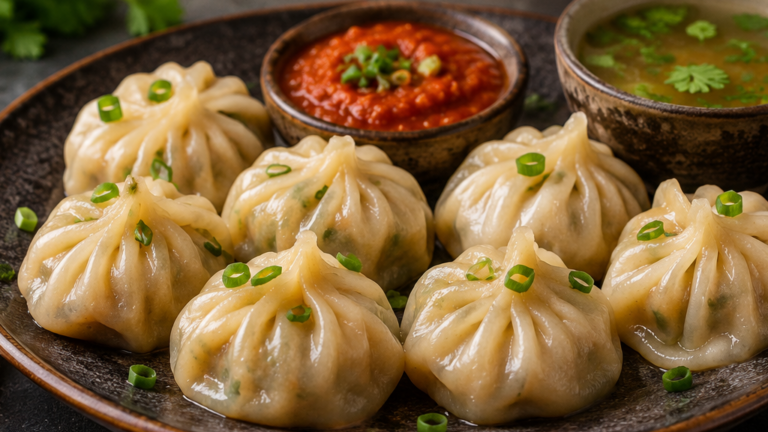
A small amount of Dalle Khursani can form part of a tomato or seed-based achar. It can also be pickled or blended into a chilli paste. The purpose is not simply to make the dish painfully hot: acidity, aromatic vegetables and the amount added determine whether the accompaniment suits the filling. Because the chilli is potent, start with a tiny quantity and taste after mixing.
A gentle way to experiment
- Confirm that the chilli is correctly identified and suitable for cooking.
- Use a very small amount in a generous cooked tomato base.
- Prepare a second, chilli-free dip for comparison.
- Taste with a fully cooked steamed vegetable momo.
- Increase heat in small increments only if wanted.
This is a tasting idea, not an authorised GI product recipe or a Momo Delights commercial formula.
Handling intense chilli thoughtfully
Wash hands and clean utensils thoroughly after chopping hot chillies. Avoid touching eyes, face or sensitive skin. Gloves can be useful for large quantities. Keep strong chilli pastes away from children and label them clearly at a mixed-preference gathering.
Chilli heat does not make a homemade condiment shelf-stable. Fresh sauces must be handled and refrigerated according to their ingredients, regardless of how fiery they taste.
GI authenticity and shopping
When buying a product that claims a GI association, review its packaging, producer information and relevant evidence rather than trusting a decorative mountain image. The official registry and APEDA provide a stronger reference than an unsupported seller claim. Do not assume that an ordinary hot chilli pepper is the registered regional product just because it is round.
For the wider setting of eastern Himalayan momos, read Momo Delights’ Sikkim food article.
FAQ
Is Dalle Khursani a type of pepper?
Yes, it is a distinctive hot chilli associated with the eastern Himalayas.
Has it received a GI registration?
Yes. The official GI record lists registration in September 2021.
Is Dalle Khursani used only in momos?
No. It is used in other chutneys, pickles and regional foods.
For more context on regional dishes and momo culture, explore Momos and Soup in Sikkim: Regional Pairing Traditions and Himalayan food traditions. Regional recipes and traditions are diverse.

Leave a comment