Aa Reading preferences
This is a practical receiving-day SOP framework for restaurants, hotels, cafés, caterers and cloud kitchens. It expands the general supplier-selection topic into what the receiving team should do when a vehicle actually arrives. The checklists, sample log and corrective-action cases are educational examples, not a claim that Momo Delights uses them internally or that an unsigned supplier specification has been approved.
Foodservice operators evaluating available products can contact Momo Delights’ HoReCa/B2B supply team and review the brand’s published quality and traceability principles. Confirm actual SKU specifications, cold-chain limits, delivery routes and claim terms in writing before creating a site SOP.
Before the truck arrives: confirm your specification and storage space
Receiving quality begins before unloading. A restaurant should know what it ordered, what evidence is needed and whether there is room to store an accepted delivery at its required temperature. If the freezer is already full or not working, accepting a large consignment can create a food-safety problem immediately.
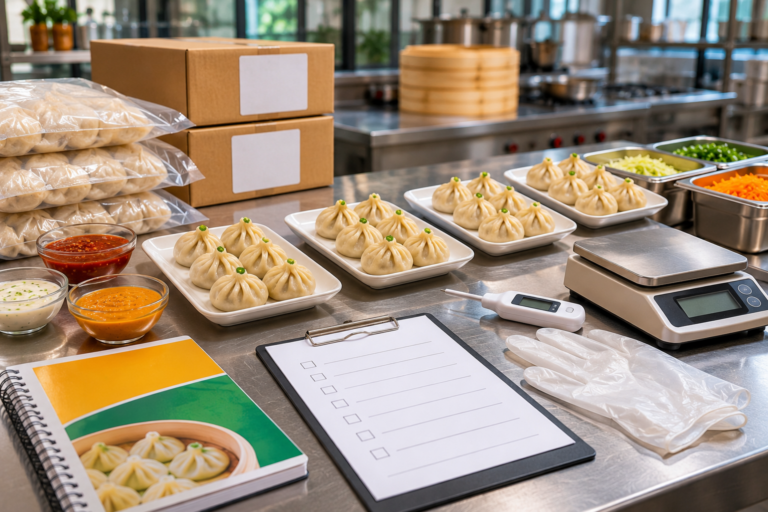
Keep these ready: the purchase order, controlled product specification, applicable receiving temperature limits, approved packaging and label information, a calibrated suitable thermometer, a clean receiving surface, a rejection/hold procedure and an identified staff member authorised to decide when to escalate. Staff should not change acceptance criteria during an argument with a driver.
FSSAI’s hygiene framework requires food businesses to control food-safety hazards throughout production, storage and distribution through appropriate Food Safety Management Systems. An official inspection checklist compilation includes receiving-temperature, frozen storage, stock-rotation and recordkeeping checks for applicable warehouse operations.
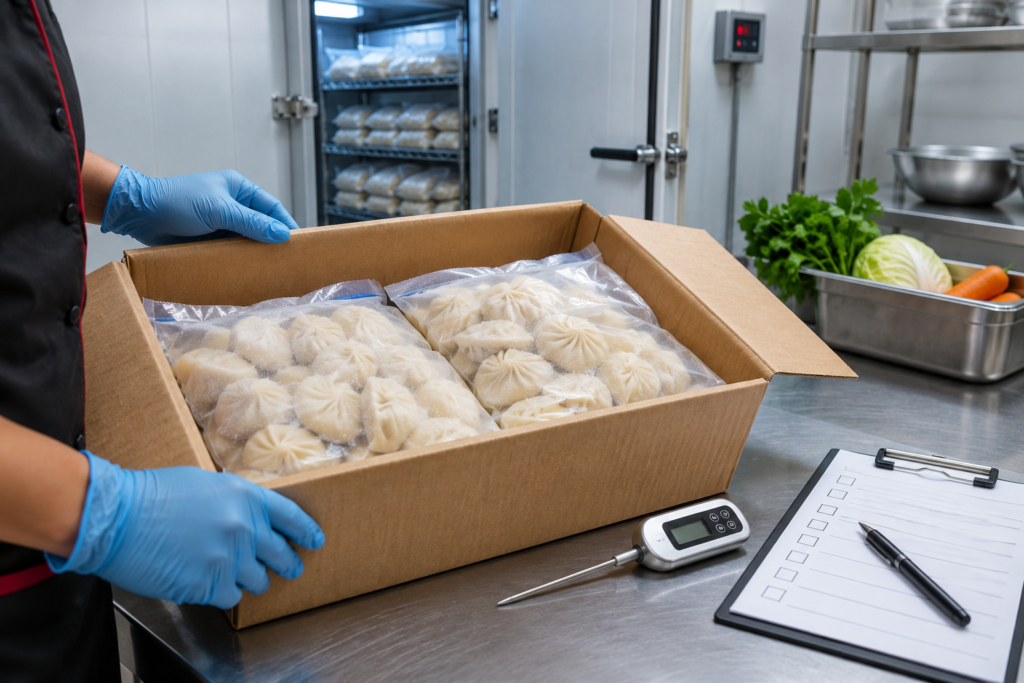
Ten checks for every bulk frozen momo delivery
- Confirm the supplier and delivery documents. Match the purchase order, consignment note and approved food-business identity where applicable.
- Confirm the exact SKU. A “veg momo” carton may not be the same product code, filling, piece weight or cooking status as the one you purchased.
- Count packs and pieces. Verify cartons, packages, net quantity and shortages without delaying temperature-controlled handling unnecessarily.
- Check transport temperature evidence. Review the relevant vehicle/refrigeration records, with exceptions recorded and investigated.
- Check product temperature appropriately. Use an approved sampling and measurement method suited to the pack and the frozen product, not a casual touch test.
- Inspect packaging and seals. Look for damaged cartons, tears, leaks, tampering, excessive condensation, unusual ice patterns or exposed food.
- Read dates and batch codes. Record manufacturing/packing date, best-before or expiry and lot identifiers; confirm usable remaining shelf life.
- Check allergen and product status. Confirm raw, partly cooked or fully cooked state, veg/non-veg status and key ingredient declarations against the controlled specification.
- Record acceptance or exception. Document time, quantity, temperature evidence, assessor, photographs if needed and the disposition decision.
- Transfer acceptable stock to controlled storage. Segregate raw and cooked products as required and practise appropriate FEFO/FIFO stock rotation.
Use the checklist as a training aid and adapt it to the establishment’s legally applicable food-safety requirements and supplier specification. It is not a substitute for qualified FSMS or HACCP design.
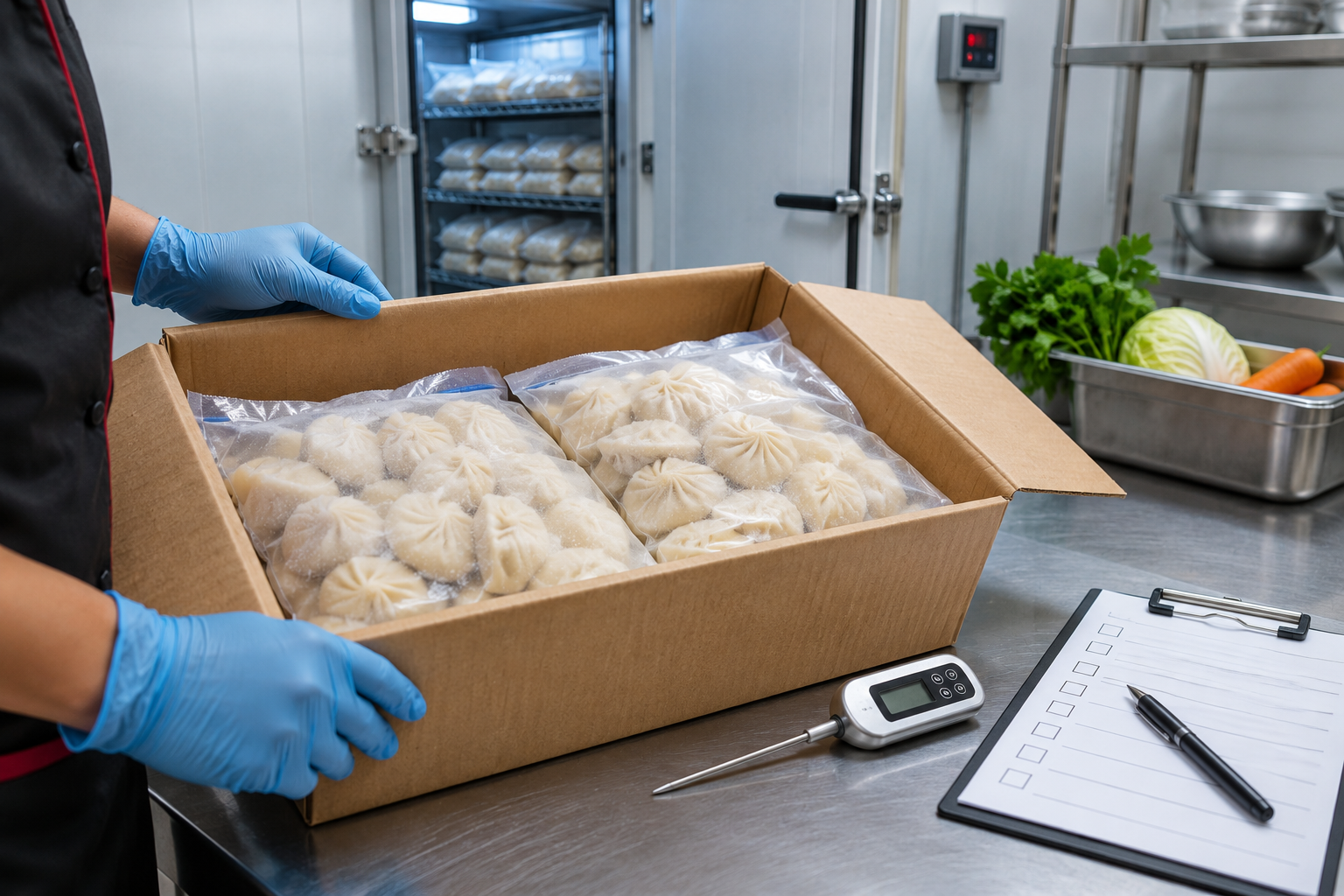
What temperature should frozen momos arrive at?
For applicable Indian warehouse operations, FSSAI’s inspection checklist references receiving and storing frozen products at −18°C or below and chilled products at 5°C or below. These are significant reference values, not a promise that every temperature-measurement procedure or product can be evaluated identically. The relevant operation’s regulations and documented product specification govern its actual acceptance criteria.
How you measure matters. Air temperature on a vehicle display, temperature of the outer carton and actual product temperature are different observations. A professional receiving SOP should define suitable instrument type, calibration, representative sample location, measurement method and acceptable deviation/disposition rules. A single freezer-display reading cannot prove that a consignment stayed cold throughout transport.
Why thawed-looking packages need escalation
Wet outer cartons, unusual pooled liquid or partially thawed dumplings can indicate damage or temperature problems, but visible signs alone cannot measure the full temperature history. Hold the stock, document the evidence and seek an authorised quality decision. Do not place suspect product back into sale simply by refreezing it.
Why frozen status doesn’t prove cooking status
A frozen dumpling may be raw, partially cooked or fully cooked. Labels such as ready-to-cook and ready-to-eat have different operational meanings. USDA FSIS consumer guidance for frozen raw breaded poultry illustrates why brown or cooked-looking surfaces are not evidence of safe cooking; that source is an illustrative US poultry example, not a universal legal definition for momos. Always follow the actual momo product specifications.
Example frozen momo receiving log
A receiving log should be simple enough that staff complete it during a busy shift while retaining the evidence needed for a complaint or recall. The example structure below is not a record of any actual delivery.
| Field | Example entry (fictional) |
|---|---|
| Received at | 02 Nov 2026, 11:15 AM |
| Supplier / PO | Example Supplier / PO-001 |
| Product / SKU | Example frozen veg momo, SKU V-01 |
| Pack and quantity | Example: 8 cartons × 10 packs |
| Lot / batch | EXAMPLE-B001 |
| Product status | Ready-to-cook (as declared in sample specification) |
| Manufactured / best-before | Read actual label, do not invent |
| Temperature method and result | Actual calibrated instrument, sample position, measured value |
| Packaging | Intact / damaged / uncertain, with notes |
| Decision | Accept / Hold / Reject |
| Staff name and action | Signed receiving record and escalation contact |
Never write the expected temperature in the measurement box instead of recording the observed value. Repeatedly copying a “standard” number destroys the log’s reliability.
Accept, hold or reject? A simple decision framework
| Status | When it may apply | What staff should do |
|---|---|---|
| Accept | All approved product, temperature, pack, date and documentation criteria are met | Sign and transfer promptly to the correct storage; retain the lot record |
| Hold / quarantine | Temperature evidence is incomplete; a batch/date mismatch needs investigation; damage is uncertain | Segregate under appropriate safe conditions, mark clearly and escalate for authorised disposition |
| Reject | Documented failure against mandatory acceptance criteria or an authorised food-safety rejection decision | Follow the agreed claims and safe-return/disposal procedure; record evidence |
Do not let a driver pressure the kitchen into signing an “accepted in good condition” statement before checks are complete. At the same time, avoid leaving cold stock warm while administrative disputes continue. A pre-agreed hold and supplier-escalation protocol is essential.
Sample corrective-action situation
Imagine that an illustrative shipment arrives with one damaged carton and missing temperature logs. The receiver records photos, identifies affected batch numbers, keeps stock segregated within suitable safe storage where possible, and contacts the designated quality lead and supplier. The final decision might be acceptance after documented investigation, rejection or another permitted disposition; this article does not pre-authorise the use of food with uncertain safety.
What happens after receiving: freezer transfer and stock rotation
Correct receiving is wasted if accepted cartons sit beside a hot kitchen line. Transfer products promptly to storage that satisfies the current specification. Organise racks and airflow without placing food directly on the floor. Keep access and cleaning routes clear, avoid mixing non-food chemicals with food, and follow the manufacturer’s storage and segregation directions.
Two common stock-rotation terms are FIFO (first in, first out) and FEFO (first expiry, first out). For products with different expiry dates, FEFO can help use earlier-expiring stock first, subject to condition and approved status. The FSSAI inspection checklist addresses FIFO/FEFO and records of temperature monitoring. Never move a recalled, quarantined or expired carton into ordinary saleable stock merely because it was first to arrive.
Outlet managers should verify freezer-temperature records and investigate excursions using the business’s food-safety plan. Routine equipment maintenance and a response plan for power failures are relevant parts of cold-chain control.
Batch traceability: can you find every outlet that received a lot?
A well-run receiving system connects the supplier, SKU, batch, shipment, quantity and receiving outlet. If the supplier later flags a lot, the business should know which store locations received it and how much remains. FSSAI’s food recall information explains the obligation to withdraw non-compliant or unsafe products as required.
FSSAI announced a FoSCoS food-recall functionality in March 2026. The scope and reporting duties depend on the applicable recall procedures and business status; the existence of a portal does not mean a blog can determine the correct legal response to every incident.
For a restaurant chain, perform a documented test using an illustrative lot: find the delivery note, recipient outlets, quantities and current stock. If the result requires manual searching across messages and photographs, improve the records before an actual recall event.
How to train staff to perform a receiving check consistently
Give receiving staff a short controlled one-page form plus a practical demonstration. A useful competency check includes interpreting the pack label, identifying the product as raw or cooked, taking an appropriate temperature measurement, recording lot numbers, recognising damaged packaging, and knowing whom to call. Employees should be empowered to put unsafe or questionable goods on hold.
A supervisor can periodically compare receiving logs to the inventory system and actual cartons. Missing temperature evidence, repeated overwritten records or an implausible run of identical readings should prompt a process review. The goal is reliable evidence, not paperwork volume.
Questions to agree with a wholesale momo supplier before the next delivery
- Which frozen, chilled or cooked product formats are currently supplied, and with what specifications?
- What storage and receiving temperatures, measurement methods and permitted tolerances apply?
- Can the supplier provide relevant dispatch, vehicle and batch documentation?
- Who is contacted for a transport delay, temperature excursion or short shipment?
- What are the claim windows and rules for rejected food and replacement stock?
- What is the process for changes in ingredients, allergens, shelf life, cartons and labels?
- How are affected outlets notified if a batch is withdrawn?
Momo Delights presents a foodservice proposition on its HoReCa/B2B page, together with published ingredient sourcing and quality and traceability information. Those pages are appropriate for enquiry and context; this article does not claim any particular delivery temperature record, certificate, service area or supplier guarantee has been verified for Momo Delights.
Frozen momo delivery receiving FAQs
What should a restaurant check first when frozen momos arrive?
Check the ordered SKU, delivery/temperature evidence, packaging integrity, quantity and dates, then document receipt and move approved stock promptly to correct storage.
What temperature is used for frozen food receiving in FSSAI inspection checklists?
Applicable checklists reference −18°C or below for frozen stock. The specific operation must apply the current legal requirements and written product specification.
Can I accept a delivery if it still feels cold?
A touch test alone cannot establish an acceptable cold chain. Use defined measurements and documentation.
What if a frozen momo carton is damaged?
Document it, isolate as appropriate and follow the approved quality and claims procedure rather than automatically selling or discarding it without assessment.
What is FEFO in frozen food storage?
First Expiry, First Out: stock with the earliest applicable expiry is used first, provided it is safe and approved.
Why record batch numbers?
They help connect complaints, stock and potential recalls to the relevant consignment or production lot.
Does a frozen momo count as ready-to-eat?
Not automatically. Frozen describes storage; the product may be raw, partly cooked or already cooked.
Should staff refreeze partially thawed stock?
Never make that decision from appearance alone. Follow product-specific instructions and authorised food-safety disposition.
Is this the actual Momo Delights warehouse SOP?
No. It is an educational checklist for restaurant operators, not an audited brand procedure.
How can I request Momo Delights B2B specifications?
Use the official B2B enquiry page and ask for current SKU-specific documentation and commercial terms.
Sources and editorial disclosure
- FSSAI — Hygiene Requirements (FSMS, GMP, GHP).
- FSSAI — Revised Inspection Checklists, April 2025 (receiving temperatures, storage controls, stock rotation).
- FSSAI — Food Recall (withdrawal of unsafe/non-compliant food).
- FSSAI — March 2026 FoSCoS Recall Order (recall portal implementation).
- Momo Delights — HoReCa/B2B Supply (business enquiry channel).