

Aa Reading preferences
Preventing Vegan and Allergen Cross-Contact in a Shared Momo Kitchen is an editorial guide for readers and food businesses. Product composition and operating requirements must be checked for the specific item and location.
Two different promises require two different controls
Vegan integrity concerns the absence of animal-derived ingredients such as conventional paneer, cheese and ghee. Allergen safety concerns foods including wheat, milk, soy, sesame and peanuts that may cause a reaction in susceptible diners. A vegan food can still contain allergens; a dairy-free kitchen may still handle wheat and soy. Neither statement implies a guaranteed zero-risk environment.
Map every product before designing the workflow
Make a one-page specification for every SKU covering wrapper, filling, sauce, garnish, supplier and approved substitutions. Identify allergens in ingredients and seasoning blends, and give each open container a clear label. Any change in supplier, frying oil, prepared sauce or coating can invalidate yesterday’s ingredient answer.
Do not let staff rely on a mental list of “usually safe” dishes when a customer’s allergy is involved.
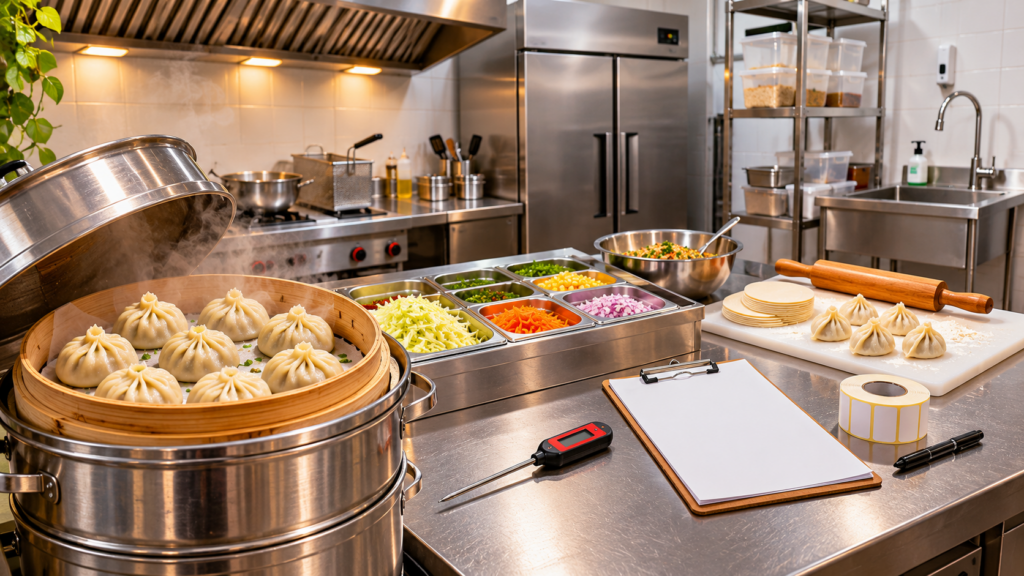
Find the hidden transfer points
| Station | Possible cross-contact | Control to assess |
|---|---|---|
| Dough board | Wheat flour dust | Dedicated equipment or validated clean-down |
| Blender | Sesame or peanut paste | Dedicated jar or effective documented cleaning |
| Steamer | Leaking dairy filling | Suitable trays and assessed cleaning |
| Fryer | Shared oil with wheat breading | Separate process where needed |
| Service | One ladle used for two dips | Dedicated, labelled spoons |
| Packing | Wrong sauce placed in order | Two-person or two-point verification |
The six-step order protocol
- Record the customer’s exact ingredient restriction, not a vague “special” marker.
- Confirm the current recipe and whether it can be safely accommodated.
- Assign ingredients, tools and a work area with appropriate controls.
- Cook and handle food under a documented procedure.
- Package it separately, with the order correctly identified.
- Have a designated person verify the order at handoff.
If cross-contact may have happened, do not simply remove the suspected ingredient. The order may need to be remade or declined.
Cleaning must be more than a quick wipe
Food Allergy Research & Education warns that allergens can transfer via worktops, utensils and shared food-preparation equipment. Cleaning requires an appropriate, validated method for the actual surface and food residue. A shared blender’s gasket or a textured chopping board can be harder to clean than a smooth steel counter.
FSSAI’s food-service Schedule 4 guidance explicitly identifies allergens and calls for separation and controls against cross-contact; where safety cannot be assured, consumers should be informed.
Train, test and document
Have front-of-house staff practise explaining why “vegan” does not mean peanut-free and why “veg momo” may still include wheat. Walk one mock allergen-sensitive order through the kitchen weekly and record the outcome. Train new starters before leaving them to improvise answers at a busy counter.
For Momo Delights brand-level information see the published allergen page. This article is a suggested operational framework, not a claim that every outlet already uses these exact procedures.
For additional foodservice guidance, see Momo Kitchen Equipment Checklist: Steamer, Freezer, Layout & Setup Guide and Foodservice supply. Use verified product specifications and food-safety procedures.
Frequently asked questions
Does vegan mean allergy-safe?
No. Plant-based foods can contain several serious allergens.
Can every steamer be shared?
That depends on equipment, cleaning validation and the customer’s specific requirements.
What if staff cannot verify the ingredients?
Do not promise the product is suitable.


Leave a comment