Aa Reading preferences
Momo franchise staffing costs depend on the approved menu, shift coverage, opening hours, food-safety duties, service capacity and local employment requirements. A compact outlet may have fewer people than a dine-in restaurant, but it still needs someone to receive and store food safely, cook, pack, serve customers, reconcile orders and clean properly. Cutting staff below safe capacity can damage service, while scheduling too many people during quiet periods can consume contribution.
At Momo Delights, our Healthy. Tasty. Organised. approach combines chef-led Himalayan-inspired food with defined product systems, training and clear daily operations. This guide provides an illustrative shift roster, labour-budget worksheet, peak-hour capacity test and training checklist. These are owner-planning tools—not published Momo Delights mandatory headcounts, official wage rates or outlet profit forecasts.
Quick answer: Start with tasks and food-safety coverage, then schedule a realistic number of people for each trading period. Calculate employer costs beyond take-home wages and check local legal requirements. Test whether the team can handle peak orders safely and keep the payroll plan inside a conservative contribution forecast.
What jobs exist inside a compact momo outlet?
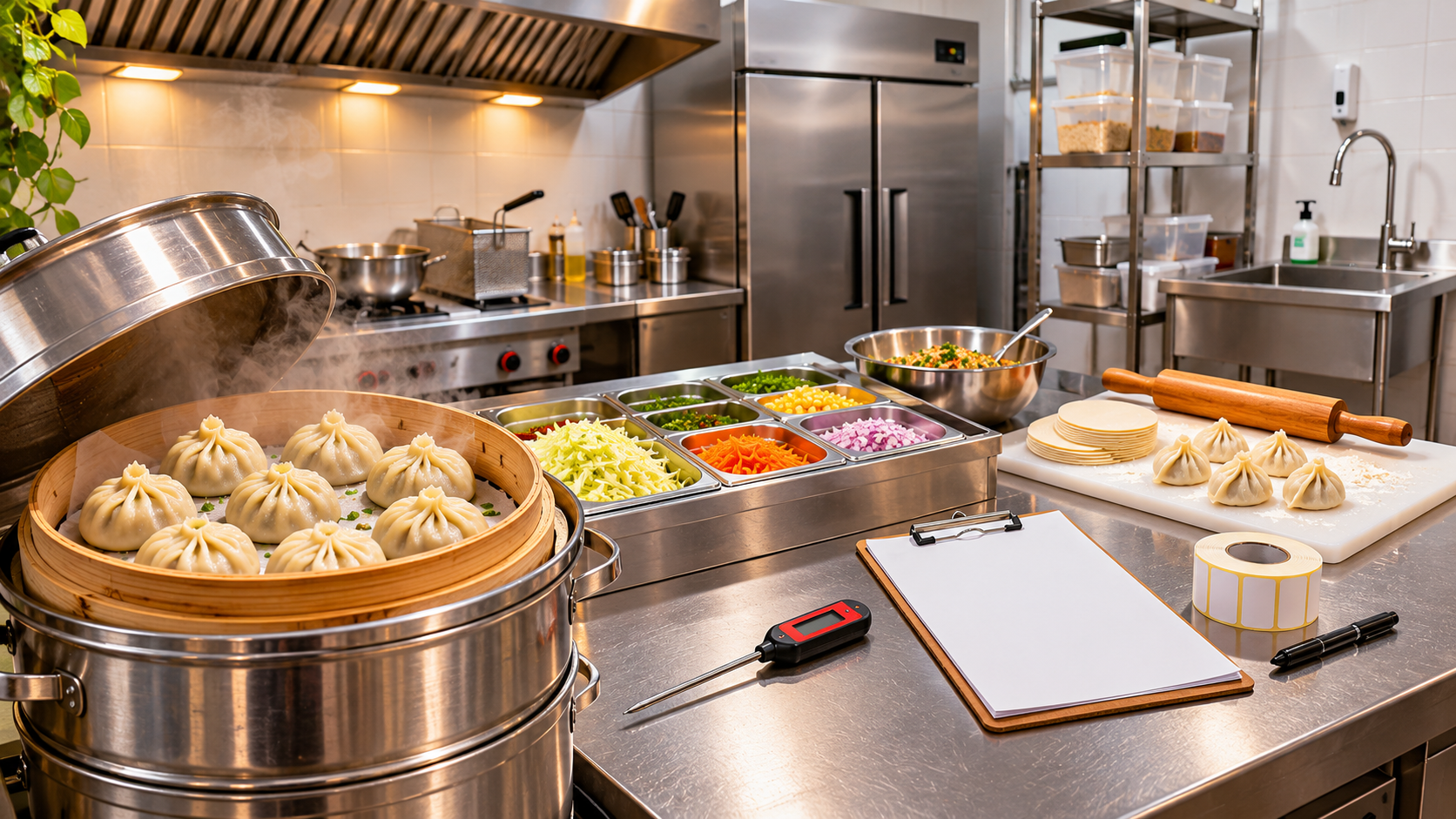
One employee may perform more than one function if properly trained and if hygiene and service needs allow it, but responsibilities still need to be named. A typical task map includes receiving, storage, food preparation, cooking, sauce handling, packing, POS, customer service, cleaning and closing reconciliation.
| Task | Main responsibility | Risk if neglected |
|---|---|---|
| Receiving and cold storage | Check deliveries and store products under specified conditions | Unsafe food, missing stock and spoilage |
| Cooking and portioning | Use approved equipment, cook methods and portion controls | Inconsistent taste, delays and safety problems |
| Order and sauce packing | Check items, labelling, sauce containment and collection | Refunds, complaints and texture loss |
| Counter / POS | Accurate pricing, payment and helpful customer service | Wrong transactions and queue abandonment |
| Cleaning and sanitation | Handwashing, utensil cleaning, surface and waste routines | Food-safety incidents and operating disruption |
| Shift lead / manager | Assign work, solve issues, manage stock and reconcile cash | Repeated errors and poor accountability |
A supplier-supported product system may reduce some scratch-production tasks, but it does not eliminate receiving, cold-chain, correct cooking or service obligations. Our first-week staff training guide and multi-outlet quality SOP show why documented procedures matter.
How many staff does a momo franchise require?
There is no defensible universal answer without a site and its approved menu. Staffing depends on actual trading hours, expected order peaks, preparation complexity, storage and cleaning needs, mandated rest periods and whether the owner personally works shifts.
The schedule below is a hypothetical coverage exercise for a compact takeaway, not a Momo Delights staffing rule:
| Operating period | Illustrative coverage | Work to test |
|---|---|---|
| Opening preparation | Shift leader plus food preparation support | Receive/check stock, start equipment, cleaning, prep |
| Quiet trading | Two trained people sharing stations | Orders, safe cooking, packing and counter response |
| Lunch or evening rush | Three trained people with defined roles | Cooking, packing, payment and rider/customer flow |
| End of day | Appropriate close team under designated lead | Stock control, safe food storage, cleaning, cash reconciliation |
This is a description of task coverage within periods, not a four-shift employee count. A legal and affordable weekly roster must additionally account for staff hours, breaks, weekly rest, leave, absence and actual trading schedule. One person cannot be counted as available for simultaneous work at different stations. Validate with real service trials.
Design a shift roster around order peaks
Suppose a fictional shop trades for ten hours daily with two pronounced order peaks. Scheduling the same crew size throughout the day may waste labour during quiet periods or leave too few people during rush. Map every employee’s actual paid hours, breaks, skills and the tasks requiring dedicated attention.
What a weekly roster spreadsheet should contain
| Field | What to record |
|---|---|
| Employee and skills | Approved stations and required training |
| Shift start/end | Actual working period with required rest and breaks |
| Peak assigned role | Cook, pack, counter, delivery dispatch or supervisor |
| Leave and absence cover | Qualified replacement and call-in plan |
| Payroll category | Base pay, applicable allowances, overtime and employer obligations |
| Training and safety | Required refresher, hygiene or equipment instruction |
Review the rota after observing actual completed orders and service times. A complex menu can require more labour without adding enough contribution; our focused QSR menu guide helps evaluate this trade-off.
What should be included in labour cost beyond salary?
Monthly wages alone can understate employer cost. A full budget considers applicable payroll contributions, overtime, leave, staff meals or uniforms, recruitment and replacement training, compliance work and any temporary coverage. The obligations depend on location, establishment and applicable employment rules, so do not use one all-India minimum wage number.
Hypothetical monthly labour-budget example
| Planning item | Fictional amount |
|---|---|
| Wages and regular pay for planned team | ₹62,000 |
| Employer contributions and allowances | ₹6,000 |
| Shift backup and overtime provision | ₹5,000 |
| Recruitment and training amortised allowance | ₹3,000 |
| Illustrative labour budget | ₹76,000 monthly |
These are teaching numbers, not current wages in any city, an official Momo Delights headcount or a legal payroll calculation. Replace them with offers that comply with the relevant state or UT rules, and confirm any employee benefits and statutory contributions with an adviser.
How labour cost changes break-even
Suppose a hypothetical outlet has ₹75,000 in monthly costs excluding staffing and average ₹90 contribution per paid order. At ₹76,000 staffing expense, fixed costs total ₹1,51,000 and operating break-even requires 1,678 orders per month (rounding up). That equals roughly 56 daily orders over 30 trading days.
If staffing costs increase by ₹12,000 without a change to contribution, break-even rises to 1,812 monthly orders, about 61 daily. The additional coverage might be worthwhile if it safely increases completed profitable orders or reduces refunds and errors. Do not treat the smallest payroll as the best one; measure the difference in service and contribution. These are hypothetical figures, not expected store sales.
Our monthly costs and break-even framework explains broader expense categories and cash runway.
Peak-hour capacity: why the team must match the kitchen
A steamer cycle, portion process, packing station and POS queue create a chain. If the cooking station can safely produce 18 orders in fifteen minutes but packing can finish only 12, the effective system throughput is constrained by packing—unless the workflow changes safely. Actual results depend on product, staff competence, equipment and order mix.
Run a controlled, food-safe service simulation with timed orders. Record cooking completion, packaging delay, order accuracy and customer collection. Do not pressure employees to skip temperature, handwashing or cleaning procedures to hit an unrealistic speed target. The equipment planning checklist helps identify the physical limits.
Training, safety and FoSTaC supervision
The Food Safety and Standards Authority of India (FSSAI) states that food businesses holding State or Central licences should have at least one trained and certified food safety supervisor for every 25 food handlers or part thereof at their premises. Confirm the requirement and applicable training under the current food-business category; FoSTaC catering courses address foodservice hygiene.
Train all staff in the operations relevant to their role, including allergens, receipt, safe storage and cooking, handwashing, cleaning, equipment failure, customer complaints and critical escalation. A supervisor certificate does not replace safe daily procedures or outlet-specific documentation.
Five demonstrations before independent station work
- Correctly receive and store an approved delivery, including exceptions.
- Prepare an order safely with the correct portion and cooking method.
- Package and label an order accurately, keeping sauces secure.
- Respond to a customer food-allergy question using the approved procedure.
- Clean the workstation and complete end-of-shift handover records.
Document training completion and revisit gaps following menu or equipment changes. A confident, consistent team supports repeat orders better than a one-time launch event.
How staffing responsibilities work in our FOFO model
Our published Franchise Owned, Franchise Operated programme places everyday staff and store management with the local partner. The documented core package is ₹10 lakh for licensing/onboarding and defined turnkey setup, and the programme lists 0% sales royalty, a ₹10,000 Brand Growth Fund per month and an optional ₹10,000 Local Sales Booster. The store’s actual payroll and working capital need separate budgeting; the core amount is not an all-in staffing forecast.
Our operating framework supports the food and training systems, but the partner must ensure the team performs daily duties. Review our FOFO ownership model, investment structure and quality overview when planning responsibilities.
Weekly staffing performance dashboard
| Metric | What it helps improve |
|---|---|
| Completed paid orders per labour hour | Team productivity without assuming every order has the same margin |
| Peak order handover time | Cooking and packing bottlenecks |
| Wrong orders and refunds | Training and station handover |
| Waste by product and shift | Portion control, storage and ordering |
| Absence and unfilled coverage | Scheduling resilience |
| Hygiene and training exceptions | Safety and operating readiness |
Monitor quality alongside labour productivity. A staff member forced to rush unsafe food preparation is not a productive operational improvement.
Frequently asked questions about momo franchise staffing
How many employees does a momo shop need?
No one figure suits every outlet. It depends on the approved layout, menu, hours, expected peak order load and legal staffing rules. Assess task coverage and breaks before selecting headcount.
Does a franchise provide all employees?
Do not assume that. Our published FOFO structure places daily staff and payroll responsibilities with the partner, supported by defined onboarding and operating methods under the agreement.
What is the typical salary for a momo outlet worker in India?
There is no trustworthy universal salary or legal rate. Pay and statutory requirements depend on the state or UT, job classification, working hours and current notifications. Verify actual offers and official guidance for your premises.
Can I reduce wage cost by hiring no shift lead?
A shift still needs clear accountability for hygiene, stock, customer service and cash. If a trained owner performs that role, account for the owner’s time and proper coverage rather than treating supervision as unnecessary.
How do I discuss staffing with Momo Delights?
Prepare the proposed hours, location, intended operator and menu format, then enquire through our official franchise programme for current training and partner responsibilities.
Build a team that can deliver the food consistently
Our Healthy. Tasty. Organised. philosophy depends on people following reliable routines. A strong staffing plan balances safety, hospitality, wages, shift resilience and real order contribution—so the food guests love remains consistent from opening to closing.
Sources and editorial method
Reviewed 22 November 2026. Food safety training: official FSSAI FoSTaC guidance and catering training. Franchise ownership: published FOFO guide. Rosters, wage scenarios and order-count calculations are original planning illustrations, not legal wage schedules or real store data.