Aa Reading preferences
Momos are part of a varied Himalayan dumpling tradition, and folding styles differ across communities, households and restaurants. This illustrated guide teaches practical shaping techniques, explains why wrappers open or tear, and helps you choose a folding style for steamed or pan-seared dumplings. It is a technique guide for home cooks, not the proprietary recipe used by Momo Delights.
Before you start: prepare the dough, filling and workspace
A typical momo wrapper begins with flour, water and sometimes salt or oil, rolled into small, thin discs. The Government of Sikkim’s cuisine guide describes rolling thin circles, adding a seasoned filling, folding and pleating, then steaming. Specific dough ratios, ingredients and cooking durations vary across recipes. For the folding stage, what matters is that the dough is pliable, not brittle or overly wet.
Use a clean rolling board, rolling pin, a lightly floured surface and a spoon for portioning filling. Keep the dough pieces or finished wrappers under a clean cloth or suitable cover while working. If vegetables release lots of water, an excessively wet filling can undermine the seams; adjust the filling according to a trusted recipe before assembly.
| Component | What good handling looks like | Why it matters |
|---|---|---|
| Dough | Rested, workable and evenly hydrated | Less cracking during pleating |
| Wrapper disc | Round, even and thin enough to fold without tearing | Creates room for filling and a dependable seal |
| Filling | Seasoned, portioned and not excessively wet | Reduces leaking and uneven closure |
| Wrapper edge | Clean of loose filling and excessive flour | Two dough surfaces can press together firmly |
| Work area | Clean surface; unused dough covered | Prevents drying and supports hygienic handling |
Published instructions differ on wrapper size. Dassana’s Veg Recipes demonstrates larger discs for paneer momos and suggests thinner edges for sealing, while a Columbia-hosted illustrated guide demonstrates smaller discs and two pleating traditions. Neither size is a universal standard. Choose a proportion that matches your filling and tested cooking method.
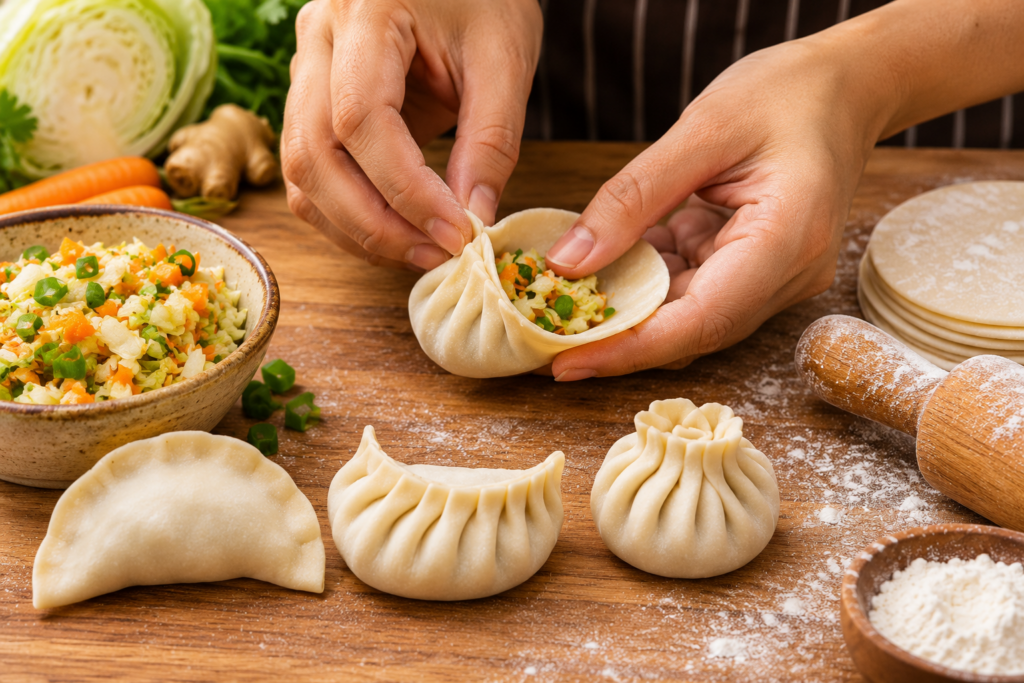
Three practical momo shapes to learn
| Shape | Relative difficulty | Key motion | Useful starting point |
|---|---|---|---|
| Half-moon | Beginner | Fold disc in half and pinch all around | Practice forming a complete seal |
| Pleated crescent | Intermediate | Make small overlapping pleats along a curved edge | Learn controlled folds without too much filling |
| Round pleated pouch | Intermediate | Gather small pleats around a circle into a sealed top | Practice turning the wrapper between fingers |
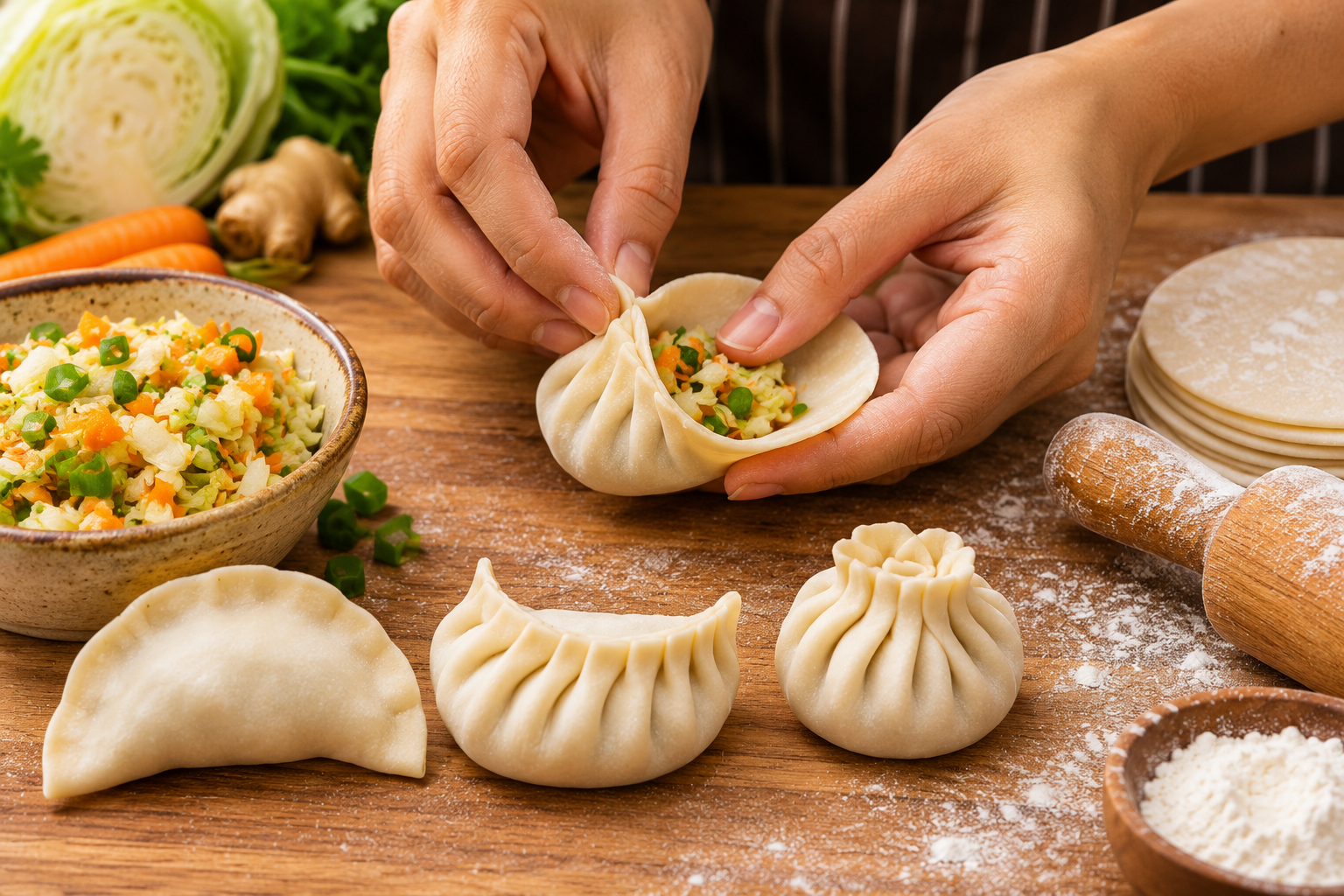
Method 1: The half-moon momo fold
This is a sensible first shape because it requires no decorative pleats. It also creates a broad flat side that can be useful in some pan-seared or kothey preparations, although the cooking process must be adapted to the actual dumpling.
- Hold a workable wrapper flat in one palm or lay it on a clean board.
- Add a small measured portion of filling in the centre. Leave enough uncovered border to seal.
- Bring the two opposite wrapper edges together so the disc becomes a half circle.
- Pinch the centre first, then press outward toward the ends, expelling large trapped air pockets without squeezing filling out.
- Pinch along the entire curved edge until there are no visible gaps.
- Place on a suitable clean tray and cover while you shape the rest.
Check your work: The dough should join edge to edge with no vegetable strands trapped between them. If the filling spills out, reduce the next portion or use a disc with more workable surface area.
Method 2: Pleated crescent momos
For a crescent, the wrapper is folded into a curved shape and small repeated folds create a decorative sealed rim. The paneer momo demonstration from Dassana’s Veg Recipes documents a version where pleats are made alternately from both sides and joined. The Columbia-hosted guide also shows a half-moon pleating approach with folds mirrored from the centre. Shapes and names are not universal.
- Place a modest amount of filling in a circular wrapper and bring opposite edges together without completely sealing the full rim.
- Choose one starting corner or the centre, depending on your preferred folding technique.
- Using thumb and forefinger, pick up a short section of the front edge and fold it back over itself.
- Press the new fold against the opposite edge to create a firm sealed section.
- Repeat with small overlaps, moving steadily along the curved rim.
- Close the remaining edge and check for tiny gaps, especially at both ends.
Tip: Keep pleats small and consistent rather than aiming for a record number. More folds do not guarantee better flavour, higher quality or safer cooking. The goal is a wrapper that remains intact through the cooking process and is pleasant to eat.
Method 3: Round pleated pouch or rosette
Another recognised momo shape gathers the entire rim of a circular wrapper toward the centre, creating a round pouch with a pinched top. Some cooks call it a money-bag or rosette shape. Exact cultural names and presentation conventions vary.
- Place the filling in the middle of a wrapper while leaving a continuous clean border.
- Support the centre with one hand and use the other hand to lift a small section of the edge.
- Pinch a small pleat, rotate the wrapper slightly and gather the next section.
- Continue in a circle until the rim forms a series of overlapping folds above the filling.
- Press or gently twist the gathered top so it closes securely; do not leave a large open hole unless a specific tested recipe calls for it.
- Inspect the base, sides and gathered top for breaks before placing the momo on the tray.
Why the top can become chewy: If too much dough is gathered at one point, the top becomes thick and may cook differently from the thinner sides. The precise balance depends on the recipe, not on a compulsory pleat count.
How do you keep the wrapper edges from drying before folding?
Work with only a few wrappers at a time and protect the rest from direct airflow. When a dough edge is already brittle, forcing more pleats tends to create cracks. A very small amount of water along an excessively dry edge may help in some recipes, but soaking the rim can create sticking or weak seams. Use the minimum needed and make adjustments according to the actual flour and dough.
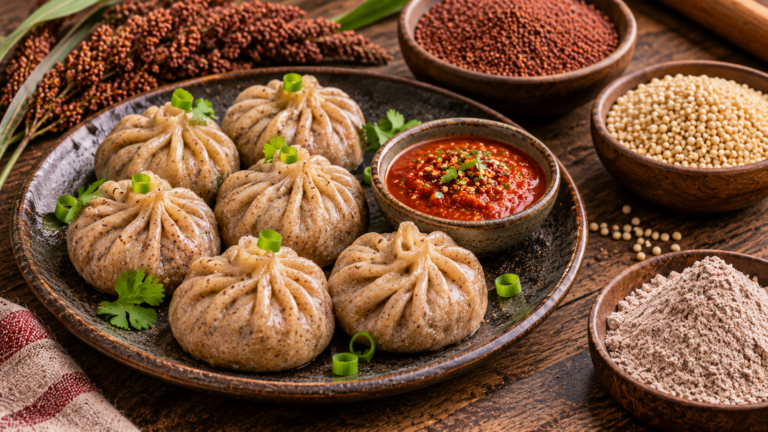
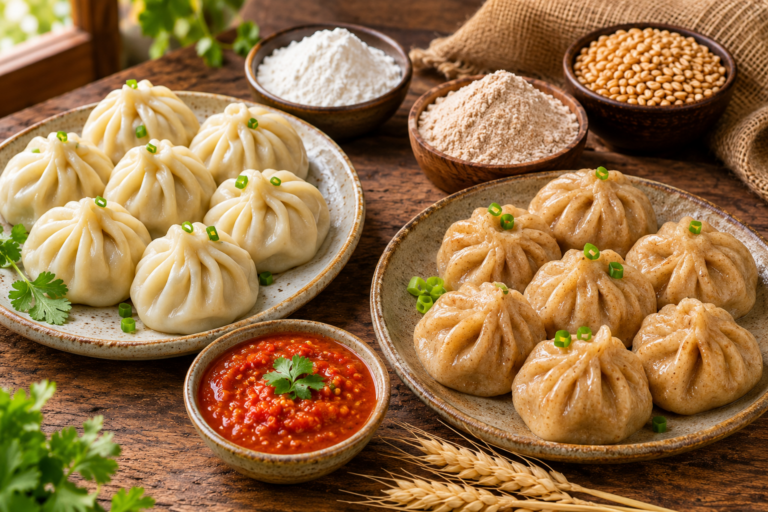
For whole-wheat or alternative-grain wrappers, dough extensibility can differ from refined wheat wrappers. A menu name such as “whole wheat” or “millet” does not tell you the exact dough formulation. If using a less elastic wrapper, it can be easier to start with a simpler shape and a smaller filling portion.
Seven momo folding problems and how to fix them
| Problem | Common cause | Practical improvement |
|---|---|---|
| Momo opens while cooking | Incomplete seal, filling in seam, weak dough | Clean the edge and press every section firmly |
| Wrapper tears during shaping | Too little dough strength or too much filling | Use a workable dough and smaller filling portion |
| Top is thick and tough | Excess dough gathered into one point | Use smaller, more even pleats |
| Wrapper sticks to the tray | No suitable release surface or excessive wetness | Use a clean approved liner or release aid |
| Pleats look uneven | Inconsistent folding size or hurried movements | Practice repeated small folds at a comfortable pace |
| Filling leaks before cooking | Too much free moisture or poor portion control | Use a tested filling and measured portion |
| Folded momos crack while waiting | Exposure to dry air | Cover finished dumplings and follow safe holding rules |
These are kitchen-technique suggestions, not food-safety clearance criteria. A sealed wrapper does not guarantee that a raw filling has been properly cooked.
Food safety: folding is only the assembly step
A neatly shaped dumpling can still contain raw vegetables, poultry or other ingredients that require safe handling and cooking. Follow a trusted tested recipe or product-specific instructions for storage, cooking and the appropriate centre temperature. Avoid leaving perishable raw fillings out while practicing folds. Separate raw and cooked foods and keep utensils clean.
India’s FSSAI hygiene requirements describe safe food-management expectations for food businesses. If your dumplings are commercial ready-to-cook products, do not substitute folding recipes for the manufacturer’s validated cooking instructions.
Which fold should you use for steamed versus kothey momos?
Round pouch and pleated crescent shapes are commonly steamed, while a half-moon or other shape with a broad contact surface can be convenient for a pan-seared kothey finish. No single shape belongs exclusively to one cooking method. Both shape and filling need to work with the equipment and validated recipe.
Browse the Momo Delights menu for steamed, fried and kothey styles. The menu does not promise any particular number of pleats or disclose the brand’s internal folding standard. Those details should not be invented in an editorial article.
Can restaurant kitchens standardize momo folding?
Yes, but productive standardization focuses on measurable parameters: piece weight, dough-to-filling balance, acceptable sealing, breakage, appearance and trained competence. A restaurant should not pursue perfect decorative pleats at the expense of safety, flavour, speed or yield. This matters particularly when comparing hand-made products with purchased ready-to-cook momos.
For business readers, see Momo Machine vs Ready-Made Momos and Adding Momos Without a Specialist Chef. Enquiries about current supplier formats belong on the Momo Delights HoReCa/B2B page, rather than assuming every consumer-menu product is also a wholesale SKU.
Frequently asked questions about folding momos
What is the easiest momo fold for beginners?
A basic half-moon: fold the wrapper in half over a modest portion of filling and pinch the curved edge securely.
How many pleats should a momo have?
There is no universal required number. Pleat size, wrapper thickness and folding tradition vary; a complete seal matters most.
Why do my momos open in the steamer?
Possible reasons include a weak seal, filling caught in the rim, excess filling or dough that dries or tears during shaping.
Should momo wrapper edges be thinner?
Many recipes use relatively thin edges to avoid a bulky seam while maintaining enough strength in the centre to support the filling.
Can I fold momos without pleating?
Yes. Half-moon momos can be sealed by pressing the rim together without decorative folds.
Do round momos taste different from crescent momos?
Shape can affect wrapper thickness and cooking, but filling, dough and cooking method usually have a larger influence than shape alone.
How do I prevent wrappers from cracking?
Maintain workable hydration, rest the dough according to the recipe and keep unused portions protected from drying.
Can I practice with paneer or vegetable filling?
Yes. Choose a properly prepared, relatively manageable filling, but follow safe holding and cooking rules.
Does Momo Delights use these exact folding methods?
This article teaches general techniques and does not claim to document the brand’s proprietary preparation process.
Research sources
- Government of Sikkim — Cuisine (momo dough, filling and folding steps).
- Dassana’s Veg Recipes — Paneer Momos (half-moon and round-pouch shaping with step-by-step examples).
- Columbia-hosted illustrated momo folding guide (example of two differing pleating styles).
- FSSAI — Hygiene Requirements (safe handling framework).
Editorial note, 1 November 2026: This is a general educational folding guide rather than a Momo Delights recipe or cooking SOP. No exact pleat-count standard, safety time or brand-specific method is asserted. The featured image is an AI-generated conceptual illustration, not a photograph of a Momo Delights employee or kitchen.