

Aa Reading preferences
The gap between cooker and customer is where many good momos lose their character. Wrappers dry when exposed to air, soften in wet condensation and tear when piled too deep. More importantly, food held at an unsuitable temperature can become unsafe even if it still looks warm.
A professional holding plan therefore has two separate goals: validated food safety and consistent eating quality. A restaurant should measure both rather than assume one guarantees the other.
Start with the applicable Indian safety control
FSSAI’s foodservice inspection and catering guidance sets hot-food holding at 65°C or above in the referenced Indian framework. This differs from the 60°C/140°F benchmark often seen in US consumer material. Follow current applicable FSSAI requirements and the site’s approved Food Safety Management System; a published blog temperature does not replace those responsibilities.
Use a calibrated food thermometer to measure the dumplings themselves, not only the steamer reservoir or warming cabinet display. The coldest representative part of a large tray may differ from the surface nearest the heat source.
The ideal holding setup preserves moisture without flooding
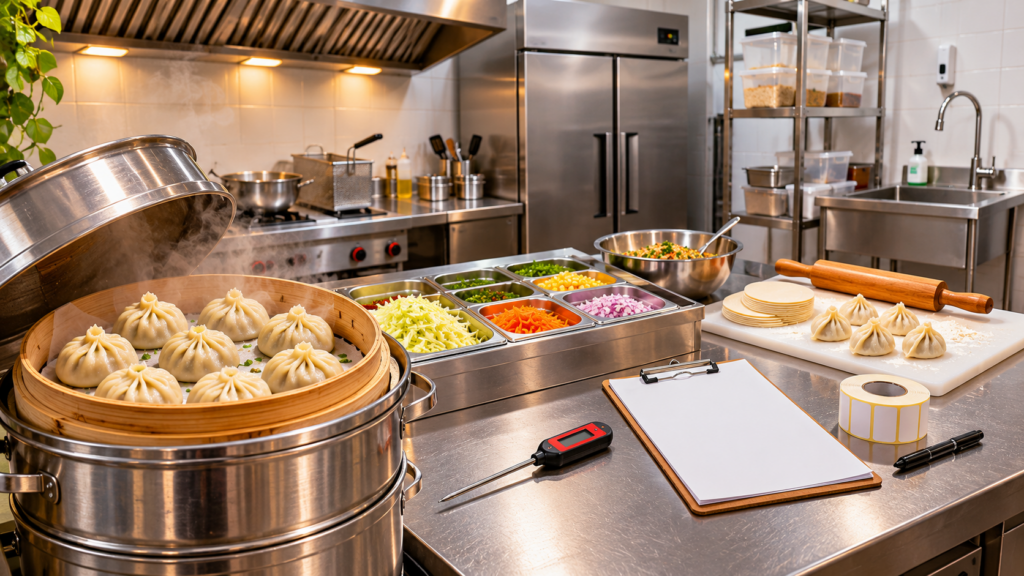
A covered, food-grade tray can reduce surface drying, while a dripping lid can make wrapper bottoms soggy. Check the steamer or holding cabinet for condensation and use manufacturer-approved racks or liners. Keep gaps between dumplings and avoid stacking many layers, especially around pleated seams.
A holding unit is not a reheater. Start with momos fully cooked under the approved SKU procedure. If their safety status is uncertain, stop service and follow the corrective-action protocol rather than turning up a dial and hoping.
Build a short-batch replenishment rhythm
Instead of loading a huge mound for the whole lunch hour, determine how many servings a small approved tray can cover. Monitor demand and cook or issue another batch before the existing tray is depleted. This improves texture and makes each lot’s service time easier to trace.
For example, if a tray holds 24 small dumplings and an average order contains six pieces, it provides four servings. That arithmetic is illustrative; actual equipment capacity and portion size must be validated by the restaurant.
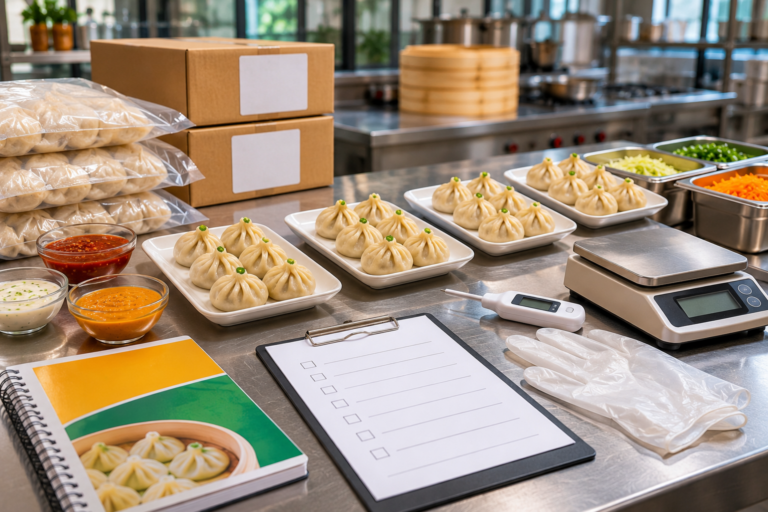
A shift-ready quality and safety log
| Field | Why it matters |
|---|---|
| SKU and lot | Identifies what is being served |
| Cooking verification | Shows the product was prepared correctly |
| Time into holding | Enables defined quality and safety checks |
| Measured food temperature | Verifies the actual hot-holding condition |
| Wrapper quality | Captures dryness, sticking or splitting |
| Corrective action | Documents replacement, quarantine or disposal |
| Staff initials | Defines responsibility |
What to do when wrappers dry or stick
Dry tops suggest exposure, excessive heat or too long a quality hold. Wet bottoms suggest pooled condensation, water contact or crowding. Torn seams can also arise from weak dough or overfilled dumplings before cooking. Record the pattern, then change one operational variable at a time. Never add water directly to a hot electrical holding unit unless its manual expressly instructs it.
Temperature excursions are not a free pass to reheat repeatedly
The referenced FSSAI guidance describes specific, restricted handling conditions for foods temporarily outside the required hot-holding range, including time and reheating limits. Staff should follow the current validated site procedure and record the event; they should not invent a two-hour grace period for every product or repeatedly rewarm leftover trays. A quality defect may require immediate replacement even when temperature has remained compliant.
Make allergy and SKU separation visible
Keep paneer, vegetable and other varieties correctly labelled and protected from cross-contact. Shared tongs and sauce cups can spread dairy, sesame, soy or other allergens. For professional ingredient information, check Momo Delights HoReCa/B2B supply and request current SKU specifications rather than relying on a general article.
Explore related Momo Delights guides: commercial momo kitchen equipment and our frozen momo receiving checklist. For actual operating procedures and supplier specifications, verify current product documentation and applicable food-safety requirements.
Frequently asked questions
Can a steaming-hot lid prove food is safely held?
No. Measure food temperature with a suitable thermometer.
Should cooked momos be kept under vigorous steam indefinitely?
No. This can damage quality and is not a substitute for a validated holding procedure.
Can new and old trays be mixed together?
Use a documented lot/time system and replacement protocol rather than obscuring the holding history.

Leave a comment