


Aa Reading preferences
A new momo flavour can win a tasting and still fail on the restaurant floor. Perhaps the sauce slows service, the wrapper breaks after delivery, or diners love it only when the launch discount is unusually deep. A short trial should reveal those problems before you commit a permanent menu slot.
This 14-day trial framework is designed for restaurants, cafés and cloud kitchens. It is an operational example rather than a guarantee of sales or a statistically powered scientific experiment.
Write the decision before you launch
Start with one clear question: “Can this proposed momo item maintain our safety and quality standards, fit our kitchen capacity, and earn enough contribution per serving at the planned selling price?” Avoid changing filling, coating, sauce, price and pack size all at once. Too many changes make results difficult to interpret.
Define what would count as a success, a revision or a rejection. Record assumptions before the first sale so you do not rewrite them to match the result.
Days 1–2: approve recipe and safety information
Finalise a written recipe, portion weight, ingredient list, allergen declaration, supplier source, preparation method, storage conditions and cooking safety standard. If using purchased frozen momos, confirm the manufacturer’s instructions and batch traceability. Test the item in its real takeaway packaging as well as on a plate.
Any uncertain allergen or food-safety control should block the commercial trial until resolved. A popular item cannot compensate for a safety problem.
Days 3–4: train and time the kitchen
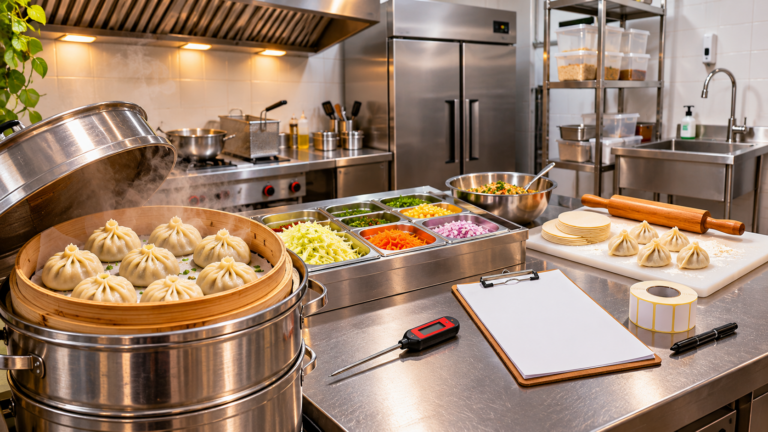
Have at least two staff members prepare the product using the same SOP. Record preparation time, equipment occupancy, rejects and delays during a busy shift. Ask: does it consume the same steamer capacity as three regular servings? Does it force a separate sauce or coating station? Can a new employee reproduce the outcome?
Photo examples, a portion scale and a short prep checklist can make training far more effective than a verbal recipe.
Days 5–11: run a controlled live-menu trial
Offer the item during a clearly defined period. Track the number of orders, portion returns, quality complaints, preparation time, waste and guest comments. Separate dine-in from delivery where relevant; they may have different texture results and costs. Document promotions so you can interpret a price-driven spike honestly.
A sample record for each day could include: orders, selling price, variable ingredient cost, packaging, channel fees, rejects and qualitative feedback. Avoid claiming “conversion improved” unless you have a defensible denominator.
Contribution is not the same as revenue
Use an illustrative calculation: a serving sold for ₹150 with ₹48 food cost, ₹12 packaging and ₹15 other order-variable costs generates a ₹75 contribution before fixed costs. That is ₹150 minus ₹48, ₹12 and ₹15. It does not represent net profit because rent, fixed labour, equipment and other overhead remain.
Change the assumptions to your actual figures. If the item has a high reject rate or consumes unusual equipment time, the arithmetic should reflect that.
Days 12–13: review the evidence
| Question | Evidence to review | Possible action |
|---|---|---|
| Do customers like it? | Repeat orders and specific feedback | Keep or refine flavour |
| Does the kitchen manage it? | Prep time, bottlenecks and rejects | Change SOP or capacity |
| Is it financially workable? | Contribution per serving | Reprice or reformulate |
| Does it travel well? | Delivery texture and packaging checks | Revise pack or serve format |
| Is the information accurate? | Specs and allergen documentation | Correct before extending trial |
Day 14: decide and document why
Choose launch, revise and retest, or stop. A weak result over two weeks is not necessarily proof that there is no market, and a launch-week spike is not evidence of durable demand. Consider season, footfall, promotion and whether staff had enough practice.
Archive the final recipe, photograph, ingredients, cost model and decision notes. For wider operations advice, see Momo Delights’ restaurant sales guide and menu photography guide.
Simple trial checklist
- Write objective and success criteria.
- Check supplier specs and allergen details.
- Validate cooking and storage.
- Measure yield and true variable cost.
- Train at least two cooks.
- Record dine-in and delivery separately.
- Review rejects and feedback daily.
- Make a documented go/no-go decision on day 14.
FAQs
Is 14 days enough to prove demand?
No. It is a useful operational screening window, not a guarantee of long-term performance.
Should I discount the item heavily?
Only with the promotion recorded clearly; discounts can obscure normal-price demand.
Do I need customer reviews for the test?
Detailed, consented feedback is useful, but do not incentivise misleading public reviews.
For more foodservice operational detail, explore HoReCa / B2B supply. Check applicable handling rules and current SKU specifications.

Leave a comment