

Aa Reading preferences
Customers order by flavour and craving. Kitchens have to deliver those choices through steamers, fryers, staff and a finite service window. A crispy momo may be attractive on a menu yet require a second finishing station; a steamed momo may be simple but compete for limited steamer space at peak time.
The useful question is not which style is universally more profitable. It is what each item contributes after accounting for its actual kitchen capacity and cost. Here’s a framework restaurants can test with their own equipment.
Map the real process for each item
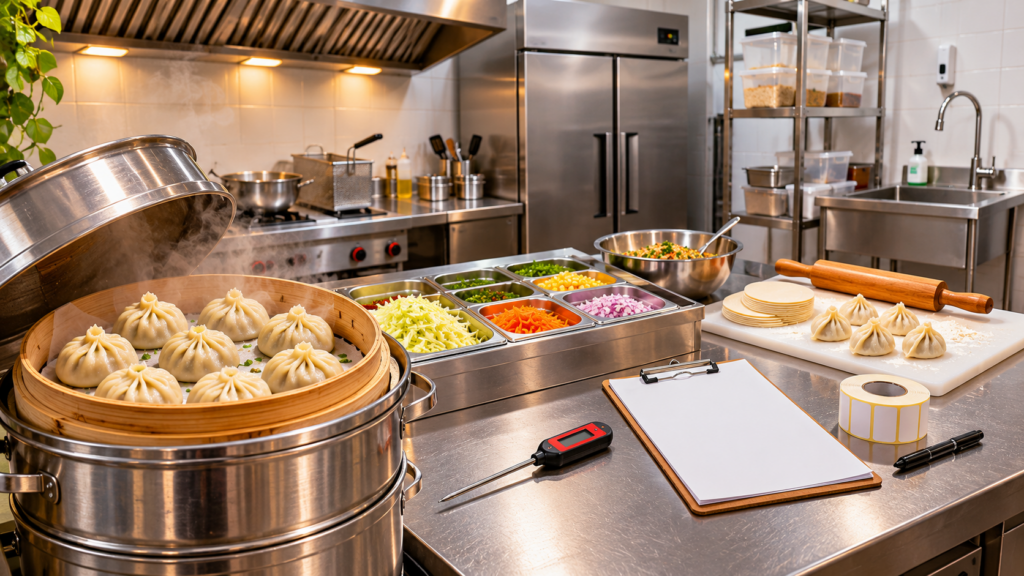
Write the steps from approved frozen or fresh stock to finished order. A typical steamed process may include checking the batch, loading the steamer, cooking, verifying doneness and plating. A crispy finish can add coating, frying or air-frying, draining, seasoning and possibly more cleanup.
The process will vary by SKU and equipment. Do not assume a raw frozen product can safely be deep-fried unless its manufacturer approves that method. Safety validation comes before speed.
Identify the bottleneck—not just the stopwatch time
Say a steamer holds 24 pieces per full batch and a hypothetical cooking-and-changeover cycle takes 12 minutes. In continuous ideal operation, that suggests 120 pieces per hour: 24 × (60 ÷ 12). Actual throughput will be lower when loading, cleaning, demand gaps and staff availability intervene. The figure is illustrative arithmetic, not a Momo Delights equipment claim.
If a crispy item adds a fryer step, the fryer or staff member may become the bottleneck. More orders do not automatically mean more output when two steps compete for the same cook.
Build a simple throughput worksheet
| Metric to record | Steamed SKU | Crispy SKU |
|---|---|---|
| Pieces per serving | Actual menu standard | Actual menu standard |
| Cooking cycle | Measured and validated | Measured and validated |
| Finishing minutes | Plating/sauce | Coating/frying/seasoning |
| Equipment station | Steamer | Steamer and/or approved fryer |
| Waste/defect rate | Observed broken pieces | Observed rejects or excess oil |
| Packaging cost | Actual material | Actual material |
Contribution margin needs the full variable cost
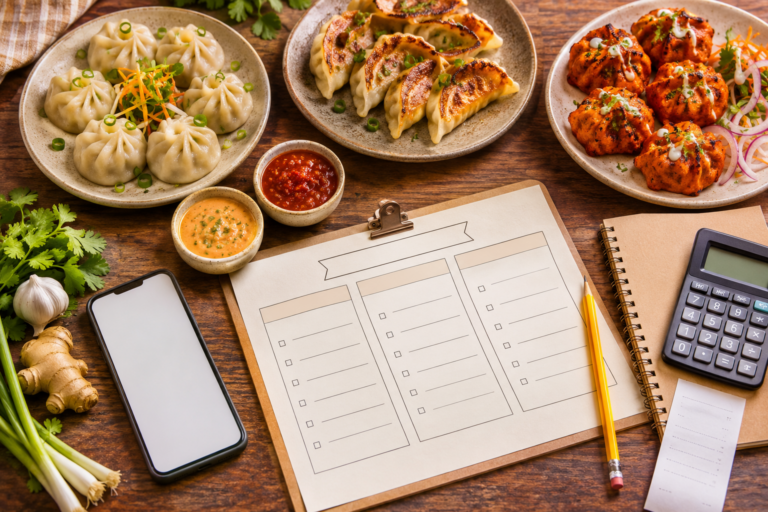
Consider a fictional steamed serving sold at ₹120 with ₹42 food cost, ₹8 packaging and ₹10 order-variable costs: contribution = ₹60. A crispy serving at ₹155 with ₹52 food cost, ₹10 added oil/coating, ₹10 packaging and ₹15 other variable costs contributes ₹68. The crispy item earns ₹8 more per hypothetical order, but it might take extra equipment time. Neither amount is net profit.
Record the actual units sold during peak service and the resulting constraint before declaring a winner. Fixed labour, rent and utilities still need consideration.
Quality during delivery is an operating cost
A crispy product may lose crunch inside a humid box, increasing returns or complaints. A steamed item may stick together or dry out while waiting. Packaging, timing and sauce placement should be tested as part of the SKU’s throughput—not added only after a dish sells well on a tasting plate.
Photograph the actual serving so the menu accurately represents size and finish. The Momo Delights food photography guide covers practical online-ordering presentation.
A controlled 90-minute peak-shift test
- Record equipment condition and batch instructions.
- Run both SKUs through normal staffed stations.
- Measure orders completed, queue length and rejected pieces.
- Note which operation runs out of capacity first.
- Test one normal delivery pack for texture at handoff.
- Calculate contribution per serving and per constrained station-minute.
Repeat the test in more than one service period before making a permanent menu decision. A single rush might be unusually busy or quiet.
Food safety and SOPs remain non-negotiable
FSSAI describes food-safety management, good manufacturing and hygiene practices as requirements for licensed food businesses. Use validated cooking and holding procedures, segregate allergens, and follow the product’s approved preparation method. A faster process is not better if it bypasses complete cooking or creates cross-contact.
FAQs
Are steamed momos always faster?
No. A small steamer may be the bottleneck while a properly organised frying line has spare capacity.
Does a higher price mean higher contribution?
No. Count coating, oil, packaging, rejects and channel costs.
Should I remove crispy momos from the menu?
Only after examining customer demand, margin and capacity with your own data.
For related foodservice resources, see How to Choose Between Steamed, Spiced and Crispy Momos and Preventing Vegan and Allergen Cross-Contact in a Shared Momo Kitchen. Follow current safe-handling requirements and supplier guidance.

Leave a comment