
Aa Reading preferences
What is the best momo franchise in India? The best choice is the one that can consistently serve food customers want to buy again, operate safely at your chosen site, and support sustainable economics under a clear franchise agreement. A famous logo, the lowest initial fee or a promised payback period is not enough to establish those qualities.
At Momo Delights, we believe the foundations of a strong momo business are simple to explain but difficult to execute well: Healthy. Tasty. Organised. Real flavour and reliable product quality matter alongside disciplined food safety, product sourcing, training, local demand and business controls. This guide gives prospective partners a 100-point franchise evaluation scorecard, an evidence checklist, a food tasting method and practical questions to ask before investing.
Direct answer: Choose a momo franchise using verifiable product consistency, realistic unit economics, reliable supply, practical training, location suitability and fair written terms. Score each factor on evidence—not claims. This is an impartial decision framework published by Momo Delights, not an unsupported ranking of competing companies.
What makes a momo franchise a strong long-term choice?
Food franchising has two parts. The consumer buys the eating experience: taste, texture, portions, hygiene, speed and service. The franchise partner invests in the system that produces that experience repeatedly. The two are connected. Attractive menu photography cannot replace product consistency; a sophisticated business presentation cannot create genuine customer demand.
Research from Redseer in July 2026 places the Indian foodservice market around US$90 billion and forecasts growth towards US$150 billion by 2030, with organised operators growing faster than the overall industry. These are industry-wide estimates, not an earnings forecast for a momo outlet. Demand still has to be earned locally.
Look at repeatable operations, not a single successful tasting
A great tasting platter matters—but can a team produce the same wrapper texture, filling weight, temperature and sauce pairing at a weekday rush? Can frozen or prepared inventory be delivered consistently and handled according to the specified method? Is the menu manageable at peak volume? Good franchise evaluation connects what customers taste with the equipment, supply and work routines required to deliver it.
The 100-point momo franchise evaluation scorecard
Our scorecard is an original buyer decision tool, not a certification system or a guaranteed predictor of profitability. Adapt the weights for your circumstances, and do not use a high score to overlook safety, legality or unsustainable cash requirements.
| Criterion | Maximum points | What evidence to inspect |
|---|---|---|
| Product quality and customer experience | 20 | Blind tastings, repeat visits, recipe consistency, real customer feedback |
| Supply, hygiene and quality control | 20 | Product specifications, cold-chain plan, stock handling, traceability and SOPs |
| Unit economics and commercial clarity | 20 | Written fees, realistic rents, channel mix, margins and cash-flow scenarios |
| Training and operational support | 15 | Training syllabus, opening support, troubleshooting and refresher process |
| Location and format suitability | 15 | Site scorecard, power/water/layout, traffic and delivery feasibility |
| Contract clarity and partner fit | 10 | Rights, obligations, exit clauses, operator role and verified contact points |
| Total | 100 | Score only after gathering evidence |
How to use it: For each area, give full points only for clear, inspectable evidence; partial points for incomplete information; and zero if the item remains unclear. Record links, documents, visits and notes. A 75/100 score that hides an unresolved food-safety failure or unaffordable lease is not an acceptable decision.
1. Taste and product consistency: evaluate what customers actually receive
Momos can vary in dough thickness, filling moisture, seasoning, texture, cooking method and sauces. Some differences are intentional menu choices; unwanted variation between batches and shifts can undermine repeat demand. Test the product at its normal intended serving temperature and delivery time, not just directly out of an ideal kitchen demonstration.
A practical tasting test
- Order the same core item on two separate occasions rather than judging one visit.
- Assess wrapper tenderness, filling balance, safe temperature, portion consistency and sauce pairing.
- Repeat the test as a takeaway order after a realistic transit period.
- Record objective issues such as torn wrappers, leaking packaging and uneven portions.
- Ask how the kitchen documents the cooking standard and resolves complaints.
Use a simple five-point scale per criterion and note the reason for each score. If you are considering a centrally supplied model, the test should also include receiving, storage and preparation requirements—not taste alone. See our 12-step quality standardisation guide and compact QSR menu-design framework.
2. Food safety and supply reliability: evaluate the system behind the plate
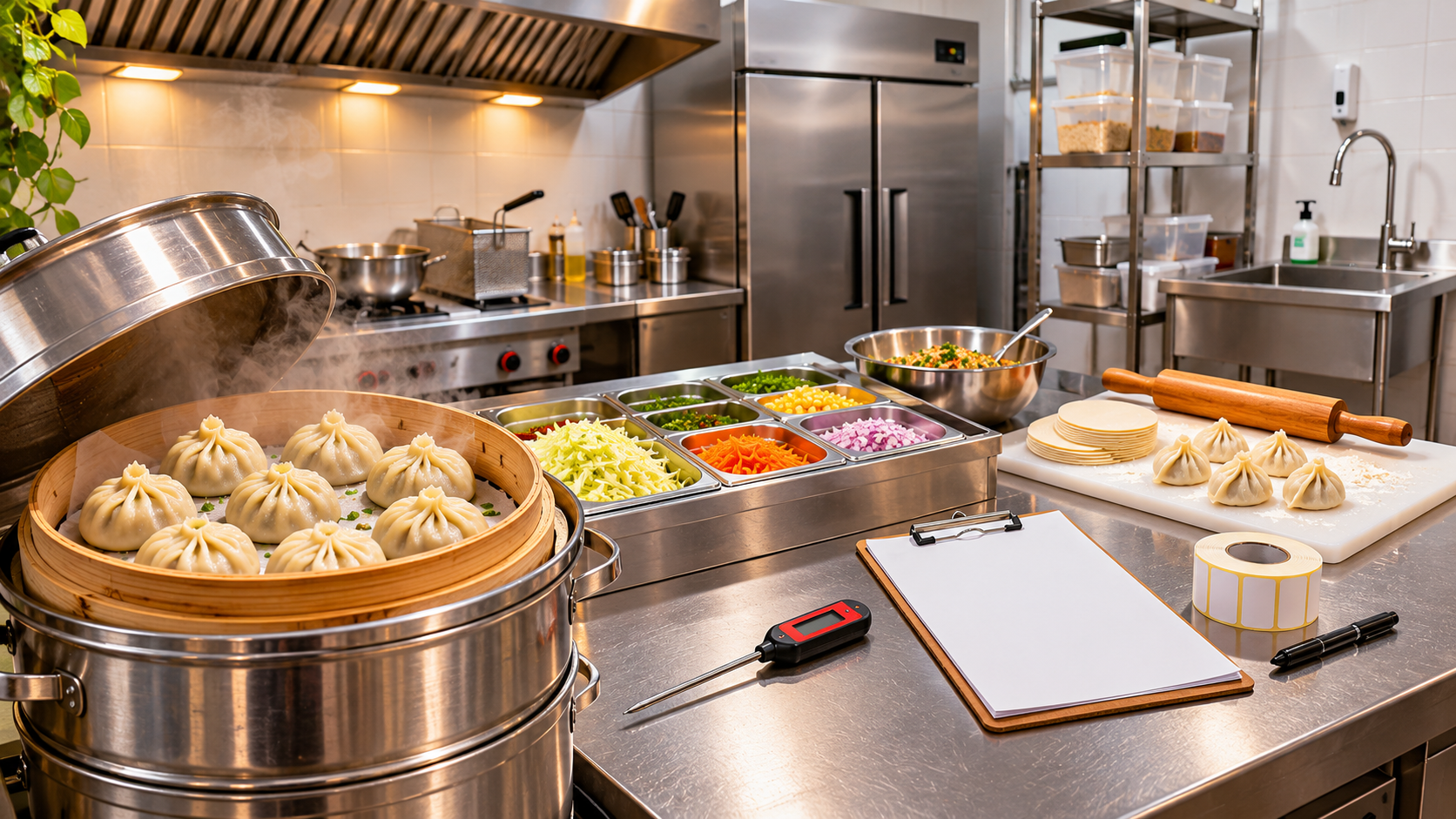
Food-service reliability starts before the customer places an order. Ask how products are specified, dispatched, received, stored, cooked and tracked. A centralised supply system can support repeatable standards, but only when temperature requirements, stock ordering, capacity and incident handling are clearly defined.
Seven supply-chain questions to ask
| Question | Why it matters |
|---|---|
| Are product specifications, portions and preparation instructions documented? | Limits preventable variability |
| What is the dispatch frequency and minimum order value? | Affects stock investment and replenishment risk |
| Who is accountable for transport temperature and rejected deliveries? | Protects product safety and financial clarity |
| How are expiry, FIFO/FEFO and stock records managed? | Reduces waste and unsafe inventory handling |
| Can batches be traced if a complaint or recall occurs? | Supports safe investigation |
| What happens when demand exceeds forecast? | Tests emergency stock and peak capacity |
| What training is given for cleaning, allergens and cross-contact? | Protects consumers and staff decisions |
At Momo Delights, chef-driven development and centralised production are part of our approach to standardising products. Our quality assurance and traceability information explains the controls we consider central to dependable foodservice. The official FSSAI FoSTaC training curriculum references the Schedule 4 hygiene obligations for the catering and restaurant sectors.
3. Unit economics: the strongest franchise is still a real business
Sales alone do not show success. An operator must understand realised revenue after refunds or discounts; the variable cost of products, sauces, packaging and order platforms; and monthly fixed expenses such as rent, payroll and utilities. Franchisor fees and agreed contributions belong in the budget too.
Contribution per order = realised revenue per completed order − the order-variable costs. Operating break-even orders = monthly fixed expenses ÷ average contribution per order. A business also needs a separate cash-flow model covering working capital, financing and asset replacement.
Illustrative example: why margin matters more than gross sales
Consider an educational scenario in which average realised revenue is ₹180 and variable expenses are ₹90 per order. Contribution is ₹90. With ₹1,50,000 monthly fixed expenses, operating break-even would be around 1,667 orders per month (about 56 daily across 30 operating days). If contribution falls to ₹70 while fixed costs remain unchanged, break-even rises to roughly 2,143 monthly orders (about 72 daily). This is mathematical illustration—not Momo Delights store performance or a claimed industry benchmark.
Before paying for a site, use real rent, expected channel mix and written product costs. Explore our momo franchise investment guide, break-even and cash-flow framework and rent sensitivity worksheet.
4. Training and support: evaluate what happens after the opening
A training promise is meaningful only when responsibilities and deliverables are clear. Examine who trains initial staff, how much time is allocated, what a successful trainee must demonstrate, and what happens if employees change. Ask whether the team receives written SOPs, food-safety instructions and a contact or escalation process.
In a franchise-owned, franchise-operated arrangement, a partner still runs the outlet. Staff rosters, daily supervision, inventory counts, service recovery and local team culture require attention. Our first-week momo outlet training framework offers a practical look at the routines a new team must master.
Test support against actual situations
Instead of asking only “Is ongoing support provided?”, ask what happens when a steamer fails during rush hour, a delivery arrives with damaged stock, a new employee joins at short notice or the weekly waste rate rises. A brand operating system should address routine and unexpected events in practical terms. Contracted support may differ by format and must be verified in the agreement.
5. Location choice: the best food franchise must fit its neighbourhood
Judge demand and operating feasibility together. Observe peak periods, relevant foot traffic, office and residential use, entry visibility, competitor pricing and delivery pickup. Then inspect utilities and safe food-handling space. A high-footfall location can still fail if rent, queue management or kitchen capacity makes the unit economics weak.
Site decision checklist
- Are potential customers present at the times you intend to trade?
- Is the menu’s price point consistent with observed local purchasing behaviour?
- Can staff receive, store, prepare and serve product safely at peak demand?
- Do rent, deposit and lease restrictions fit the cautious business plan?
- Is the location compatible with brand approval and relevant local permissions?
Use our franchise location-selection scorecard to record observations rather than relying on intuition. Location approval must follow the actual model’s requirements.
6. Agreement quality: understand rights and obligations
A franchise is a commercial relationship. Assess duration, renewal, fee definitions, supplier restrictions, territory rights (if any), trademarks, quality standards, training, equipment ownership, transfer and termination terms. Have the actual written agreement reviewed independently.
There is a meaningful difference between a zero-percent sales royalty and a business with no recurring obligations. For example, the Momo Delights published FOFO structure describes a 0% sales royalty, alongside a ₹10,000 monthly Brand Growth Fund and an optional ₹10,000 Local Sales Booster. Initial site and ongoing operating costs still apply. Read our franchise agreement document checklist for more detail.
Be wary of pressure to decide before reviewing the scope, unsupported promises of fixed returns, or statements that override the signed contract. A clear agreement protects serious partners on both sides.
How the Momo Delights approach aligns food quality with business systems
Our brand is rooted in Himalayan-inspired momo and Asian food traditions. We use the phrase Healthy. Tasty. Organised. to describe three connected priorities: responsible food handling and ingredient choices, chef-led flavour and product development, and an operating framework that supports consistent execution.
Our published FOFO model places daily store operation with the franchise partner while we provide the defined brand and product system, onboarding, training framework, standard procedures and related support. The core model described in our materials is ₹10 lakh (₹3 lakh licence/onboarding plus ₹7 lakh turnkey setup) with indicative 120–250 sq. ft. premises, subject to review and approval. The complete opening requirement includes additional applicable site and working-capital costs.
We do not believe a franchise is simply a signboard. Great food creates the first visit; disciplined product and service systems help create the next. Explore our brand story and franchise programme to understand whether our approach fits your ambitions and your proposed location.
Three founder profiles: which partner situation are you in?
| Your situation | Most important focus | First practical action |
|---|---|---|
| First-time entrepreneur | Operator role, staff training and cash-flow resilience | Speak with the team and model a cautious sales case |
| Existing foodservice operator | Site fit, supply consistency and incremental kitchen capacity | Assess existing premises and true cost-per-serving impact |
| Multi-unit or expansion-focused partner | Repeatable SOPs, stock visibility and delegated supervision | Inspect documented controls and multi-outlet execution standards |
These profiles are planning examples, not claims of separate franchise programmes. Decide what kind of owner you will be before deciding what format you will seek.
Frequently asked questions about the best momo franchise in India
Which is the best momo franchise in India?
There is no single answer for every investor, city or operating format. The right franchise should offer a suitable site and business model, consistent food, viable unit economics, transparent responsibilities and reliable training and supply systems. Use the scorecard to evaluate evidence.
Is a low franchise fee the most important criterion?
No. A low headline figure can exclude critical equipment, deposits, inventory or the reserves needed after opening. Compare complete capital and recurring obligations, not only the licence charge.
How do I evaluate momo franchise profit margin?
Calculate realised revenue and variable costs separately for direct/takeaway and delivery channels, then deduct fixed expenses. The brand or category name alone does not establish a predictable margin.
Why does centralised product supply matter?
It can make specification and portion consistency easier to manage, provided the supplier’s product quality, delivery coverage, storage instructions and cost terms are suitable for the actual outlet. It does not eliminate the need for local hygiene or inventory management.
What makes Momo Delights different?
Our franchise proposition combines chef-driven Himalayan-inspired food with centralised products, defined recipes and operating procedures, staff onboarding and the Healthy. Tasty. Organised. philosophy. Specific current commercial terms follow the format and written proposal.
Can a franchise guarantee income or return on investment?
No credible guarantee follows solely from buying a franchise. Sales, costs, location, execution, seasonality and financing affect results. Verify all economic claims and model downside scenarios.
Make a better franchise decision with evidence
The best momo franchise for you should be a business you understand, can afford to operate and can execute consistently. Start with food quality and customer demand, then test supply, support, cash flow and contract obligations. If your ambitions align with our approach to Himalayan-inspired food and organised operating systems, explore the Momo Delights franchise programme.
Sources and editorial method
Reviewed 22 November 2026. Our criteria and 100-point scorecard are original educational tools, not an externally validated national ranking. Brand statements are grounded in Momo Delights’ published FOFO information. Broader market context is attributed to Redseer (July 2026), and hygiene training context to FSSAI FoSTaC. All financial examples are hypothetical arithmetic and not franchise performance claims.