
Aa Reading preferences
Have you brought momos home from a restaurant, or stored some after a family meal? A soft wrapper can become tough if reheated aggressively, while a crisp kothey or fried momo can become soggy when surrounded by too much moisture. This guide compares reheating methods, explains how to store cooked leftovers safely, and shows how to preserve different textures without claiming one universal cooking time works for every dumpling.
Important scope: This is about momos that were already fully cooked and safely stored. If the package says ready-to-cook, raw, or partly cooked, follow its original cooking directions instead. For brand menu inspiration, visit the Momo Delights menu; the information here is not a proprietary Momo Delights product SOP.
Before reheating: was the cooked momo stored safely?
Reheating cannot reliably undo unsafe handling. If cooked dumplings were left out too long, especially in a hot environment, simply making them hot again may not remove all hazards created during improper storage. The US Centers for Disease Control and Prevention recommends refrigerating perishable leftovers within two hours, or within one hour when exposed to temperatures above 32°C (90°F), and keeping refrigerators at about 4°C (40°F) or colder.
Put cooked leftovers in shallow, clean containers so they cool promptly and store them in the refrigerator. Separate cooked food from raw ingredients and avoid contamination from used serving utensils. USDA FSIS consumer guidance says refrigerated, properly handled leftovers should generally be used within 3–4 days or frozen for longer storage; any more restrictive label or local rule takes priority. Read the USDA leftover-handling guidance.
Discard, rather than reheat, cooked momos when storage conditions were unsafe or cannot be trusted, when the use-by instruction has been exceeded, or when obvious signs of spoilage appear. A normal appearance and smell do not guarantee safety. For foodservice operators, applicable FSSAI rules and their validated food-safety management plan govern commercial holding and reheating.
Best ways to reheat cooked momos: texture comparison
| Method | Best for | Texture goal | Main risk to manage |
|---|---|---|---|
| Covered steamer | Previously steamed veg or paneer momos | Restore moist, tender wrapper | Over-steaming can soften seams or cause sticking |
| Covered microwave | Small portions of already-cooked momos | Quick, moderately moist reheating | Uneven heating and hard edges if uncovered |
| Covered pan, then uncovered finish | Kothey / pan-seared leftovers | Warm the centre, then restore some base crispness | Brown outside may hide a cold centre |
| Oven or air fryer | Fried / kurkure styles when suitable | Dryer, crisper exterior | Wrapper can dry before centre warms fully |
| Boiling water | Usually not the preferred method for sealed momos | Not ideal for wrapper integrity | Waterlogging or broken wrappers |
These are qualitative method comparisons, not tested performance claims for a Momo Delights menu item. Type of wrapper, filling, starting temperature, portion size and kitchen equipment all affect the result.
Method 1: Reheat steamed momos in a covered steamer
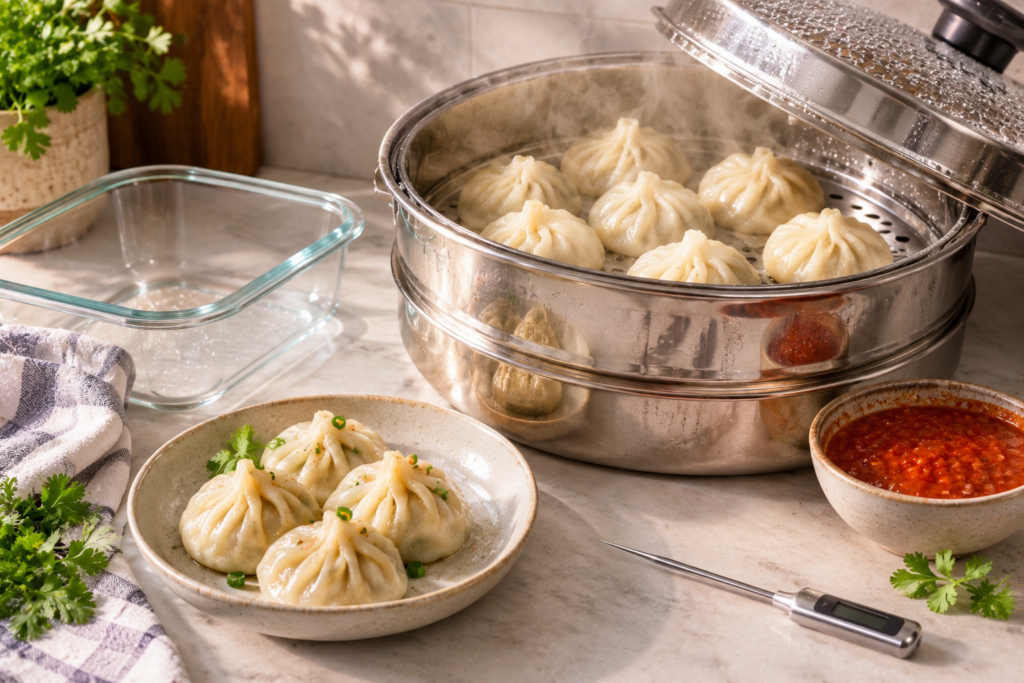
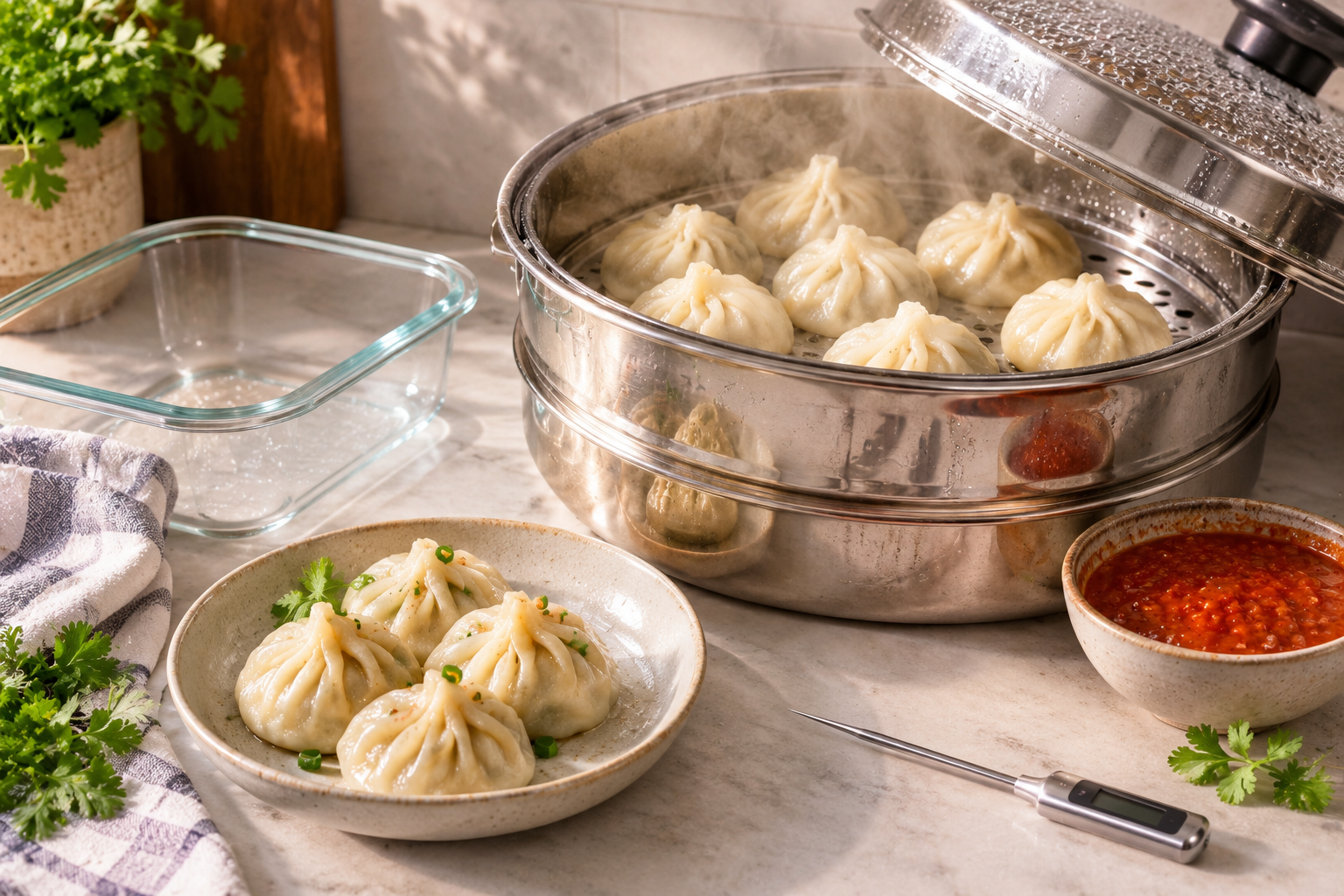
A steamer is often the simplest way to restore tenderness because steam heats the dumpling without submerging the wrapper in water. Use clean equipment and potable water beneath a steamer insert. Keep cooked momos in a single layer with enough space for steam to move around them, and use a perforated liner or approved light release coating if needed to prevent sticking.
- Check the leftovers: Confirm they were already fully cooked, cooled promptly and stored correctly.
- Prepare the steamer: Add water below the tray and bring it to a steady steam without letting the liquid touch the dumplings.
- Arrange and cover: Position momos with some separation and close the lid so the steam can circulate.
- Heat until fully hot: Reheating time depends on size and starting temperature; confirm the filling is reheated thoroughly, using an appropriate thermometer rather than a visual check alone.
- Serve safely: Remove with clean utensils, keep the sauce separate if preferred and eat promptly.
Do not use a specific number of minutes copied from another brand or a raw cooking tutorial as a guarantee. The goal is safe, even reheating with as little unnecessary extra heating as practical. If the food is still cool in the centre, continue reheating appropriately and check again.
Method 2: Microwave cooked momos without turning them rubbery
A microwave can be convenient for small portions, but uncovered dough tends to dry and microwave heating may be uneven. Use a microwave-safe dish and cover designed to vent steam. A small amount of safe moisture in the dish can help reduce drying; avoid putting sealed non-microwave-safe takeaway boxes, foil or inappropriate plastic in the appliance.
- Spread cooked momos on a microwave-safe plate, rather than piling many layers on top of one another.
- Add a small amount of water to the plate if compatible with the food and the appliance, and cover with a vented microwave-safe lid.
- Heat in controlled intervals, following the appliance and food guidance; rotate or reposition if needed to distribute heat.
- Allow the recommended standing time and check the centre in more than one place, especially with dense fillings.
- If heated unevenly, continue reheating with appropriate checks before serving.
The USDA FSIS takeout-reheating guidance specifically advises covering and rotating food, allowing standing time and verifying that several areas reach a safe internal temperature. A microwave’s wattage and a dumpling’s mass both influence heating, so a blanket “30 seconds” promise would be unreliable.
Method 3: Reheat kothey and pan-seared momos while preserving some crunch
Kothey momos have a crisp pan-contact area and a softer upper wrapper. To retain both effects, a kitchen may use a suitable pan to rewarm the dumplings evenly—sometimes with a small controlled quantity of moisture under a lid—then remove the lid to allow the pan-contact surface to dry and crisp. It is essential that the food reach a safe internal temperature; a browned bottom is not proof that the filling is hot enough.
Avoid overloading the pan or repeatedly turning the dumplings with force; wrappers can split, and a large wet sauce poured in before serving will soften any crisp surface. For culinary context, the independent kothey momo cooking recipe demonstrates how a covered pan combines moisture and a crisp base when making dumplings. A leftover-reheating process, however, must be evaluated separately from first-time cooking.
Method 4: Oven or air fryer for fried and kurkure styles
For previously fried or crumb-coated momos, an oven or air fryer may help dry the outer surface more than a covered steamer. Use an appliance-appropriate tray, avoid overcrowding, and monitor the wrapper so it does not become excessively hard. The filling still needs thorough reheating. Some dumplings have thick coatings that brown quickly while the centre heats more slowly, making thermometer verification important.
Follow the applicable equipment instructions and the USDA’s safe reheating-method guidance. That source advises oven reheating at an appliance temperature no lower than 163°C (325°F) for conventional ovens; air-fryer performance depends on the unit and food, so don’t simply transfer conventional-oven timing. It does not provide a special validated air-fryer schedule for momos.
Why reheated momos become hard, gummy, dry or soggy
| Problem | Possible cause | What to improve next time |
|---|---|---|
| Dry, hard wrapper | Uncovered microwaving or excess heat after the centre is hot | Use moisture and an appropriate cover; avoid unnecessary reheating |
| Soggy wrapper | Too much liquid, prolonged steaming or condensation | Control moisture and use a single layer |
| Cold filling | Uneven heating, overcrowding or insufficient heating | Reheat thoroughly and verify the centre |
| Broken seams | Sticking, rough handling or excess moisture | Use clean release aids and gentle utensils |
| Lost kothey crunch | Wet sauce, covered holding or excessive steaming | Keep sauce separate and use an appropriate pan finish |
| Tough fried coating | Overheating or drying | Use controlled reheating and check the core rather than cooking blindly |
These are common texture mechanisms, not a diagnostic test for food safety. A food can look appetising and still be unsafe if storage or heating was inadequate.
How long can cooked momos be stored before reheating?
Once fully cooked and promptly refrigerated, leftovers should be kept cold, covered and separate from uncooked ingredients. USDA FSIS generally advises consuming refrigerated leftovers within 3–4 days or freezing for longer storage. CDC prevention advice emphasises rapid refrigeration and proper temperatures. If the original food-business instructions are stricter, or if there is uncertainty about how the food was stored, use the stricter or safer approach.
What if the takeaway sat on the counter overnight?
Discard it. If cooked momos have spent prolonged time at ambient temperature, reheating is not a dependable way to reverse unsafe storage. This applies even if the wrapper smells normal or a sealed box appears clean.
What if they were frozen after cooking?
Previously cooked frozen leftovers can be reheated if they were handled and stored safely, but the method and time differ from refrigerated leftovers. Thaw safely according to suitable food-handling guidance and reheat thoroughly. Do not assume a frozen raw ready-to-cook pack is equivalent to a frozen, fully cooked leftover.
Can I reheat the same momos repeatedly?
Avoid repeatedly heating and cooling the same leftovers. Each cycle adds handling and temperature-control risk and usually worsens texture. Reheat only the quantity you plan to eat, and follow applicable local rules for commercial kitchens. Canada’s official leftover guidance advises discarding uneaten portions after reheating.
Which chutney should go with reheated momos?
Tomato–chilli chutney, sesame–tomato achar or a suitable creamy dip can work with a variety of momo fillings, but sauce safety and storage are separate from dumpling reheating. Some homemade sauces contain dairy, nuts or sesame and require controlled storage. Reheat a sauce according to appropriate guidance; the USDA recommends bringing soups, gravies and sauces to a boil when reheating them.
If the sauce is cold and intended to be served chilled, keep it properly refrigerated instead of heating it without knowing its ingredients or intended use. For general regional background, see Sikkim momo traditions and Darjeeling momo culture.
How a restaurant should document reheating
Foodservice reheating is an operating control rather than a consumer convenience tip. A written SOP should state whether a product is fully cooked or raw, the storage condition, permitted reheating methods, validated temperature criterion, maximum loading, monitoring frequency, corrective action and records. FSSAI’s published food-service reheating directions include a core-temperature requirement of 75°C for reheated foods in the addressed circumstances. Operators should verify the current applicable rules and implement a documented, validated method suited to their products.
Restaurants looking for product-specific preparations and supply information can contact Momo Delights HoReCa/B2B. Do not convert this home-leftover guide into a commercial SOP without validation.
Frequently asked questions about reheating momos
What is the best way to reheat steamed momos?
A covered steamer is often effective for preserving tender wrapper texture, provided the filling is reheated thoroughly.
Can I microwave momos?
Yes, for previously fully cooked leftovers, using microwave-safe equipment, a suitable cover and even-heating checks. Avoid serving food with a cold centre.
How many minutes should I reheat momos?
No single time applies across dumpling size, filling, portion count, equipment and starting temperature. Follow appropriate safety criteria and verify the centre.
What temperature should leftover momos reach?
USDA FSIS consumer guidance uses 74°C (165°F) for reheated leftovers. Food businesses must also comply with applicable local and product-specific requirements.
Can I reheat fried momos in an air fryer?
It may help restore some exterior crispness, but follow appliance guidance and check that the centre has reheated thoroughly. No universal air-fryer timing applies.
How do I keep the momo wrapper soft?
Use an appropriate amount of moisture and a cover for steamed-style leftovers, and stop unnecessary continued heating after safe reheating is achieved.
Can I reheat raw frozen momos using this guide?
No. Raw or partly cooked products require their original cooking procedure, not leftovers-reheating advice.
Are momos safe if left out overnight?
No. Perishable cooked food stored overnight at room temperature should be discarded, not merely reheated.
Can I reheat momos with chutney already poured over them?
It’s possible to warm them, but the wrapper may be soggier, and sauce ingredients require their own safe-handling assessment.
Does reheating restore the original restaurant texture completely?
Not always. Some moisture and crispness changes are difficult to reverse, even with careful reheating.
Sources and editorial note
- USDA FSIS — Reheating Leftover Take-Out Food: 74°C/165°F reheating, thermometer, microwave practices.
- USDA FSIS — Handling Leftovers Safely: prompt refrigeration and storage periods.
- CDC — Preventing Food Poisoning: refrigeration, hot-weather handling, safe reheating.
- FSSAI — Food-Service Reheating Directions: commercial handling requirements for the addressed operations.
- Health Canada — Leftover Safety: storage and repeat-reheating considerations.
Reviewed 1 November 2026: This is general educational advice for previously cooked leftovers, not an approved product-specific recipe or Momo Delights kitchen SOP. Particular food labels, local regulations and validated controls may be stricter. AI-generated images are illustrative rather than a record of a kitchen test.
Further inspiration for your momo menu: How to Steam Momos Without a Steamer: Three Practical Setups and Why Momos Stick to the Steamer: Causes and Practical Fixes. Check allergens and current product availability.